Amomum maximum
Roxb.
Great winged amomum, Java cardamom
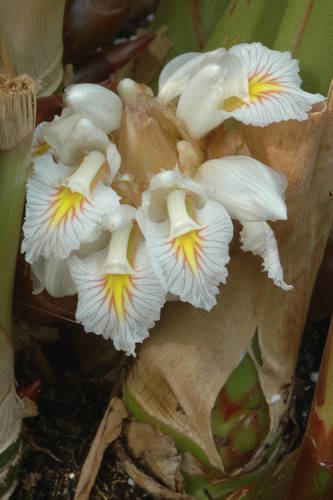
(c) Smithsonian Institution, National Museum of Natural History, Department of Botany, some rights reserved (CC BY-NC-SA)
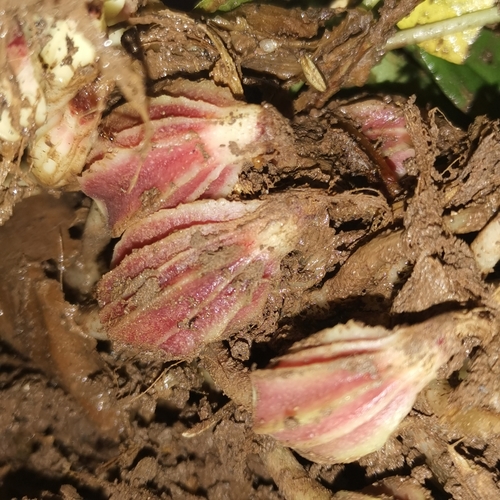
(c) guanhong, some rights reserved (CC BY-NC)
What to Eat
Edible parts: Leaves, Fruit, Fruit - spice, Vegetable, Flowers, Tuber/Rhizome, Roots
The fresh fruits are eaten raw, used as a spice, and made into chutney or candied. Young shoots and young flowers are cooked and eaten as vegetables, often with rice. The rhizomes are used in chutney.
Where to Find It
A tropical plant. It grows in shady forests and on hill slopes between 600-800 m altitude in S. China. It is usually in forests on moist humus rich soils. In Yunnan.
Andamans, Asia, Bangladesh, China, Himalayas, India, Indochina, Indonesia, Malaysia, Myanmar, Nepal, New Guinea, Northeastern India, SE Asia, Sikkim, Thailand, Tibet,
How to Identify
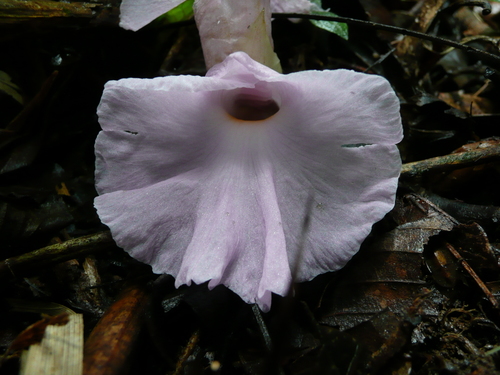
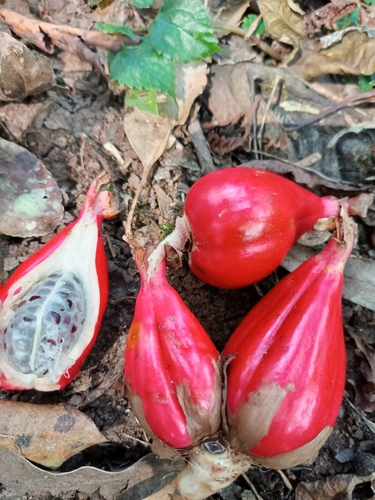
A ginger family herb. The plant grows 2-3 m tall. It has a thick underground stem or rhizome. The leaf stalk can either not exist or be up to 8 cm long. The leaf blade is oblong and 30-90 cm long by 10-20 cm wide. It is bright green on top. Underneath is has a white covering. The flower spikes are almost round and 5 cm across. The bracts are brownish and 2-2.5 cm long. They are hairy but fall off. The flower is pale with purple spots. The fruit is a capsule which is purple-green and oval. It is 2.5-3 cm long by 1.8-2.4 cm across. It has 9 wings and fine white hairs. The seeds are oval and 5 mm long by 3 mm wide.
How to Grow
It can be grown using tips of the rhizomes that have roots. It can also be grown from seeds.
Medicinal Uses
The plant is used in medicine.
Wikipedia
Source ↗Amomum maximum, commonly known as Java cardamom, is a perennial, rhizomatous herb native to a vast region spanning Tropical and Subtropical Asia. It thrives in wet, tropical biomes, typically found in the shady undergrowth of forests and on hill slopes at elevations of 600 to 800 meters. The plant is characterized by its large, oblong-lanceshaped leaves, which can grow up to 70 cm long, and its ellipsoid, purple-green fruits that have nine distinct, winged ribs. Its striking flowers are borne in nearly spherical spikes, featuring a white lip with a prominent yellow central line and radiating red veins. Known locally as Perelam (Amomum pterocarpum) in Kerala, India, this species is documented as doubtfully present in Sumatra but is native to a wide range of locations including India, China, Vietnam, Myanmar, and New Guinea. The plant's life cycle is marked by a flowering and fruiting season that typically occurs from May to October.
Other Information
It is a cultivated food plant. It is sold in local markets.
Notes
There are about 150 Amomum species. They are mostly tropical. It is used in medicine.
Names & Synonyms
Aidu, Aigeju, Aihere tel, Aihre bua, Chang gui sha ren, Ge bo di, Guogu, Hanggasa, Jiu chi dou kou, Kapulaga jawa, Leribu, Ma guo, Melao, Mieqie, Mi jie, Reivii, Resah, Sa jia hong bi
References (27)
- Arora, R. K., 2014, Diversity in Underutilized Plant Species - An Asia-Pacific Perspective. Bioversity International. p 100
- Balkrishna, A., et al, 2022, Indigenous Uses of Plants among Forest-dependent Communities of Seijosa, Arunachal Pradesh. International Journal of Economic Plants 2022, 9(1):064-080
- Benvenuti, S. & Mazzoncini, M., 2021, The Biodiversity of Edible Flowers: Discovering New Tastes and New Health Benefits. Frontiers in Plant Science Article 569499.
- Burkill, I.H., 1966, A Dictionary of the Economic Products of the Malay Peninsula. Ministry of Agriculture and Cooperatives, Kuala Lumpur, Malaysia. Vol 1 (A-H) p 132 (As Amomum dealbatum)
- Cao, Y., et al, 2020, Ethnobotanical study on wild edible plants used by three trans-boundary ethnic groups in Jiangcheng County, Pu’er, Southwest China. Journal of Ethnobiology and Ethnomedicine (2020) 16:66
- Fern, K., 2012, Tropical Species Database http://theferns.info/tropical/ (As Amomum dealbatum)
- Hazarika, T. K., et al, 2012, Studies on wild fruits of Mizoram, India used as ethno-medicines. Genetic Resources and Crop Evolution. Published on line 03 February, 2012 (As Amomum dealbatum)
- Hedrick, U.P., 1919, (Ed.), Sturtevant's edible plants of the world. p 50
- Hu, Shiu-ying, 2005, Food Plants of China. The Chinese University Press. p 326
- Kar, A., et al, 2013, Wild Edible Plant Resources used by the Mizos of Mizoram, India. Kathmandu University Journal of Science, Engineering and Technology. Vol. 9, No. 1, July, 2013, 106-126 (As Amomum dealbatum)
- Lalfakzuala, R., 2007, Ethnobotanical usages of plants in western Mizoram. Indian Journal of Traditional Knowledge. Vol 6(3) pp 480-493 (As Amomum dealbatum)
- Liu, Yi-tao, & Long, Chun-Lin, 2002, Studies on Edible Flowers Consumed by Ethnic Groups in Yunnan. Acta Botanica Yunnanica. 24(1):41-56
- Luo, B., et al, 2019, Wild edible plants collected by Hani from terraced rice paddy agroecosystem in Honghe Prefecture, Yunnan, China. Journal of Ethnobiology and Ethnomedicine 15:56
- Martin, F.W. & Ruberte, R.M., 1979, Edible Leaves of the Tropics. Antillian College Press, Mayaguez, Puerto Rico. p 225
- Medhi, P. & Borthakur, S. K., 2012, Phytoresources from North Cachur Hills of Assam -3: Edible plants sold at Hflong market. Indian Journal of Natural Products and Resources. 3(1) pp 84-109
- Medhi, P. & Borthakur, S. K., 2013, Wild edible plants sold by the Zeme Nagas at the makeshift market of Mahur, Dima Hasao district of Assam. Pleione 7(1): 84 - 93. 2013
- Medhi, P., Sarma, A and Borthakur, S. K., 2014, Wild edible plants from the Dima Hasao district of Assam, India. Pleione 8(1): 133-148
- Pfoze, N. L., et al, 2012, Survey and assessment of floral diversity on wild edible plants from Senapati district of Manipur, Northeast India. Journal of Biodiversity and Environmental Sciences. 1(6):50-52 (As Amomum dealbatum)
- Ochse, J. J. et al, 1931, Vegetables of the Dutch East Indies. Asher reprint. p 734
- PROSEA handbook Volume 13 Spices. p 274 (As Amomum dealbatum)
- Seidemann J., 2005, World Spice Plants. Economic Usage, Botany, Taxonomy. Springer. p 37
- Sukarya, D. G., (Ed.) 2013, 3,500 Plant Species of the Botanic Gardens of Indonesia. LIPI p 1060
- Terra, G.J.A., 1973, Tropical Vegetables. Communication 54e Royal Tropical Institute, Amsterdam, p 23
- Verheij, E. W. M. and Coronel, R.E., (Eds.), 1991, Plant Resources of South-East Asia. PROSEA No 2. Edible fruits and nuts. Pudoc Wageningen. p 313 (As Amomum dealbatum)
- Wu Delin, Larsen, K., Zingiberaceae. Flora of China. (As Amomum dealbatum)
- Xu, You-Kai, et al, 2004, Wild Vegetable Resources and Market Survey in Xishuangbanna, Southwest China. Economic Botany. 58(4): 647-667.
- Zeven, A. C. & de West, J. M. J., 1982, Dictionary of cultivated plants and their regions of diversity. Wageningen. p 64