Amomum subulatum
Roxb.
Greater Indian cardamom, Nepalese cardamom
(c) Phuentsho, some rights reserved (CC BY-NC), uploaded by Phuentsho
(c) connk, some rights reserved (CC BY-NC), uploaded by connk
What to Eat
Edible parts: Fruit, Seeds, Spice, Flowers, Shoots
The seeds are used as a savory spice flavoring curries, soups, and sausages—similar to cardamom but less sweet. The tender shoots and flowers are also eaten.
Where to Find It
It is a tropical plant. It grows between 1000 and 2000 m altitude in moist places in Nepal. In China it grows in dense forests between 300-1300 m altitude in S China. It is often along watercourses.
Asia, Bangladesh, Bhutan, China, Himalayas, India, Indochina, Indonesia, Malaysia, Myanmar, Nepal, Northeastern India, SE Asia, Sikkim, Thailand,
How to Identify
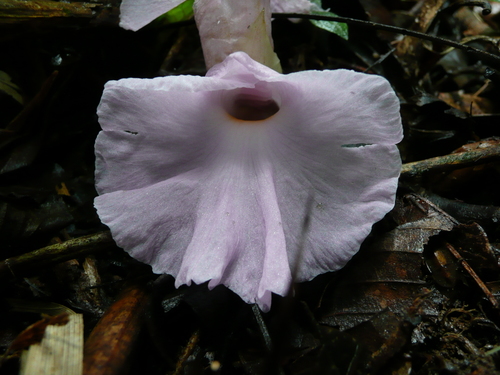
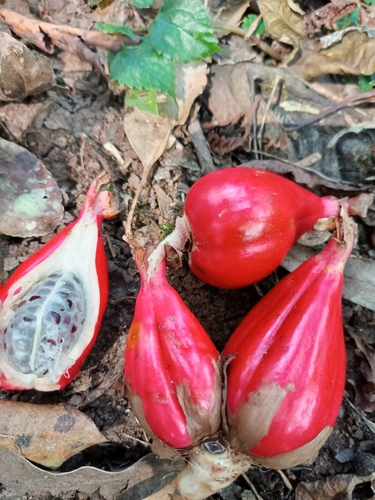
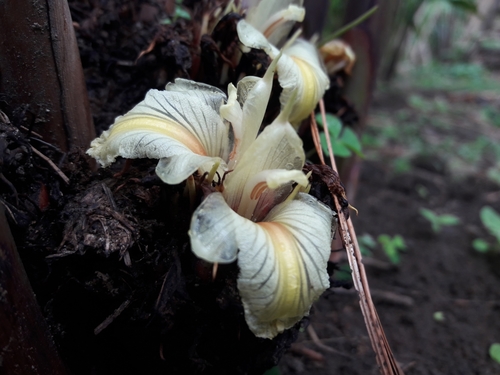
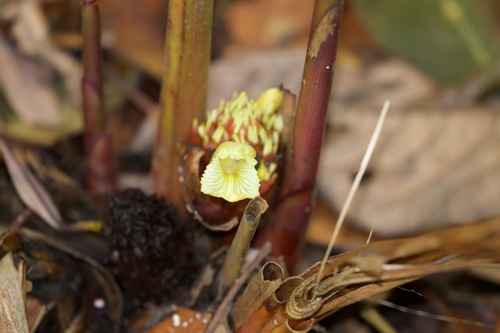
A herb in the ginger family. It grows 1-2 m high. The leaves are 30-60 cm long and 7.5-10.5 cm wide. They are oblong or sword shaped. They are green. The flowers emerge in a dense short spike near the ground. The flowers are yellowish. The base is rounded or wedge shaped and the tip forms a long cup shape. The bracts are pale red and oval. The fruit is a round capsule. It is purple to red-brown and 2-2.5 cm across. It has 10 wavy wings. It contains about 40 small round dark-brown seeds. They are in a soft, sweet smelling pulp.
How to Grow
Plants are grown by splitting the rhizome.
Medicinal Uses
Traditional uses documented in the Food Plants International database.
Other Uses
The fruit contains 1.5% essential oils. The oil contains cineol.
Production
The pods are dried.
Other Information
It is a cultivated food plant.
Notes
There are about 150 Amomum species. They are mostly tropical. The seeds contain cineol.
Names & Synonyms
Alainchi, Bara elachi, Barra illaichi, Bengal cardamom, Black cardamom, Brown cardamom, Buah pelaga, Elaichi, Hpala-gyi, Illaichi, Ka-ko-la, Kapulaga, Large cardamom, Luk kravan, Melangthi, Mutum khobu telli, Phalazee, Phree langdung, Sikkim cardamom, Sokruno, Taling, Thuo elainchi, Winged cardamom, Xiang dou kou
References (26)
- Ambasta S.P. (Ed.), 2000, The Useful Plants of India. CSIR India. p 35
- Bircher, A. G. & Bircher, W. H., 2000, Encyclopedia of Fruit Trees and Edible Flowering Plants in Egypt and the Subtropics. AUC Press. p 24
- Burkill, I.H., 1966, A Dictionary of the Economic Products of the Malay Peninsula. Ministry of Agriculture and Cooperatives, Kuala Lumpur, Malaysia. Vol 1 (A-H) p 132
- Chase, P. & Singh, O. P., 2016, Bioresources of Nagaland: A Case of Wild 4 Edible Fruits in Khonoma Village Forest. in J. Purkayastha (ed.), Bioprospecting of Indigenous Bioresources of North-East India. p 50
- Facciola, S., 1998, Cornucopia 2: a Source Book of Edible Plants. Kampong Publications, p 247
- Hemphill, I, 2002, Spice Notes. Macmillan. p 83
- Hu, Shiu-ying, 2005, Food Plants of China. The Chinese University Press. p 327
- Kumar, A., et al, 2012, Ethnobotanical Edible Plant Biodiversity of Lepcha Tribes. Indian Forester, 138 (9):798-803
- Manandhar, N.P., 2002, Plants and People of Nepal. Timber Press. Portland, Oregon. p 86
- Masoodi, H. U. R. & Sundriyal, R. C., 2020, Richness of non-timber forest products in Himalayan communities—diversity, distribution, use pattern and conservation status. Journal of Ethnobiology and Ethnomedicine 16:56
- Mozhui, R., et al, 2011, Wild edible fruits used by the tribals of Dimapur district of Nagaland, India. Pleione 5(1): 56 - 64.
- Murtem, G. & Chaudhrey, P., 2016, An ethnobotanical note on wild edible plants of Upper Eastern Himalaya, India. Brazilian Journal of Biological Sciences, 2016, v. 3, no. 5, p. 63-81
- P. Coromandel 3:75, t. 227. 1820
- PROSEA handbook Volume 13 Spices. p 245
- Purseglove, J.W., 1972, Tropical Crops. Monocotyledons. Longmans p 528
- Raghavan, S., 2007, Handbook of Spices, Seasonings, and Flavourings. Second Edition. CRC Press p 80
- Rahmatullah, M., et al, 2009, A survey of medicinal plants in two areas of Dinajpur district, Bangladesh including plants which can be used as functional foods. American-Eurasian Journal of Sustainable Agriculture, 3(4): 862-876
- Seidemann J., 2005, World Spice Plants. Economic Usage, Botany, Taxonomy. Springer. p 37
- Solomon, C., 2001, Encyclopedia of Asian Food. New Holland. p 64
- Taram, M., et al, 2018, Wild Food Plant Resources of Komkar Adi Tribe of Upper Siang District in Arunachal Pradesh, India. Bulletin of Arunachal Forest Research, Vol. 33(2), 27-35
- Teron, R. & Borthakur, S. K., 2016, Edible Medicines: An Exploration of Medicinal Plants in Dietary Practices of Karbi Tribal Population of Assam, Northeast India. In Mondal, N. & Sen, J.(Ed.) Nutrition and Health among tribal populations of India. p 157
- Tyagi, R. K., et al, 2004, Conservation of Spices Germplasm in India. Indian J. Plant Genet. Resour. 17(3): 163-174
- Wiersema, J. H. & Leon, B., 2013, World Economic Plants. A Standard Reference CRC Press. 2nd Ed. p 47
- World Checklist of Useful Plant Species 2020. Royal Botanic Gardens, Kew
- Wu Delin, Larsen, K., Zingiberaceae. Flora of China.
- Yeshi, K. et al, 2017, Taxonomical Identification of Himalayan Edible Medicinal Plants in Bhutan and the Phenolic Contents and Antioxidant Activity of Selected Plants. TBAP 7 (2) 2017 pp 89 - 106