Orogenia linearifolia
S. Watson
Indian potato

(c) madison730, some rights reserved (CC BY-NC)

(c) madison730, some rights reserved (CC BY-NC)
(c) sejurca, some rights reserved (CC BY-NC)
What to Eat
Edible parts: Root
The root can be eaten raw or cooked. Raw, it tastes similar to potatoes and has a pleasant, crisp texture, though the outer skin carries a slight bitterness. The root is available for much of the year, though its small size makes harvesting in quantity somewhat fiddly. It may respond well to cultivation.
Where to Find It
It is a temperate plant. It grows between 1,000-3,000 m above sea level.
North America, USA,
How to Identify
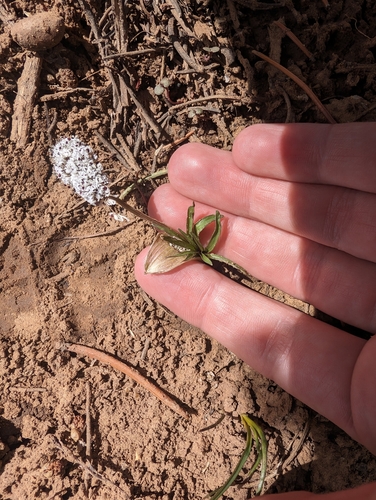
A herb that keeps growing from year to year. It grows 20 cm tall. It is practically without a stem. The leaves are long and narrow. They divide into 3. The flowers are in a compact group. There are 12 or more flowers in groups. The fruit are light green egg-shaped pods.
How to Grow
We have very little information on this species and do not know if it will be hardy in Britain, though judging by its native range it should succeed outdoors in most parts of the country. From its native habitat it can be assumed that the plant requires a sunny position in a moist but well drained light to medium soil.
Propagation: No specific propagation information has been found for this species. Sowing seed as soon as ripe in late spring or early summer is likely the best approach — sow in pots in a cold frame, then prick seedlings out into individual pots once large enough to handle. Grow on under cover for at least the first winter and plant out into permanent positions in late spring or early summer after the last expected frosts. Division should be possible at any time the plant is dormant, likely from midsummer through to late winter.
Medicinal Uses
None known.
Other Uses
None known.
Wikipedia
A compact perennial growing to 0.2 m (8 inches) with hermaphroditic flowers pollinated by insects. Self-fertile and blooms April to May. Requires light sandy or medium loamy well-drained soil, mildly acid to basic pH. Cannot tolerate shade and prefers moist conditions.
Production
It flowers just after the snow melts.
References (2)
- Kermath, B. M., et al, 2014, Food Plants in the Americas: A survey of the domesticated, cultivated and wild plants used for Human food in North, Central and South America and the Caribbean. On line draft. p 592
- Plants for a Future database, The Field, Penpol, Lostwithiel, Cornwall, PL22 0NG, UK. http://www.scs.leeds.ac.uk/pfaf/