Oroxylum indicum
(L.) Vent.
Indian trumpet flower

(c) Cheongweei Gan, some rights reserved (CC BY-NC), uploaded by Cheongweei Gan
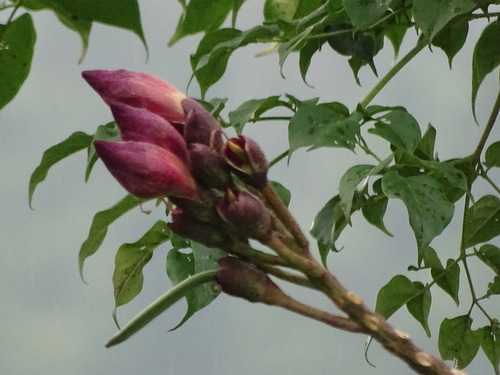
(c) Rujuta Vinod, some rights reserved (CC BY-NC), uploaded by Rujuta Vinod
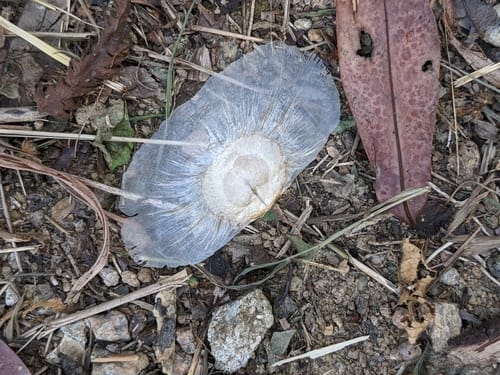
(c) portioid, some rights reserved (CC BY)
What to Eat
Edible parts: Seeds, Leaves, Fruit, Pod, Flowers, Stem
It is a plant with edible leaves, flower buds, pods and stems. The large young pods, known as Lin mai or Lin fa in Loei, are eaten especially in Thailand and Laos. They are first grilled over charcoal fire and then the inner tender seeds are usually scraped and eaten along with lap. Known as karongkandai among the Bodos of north east India, its flowers and fruit are eaten as a bitter side dish with rice. Its fruit are eaten as a side dish and water of boiled leave and bark as traditional medicine in Mizoram. It is known in Mizoram as Archangkawm. It is often prepared with fermented or dried fish and believed by them to have medicinal uses. The pods also eaten by Chakma people in Chittagong hill tracts of Bangladesh and India. Its called "Hona Gulo 𑄦𑄧𑄚 𑄉𑄪𑄣𑄮" in Chakma language. The plant is used as food by the Karen people. The flower buds are boiled and pickled. The young pods are cut open raw and the tender seeds inside are used in various local dishes.
Where to Find It
A tropical plant. It is native from India to Malaysia. It grows near the edges of forests. It grows up to 900 m altitude. They are common and widely distributed from northern Luzon to Basilan in the Philippines in thickets and secondary forest at low and medium altitudes. It grows throughout India in deciduous forest. In Yunnan, China it grows up to 1400 m altitude. It suits hardiness zones 10-12. In XTBG Yunnan. In Sichuan.
Asia, Andamans, Bangladesh, Bhutan, Cambodia, China, Himalayas, India, Indochina, Indonesia, Laos, Malaysia, Myanmar, Nepal, Northeastern India, Pacific, Philippines, SE Asia, Sikkim, Sri Lanka, Taiwan, Thailand, Vietnam,
How to Identify
A small non hairy slightly branched tree. It grows 5-20 m high. The trunk is straight and rough. It loses its leaves during the year. The bark is soft light brown. The leaves are opposite and 3 to 4 series of leaflets. The leaves are large and 1-2 m long. There are many leaflets and they are pointed at the tip. They are 6-12 cm long by 3-8 cm wide. There are many flowers. These have an unpleasant smell. They occur in large erect clusters. The fused flower petal stalk is dark purple and bell-shaped. The stalk is 50 cm long. The fruit is a long pod or seed case. It is 60 cm long by 4 cm wide. It is slightly curved and has many seeds. The seeds include very thin wings up to 6 cm wide.
How to Grow
It can be grown from seed or cuttings. It can also be grown from root suckers.
Propagation: Seed - it is best to pre-soak in warm water for 24 hours prior to sowing. Sow the seed in a lightly shaded position in a nursery seedbed or individual containers. Germination is about 50%, with the seeds sprouting in 19 - 25 days. Stem cuttings.
Medicinal Uses
Various segments of O. indicum, including leaves, root bark, heartwood, and seeds, contain diverse phytochemicals, such as prunetin, sitosterol, oroxindin, oroxylin-A, biochanin-A, ellagic acid, tetuin, anthraquinone, and emodin. Several of the compounds are under preliminary research to identify their potential biological properties. Oroxylum indicum seeds are used in traditional Indian Ayurvedic and Chinese medicines. Root bark is one of the ingredients thought to be useful in compound formulations in Ayurveda and other folk remedies.
Other Uses
The seeds are used as a lining of hats and to cover umbrellas. The papery and wined seeds are strung together as an offering to the gods and goddesses, especially by Buddhists. The fruit is used in tanning and dyeing. The bark is rich in tannins. The wood is soft. It can be used for making matches. With its long fibres, it is suitable for pulping to make paper. The wood is used for fuel. Of poor quality. A fast-growing species, always encountered in canopy openings, secondary growth and thickets, it is quite possibly suitable for use as a pioneer species. The tree can be used within its native range as a pioneer species for restoring native woodland on soils degraded by slash and burn cultivation and also for the consolidation of terraces and slopes,
Wikipedia
Source ↗Oroxylum indicum is a species of flowering plant, in the monotypic genus Oroxylum in the family Bignoniaceae. It is commonly called Indian trumpet tree, oroxylum, Indian trumpet flower, broken bones, scythe tree, tree of Damocles, or midnight horror. It can reach a height of 18 metres (59 ft). Various segments of the tree are used in traditional medicine.
Production
It is fast growing.
Other Information
It is sold in local markets.
Notes
There is only one Oroxylum species. It has established medicinal benefits. It has established anti-cancer properties.
Names & Synonyms
Aaratfari, Achi, Aralu, Archang-kawm, Arlu, Bahlawng, Bahlong, Bai lin faa, Bakalong, Bak lin faa, Baklawng, Baklong chi, Balilang-uak, Beka, Be thuyen, Bhatghila, Binkuli, Bolai kayu, Boli, Bonglai kayu, Boongli, Broken bones tree, Bu gu bu lie, Bunepale, Byili pili, Con ca, Dao din, Dingari, Dingdinga, Dundilum, Gimuarai, Golden club, Guonunga, Guonungai, Ing ka, Jamlao, Kalong, Kapung-kapung, Karokandai, Kayu lanang, Kharoi, Kok linmai, K'noc, Kotodu, Kulai, Kyaung-sha, Lin deng a, Linfa, Linmai, Lin maiz, Mai-maklin-sang, Mai-ma-leinka, Makoi, Mengkulai, Merlai, Merulai, Midnight horror, Moongli, Mulin, Murai, Napakban, Nasona, Nopak ban, Nuc nac, Ouga, Paksam-rip, Palagapaiyani, Pampini, Parang nyabor, Parang pamol, Peiarlanthei, Peka, Pekaa, Phak lin faa, Phalga, Phapni, Pharri, Pheh-ka, Pheka, Phonphonia, Phual-changkok, Pinkapinkahan, Pongporang, Pugu-rip, Salsali, Saona, Shamba, Shyonaka, So do thuyen, Sona, Sonepatta, Sonpatti, Surimala, Sword fruit tree, Takha rwng, Tantia, Tarlu, Tatelo, Tatmorang, Tatola, Tattu, Tentu, Tetu, Tigdu, Toguna, Toguna, Totala, Totla, Totola, Tonok, Tree of Damocles, Tsampaka, Tutumba, Ullu, Yod lin faa
References (101)
- Aiguo, C. & Zhiling, D., 2001, Managing Agricultural Resources for Biodiversity Conservation. Case Study Yunnan, Southwest China. Environment Liaison Center International. p 44
- Ambasta, S.P. (Ed.), 2000, The Useful Plants of India. CSIR India. p 413
- Anderson, E. F., 1993, Plants and people of the Golden Triangle. Dioscorides Press. p 217
- Arora, K., Indigenous Forest Management in the Andaman and Nicobar Islands, India.
- Bandyopadhyay, S. et al, 2009, Wild edible plants of Koch Bihar district, West Bengal. Natural Products Radiance 8(1) 64-72
- Bandyopadhyay, S., et al, 2012, A Census of Wild Edible Plants from Howrah District, West Bengal, India. Proceedings of UGC sponsored National Seminar 2012
- Bandyopadhyay, S., et al, 2012, A Census of Wild Edible Plants from Howrah District, West Bengal, India. Proceedings of UGC sponsored National Seminar 2012
- Baro, D., Baruah, S. and Borthukar, S. K. 2015, Documentation on wild vegetables of Baksa district, BTAD (Assam). Scholars Research Library. Archives of Applied Science Research, 2015, 7 (9):19-27
- Barwick, M., 2004, Tropical and Subtropical Trees. A Worldwide Encyclopedic Guide. Thames and Hudson p 304
- Bhargava, N., 1983, Ethnobotanical Studies of the Tribes of Andaman and Nicobar Islands, India. 1. Onge. Economic Botany 37(1): 110-119
- Bohra, N., et al, 2017, Ethnobotany of wild edible plants traditionally used by the local people in the Ramnagar regions from Nainital District, Uttarakhand, India. Biolife 5(1): 12-19
- Bole, P.V., & Yaghani, Y., 1985, Field Guide to the Common Trees of India. OUP p 105
- Brown, W.H., 1920, Wild Food Plants of the Philippines. Bureau of Forestry Bulletin No. 21 Manila. p 152
- Burkill, I.H., 1966, A Dictionary of the Economic Products of the Malay Peninsula. Ministry of Agriculture and Cooperatives, Kuala Lumpur, Malaysia. Vol 2 (I-Z) p 1617
- Cao, Y., et al, 2020, Ethnobotanical study on wild edible plants used by three trans-boundary ethnic groups in Jiangcheng County, Pu’er, Southwest China. Journal of Ethnobiology and Ethnomedicine (2020) 16:66
- Cengel, D. J. & Dany, C., (Eds), 2016, Integrating Forest Biodiversity Resource Management and Sustainable Community Livelihood Development in the Preah Vihear Protected Forest. International Tropical Timber Organization p 121
- Crevost & Lemarie, p 158
- Cruz-Garcia, G. S., & Price, L. L., 2011, Ethnobotanical investigation of 'wild' food plants used by rice farmers in Kalasin, Northeast Thailand. Journal of Ethnobiology and Ethnomedicine 7:33
- Dangol, D. R. et al, 2017, Wild Edible Plants in Nepal. Proceedings of 2nd National Workshop on CUAOGR, 2017.
- Deb, D., et al, 2013, Wild Edible Plants and Their Utilization in Traditional Recipes of Tripura, Northeast India. Advances in Biological Research 7(5):203-211
- Dobriyal, M. J. R. & Dobriyal, R., 2014, Non Wood Forest Produce an Option for Ethnic Food and Nutritional Security in India. Int. J. of Usuf. Mngt. 15(1):17-37
- Dutta, U., 2012, Wild Vegetables collected by the local communities from the Churang reserve of BTD, Assam. International Journal of Science and Advanced Technology. Vol. 2(4) p 122
- Decas gen. nov. 8. 1808
- Eiadthong, W., et al, 2010, Management of the Emerald Triangle Protected Forests Complex. Botanical Consultant Technical Report. p 51
- Engel, D.H., & Phummai, S., 2000, A Field Guide to Tropical Plants of Asia. Timber Press. p 108
- Etherington, K., & Imwold, D., (Eds), 2001, Botanica's Trees & Shrubs. The illustrated A-Z of over 8500 trees and shrubs. Random House, Australia. p 502
- Ethnobotany of Karbis. Chapter 4 in p 84
- Facciola, S., 1998, Cornucopia 2: a Source Book of Edible Plants. Kampong Publications, p 49
- Forest Inventory and Planning Institute, 1996, Vietnam Forest Trees. Agriculture Publishing House p 71
- Fu, Yongneng, et al, 2003, Relocating Plants from Swidden Fallows to Gardens in Southwestern China. Economic Botany, 57(3): 389-402
- Gangte, H. E., et al, 2013, Wild Edible Plants used by the Zou Tribe in Manipur, India. International Journal of Scientific and Research Publications, Volume 3, Issue 5
- Gautam, R. S., et al, 2022, Ethnobotanical Review of Wild Edible Plants of Nepal. Journal of Natural History Museum Volume 32, 2021-22 p 108
- Ghimeray, A. K., Lamsal, K., et al, 2010, Wild edible angiospermic plants of the Illam Hills (Eastern Nepal) and their mode of use by local community. Korean J. Pl. Taxon. 40(1)
- Ghorbani, A., et al, 2012, A comparison of the wild food plant use knowledge of ethnic minorities in Naban River Watershed Nature Reserve, Yunnan, SW China. Journal of Ethnobiology and Ethnomedicine; 8:17
- Guite, C., 2016, A study of wild edible plants associated with the Paite tribe of Manipur, India, International Journal of Current Research. Vol. 8, Issue, 11, pp. 40927-40932
- Heyne, K.,
- Jacquat, C., 1990, Plants from the Markets of Thailand. D.K. Book House p 97
- Jadhav, R., et al, 2015, Forest Foods of Northern Western Ghats: Mode of Consumption, Nutrition and Availability. Asian Agri-History Vol. 19, No. 4: 293-317
- Japanese International Research Centre for Agricultural Science www.jircas.affrc.go.jp/project/value_addition/Vegetables
- Jin, Chen et al, 1999, Ethnobotanical studies on Wild Edible Fruits in Southern Yunnan: Folk Names: Nutritional Value and Uses. Economic Botany 53(1) pp 2-14
- Jiwajinda, S., et al, 2002, Suppressive Effects of Edible Thai Plants on Superoxide and Nitric Oxide Generation. Asian Pacific Journal of Cancer Prevention, Vol 3, 2002
- Joshi, N., et al, 2007, Traditional neglected vegetables of Nepal: Their sustainable utilization for meeting human needs. Tropentag 2007. Conference on International Agricultural Research for Development.
- Kachenchart, B., et al, 2008, Phenology of Edible Plants at Sakaerat Forest. In Proceedings of the FORTROP II: Tropical Forestry Change in a Changing World. Bangkok, Thailand.
- Kaewjampa, N., et al, 2014, Investigation Species of Edible Tree and Medicinal Plants in Faculty of Agriculture, Khon Kaen University. International Journal of Environmental and Rural Development (2014) 5-1
- Kar, A., & Borthakur, S. K., 2008, Wild vegetables of Karbi - Anglong district, Assam, Natural Product Radiance, Vol. 7(5), pp 448-460
- Kar, A., et al, 2013, Wild Edible Plant Resources used by the Mizos of Mizoram, India. Kathmandu University Journal of Science, Engineering and Technology. Vol. 9, No. 1, July, 2013, 106-126
- Khumgratok, S., Edible Plants in Cultural Forests of Northeastern Thailand. Mahasarakham University Thailand.
- Kiran, K. C., et al, 2019, Diversity and Seasonal Availability of Potential Wild Edible Plants from Vidarbha Region of Maharashtra State, India. Int.J.Curr.Microbiol.App.Sci (2019) 8(2): 1434-1446
- Krishen P., 2006, Trees of Delhi, A Field Guide. DK Books. p 305
- Kumar, A., et al, 2012, Ethnobotanical Edible Plant Biodiversity of Lepcha Tribes. Indian Forester, 138 (9):798-803
- Liu, Yi-tao, & Long, Chun-Lin, 2002, Studies on Edible Flowers Consumed by Ethnic Groups in Yunnan. Acta Botanica Yunnanica. 24(1):41-56
- Luczaj, L., et al, 2021, Wild food plants and fungi sold in the markets of Luang Prabang, Lao PDR. Journal of Ethnobiology and Ethnomedicine (2021) 17:6
- Mahadkar, S., Valvi, S. & Rathod, V., 2012, Nutritional assessment of some selected wild edible plants as a good source of mineral. Asian Journal of Plant Science and Research 2(4):468-472
- MARDI Malaysia
- Medhi, P. & Borthakur, S. K., 2012, Phytoresources from North Cachur Hills of Assam -3: Edible plants sold at Hflong market. Indian Journal or Natural Products and Resources. 3(1) pp 84-109
- Medhi, P. & Borthakur, S. K., 2013, Wild edible plants sold by the Zeme Nagas at the makeshift market of Mahur, Dima Hasao district of Assam. Pleione 7(1): 84 - 93. 2013
- Meitei, L. R., et al, 2022, An ethnobotanical study on the wild edible plants used by forest dwellers in Yangoupokpi Lokchao Wildlife Sanctuary, Manipur, India. Ethnobotany Research and Application 23:15
- Mot So Rau Dai an Duoc O Vietnam. Wild edible Vegetables. Ha Noi 1994, p 62
- Martin, F.W. & Ruberte, R.M., 1979, Edible Leaves of the Tropics. Antillian College Press, Mayaguez, Puerto Rico. p 179
- Medhi, P., Sarma, A and Borthakur, S. K., 2014, Wild edible plants from the Dima Hasao district of Assam, India. Pleione 8(1): 133-148
- Menninger, E.A., 1977, Edible Nuts of the World. Horticultural Books. Florida p 78
- Milow, P., et al, 2013, Malaysian species of plants with edible fruits or seeds and their evaluation. International Journal of Fruit Science. 14:1, 1-27
- Monsalud, M.R., Tongacan, A.L., Lopez, F.R., & Lagrimas, M.Q., 1966, Edible Wild Plants in Philippine Forests. Philippine Journal of Science. p 445
- Mukhia, P.K., et al, 2013, Wild plants as Non Wood Forest Products used by the rural community of Dagana, a southern foothill district of Bhutan, SAARC Journal, 27 pages
- Nakahara, K. et al, 2002, Antimutagenicity of Some Edible Thai Plants, and a Bioactive Carbazole Alkaloid, Mahanine, Isolated from Micromelum minutum. Journal of Agricultural and Food Chemistry. 50: 4796-4892
- Narzary, H., et al, 2013, Wild Edible Vegetables Consumed by Bodo tribe of Kokrajhar District (Assam), North-East India. Archives of Applied Science Research, 5(5): 182-190
- Ochse, J.J. et al, 1931, Vegetables of the Dutch East Indies. Asher reprint. p 77
- Patiri, B. & Borah, A., 2007, Wild Edible Plants of Assam. Geethaki Publishers. p 94
- Pfoze, N. L., et al, 2012, Survey and assessment of floral diversity on wild edible plants from Senapati district of Manipur, Northeast India. Journal or Biodiversity and Environmental Sciences. 1(6):50-52
- Phangchopi, U., et al, 2015, Diversity of wild edible plants in Marat Longri Wildlife Sanctuary, Assam. Indian Journal of Natural Products and Resources Vol. 6(4), December 2015 pp. 305-313
- Phatlamphu, N., et al, 2021, Ethnobotany of edible plants in Muang District, Kalasin Province, Thailand, Biodiversitas Vol. 22, No. 12 pp 5432-5444
- Phon, P., 2000, Plants used in Cambodia. © Pauline Dy Phon, Phnom Penh, Cambodia. p 480
- Prabha, Y. P., et al, 2010, Documentation of Wild Edible Plants of Melghat Forest, Dist. Amravati, Maharashtra State, India. Ethnobotanical Leaflets 14: 751-58, 2010.
- Prafulla, S., 2017, Wild Food Diversity of Nawegaon-Nagzira Tiger Reserve in Gondia-Bhandara district of Maharashtra, India. Int. J. of Life Sciences, 2017, Vol. 5 (4): 620-626
- Prixar, S., et al, 2006, Species composition, distribution and management of trees in paddy fields in central Laos. p 21
- Pullaiah, Y., Krishnamurthy, K. V. & Bahadur, B., (Eds.), 2016, Ethnobotany of India, Volume 1: Eastern Ghats and Deccan.
- Reddy, K. N. et al, 2007, Traditional knowledge on wild food plants in Andhra Pradesh. Indian Journal of Traditional Knowledge. Vol. 6(1): 223-229
- Sam, H. V. et al, 2004, Trees of Laos and Vietnam: A Field Guide to 100 Economically or Ecologically Important Species. BLUMEA 49: 201-349
- Sarma, H., et al, 2010, Updated Estimates of Wild Edible and Threatened Plants of Assam: A Meta-analysis. International Journal of Botany 6(4): 414-423
- Savita, et al, 2006, Studies on wild edible plants of ethnic people in east Sikkim. Asian J. of Bio Sci. (2006) Vol. 1 No. 2 : 117-125
- Setiya, A. V., et al, 2016, Exploration and documentation of some wild edible plants used by the aboriginals from Gadchiroli District (M.S.) India. International Advanced Research Journal in Science, Engineering and Technology. 3(7)
- Shin, T., et al, 2018, Traditional knowledge of wild edible plants with special emphasis on medicinal uses in Southern Shan State, Myanmar. Journal of Ethnobiology and Ethnomedicine (2018) 14:48
- Soepadmo, E. & Wong, K. M., (Eds.), 1995, Tree Flora of Sabah and Sarawak. Volume One. ITTO, Govt. Malaysia. p 64
- Somnasang, P., Moreno, G and Chusil K., 1998, Indigenous knowledge of wild hunting and gathering in north-east Thailand. Food and Nutrition Bulletin 19(4) p 359f
- Srichaiwong, P., et al, 2014, A Study of the Biodiversity of Natural Food Production to Support Community Upstream of Chi Basin, Thailand. Asian Social Science 10 (2)
- Suksri, S., et al, 2005, Ethnobotany in Bung Khong Long Non-Hunting Area, Northeast Thailand. Kasetsart J., (Nat. Sci) 39: 519-533
- Sundriyal, M., et al, 2004, Dietary Use of Wild Plant Resources in the Sikkim Himalaya, India. Economic Botany 58(4) pp 626-638
- Sundriyal, M. & Sundriyal, R. C., 2004, Structure, Phenology, Fruit Yield, and Future Prospects of some Prominent Wild Edible Plant Species of the Sikkim Himalaya, India. Journal of Ethnobiology 24(1): 113-138
- Swaminathan, M.S., and Kochnar, S.L., 2007, An Atlas of Major Flowering Trees in India. Macmillan. p 220
- Tanaka, Y. & Van Ke, N., 2007, Edible Wild Plants of Vietnam: The bountiful garden. Orchid books. p 51
- Teron, R. & Borthakur, S. K., 2016, Edible Medicines: An Exploration of Medicinal Plants in Dietary Practices of Karbi Tribal Population of Assam, Northeast India. In Mondal, N. & Sen, J.(Ed.) Nutrition and Health among tribal populations of India. p 150
- Thitiprasert, W., et al, 2007, Country report on the State of Plant Genetic Resources for Food and Agriculture in Thailand (1997-2004). FAO p 95
- Tsering, J., et al, 2017, Ethnobotanical appraisal on wild edible plants used by the Monpa community of Arunchal Pradesh. Indian Journal of Traditional Knowledge. Vol 16(4), October 2017, pp 626-637
- Uprety, Y., et al, 2016, Traditional use and management of NTFPs in Kangchenjunga Landscape: implications for conservation and livelihoods. Journal of Ethnobiology and Ethnomedicine (2016) 12:19
- Van Sam, H. et al, 2004, Trees of Laos and Vietnam: A Field Guide to 100 Economically or Ecologically Important Species. Blumea 29 (2004) 201-349
- Van Sam, H. et al, 2008, Uses and Conservation of Plant Species in a National Park. A case study of Ben En, Vietnam. Economic Botany 62:574-593
- van Steenis, C. G. G. S., 1977, Bignoniaceae in Flora Malesiana 8 (1) p 128
- Wickens, G.E., 1995, Edible Nuts. FAO Non-wood forest products. FAO, Rome. p 109
- World Checklist of Useful Plant Species 2020. Royal Botanic Gardens, Kew
- Xu, You-Kai, et al, 2004, Wild Vegetable Resources and Market Survey in Xishuangbanna, Southwest China. Economic Botany. 58(4): 647-667
- Zawiah, N. & Othaman, H., 2012, 99 Spesies Buah di FRIM. Institut Penyelidikan Perhutanan Malaysia. p 182


