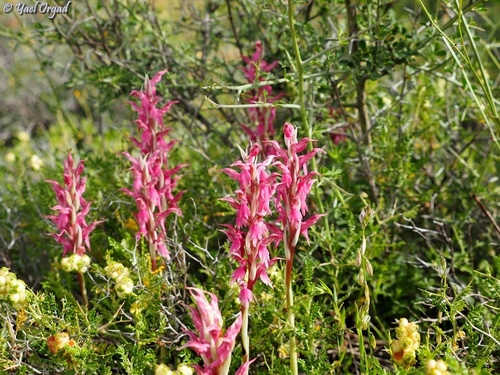
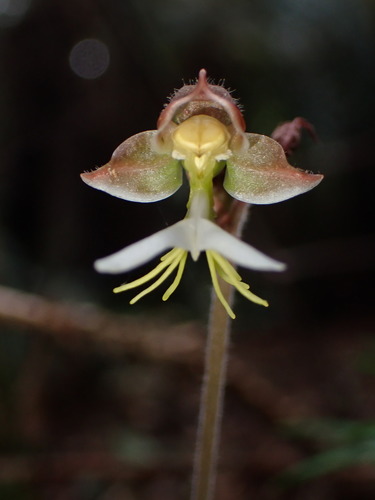
Orthoceras strictum
R.Br.
Horned orchid, Bird's mouth orchid

(c) Leon Perrie, some rights reserved (CC BY-NC-SA), uploaded by Leon Perrie
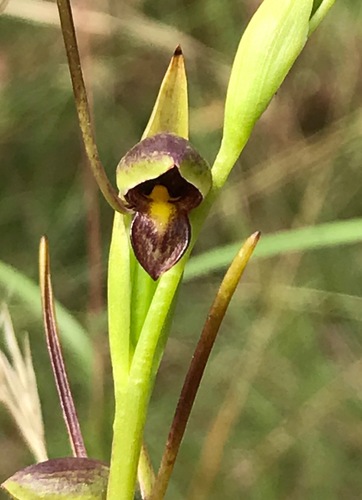
(c) SBERRY, some rights reserved (CC BY-NC), uploaded by SBERRY
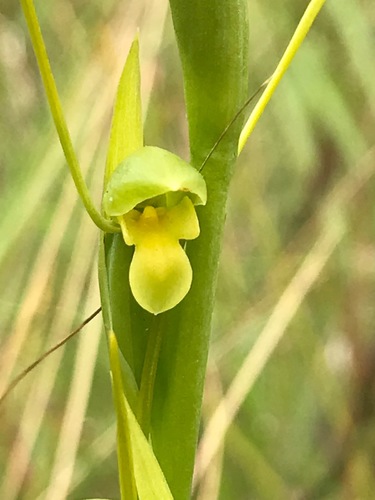
(c) SBERRY, some rights reserved (CC BY-NC), uploaded by SBERRY
What to Eat
Edible parts: Tubers, Root
The tubers and roots are eaten.
Where to Find It
It is a temperate plant. It grows in button grass and sedgy heathland. It is often on poorly drained soils. It can survive fires.
Australia*, Pacific, Tasmania,
How to Identify
A ground orchid. It grows 30-60 cm high. There are 2-5 leaves. These are narrow, like threads. They are 15-30 cm long by 2-3 mm wide. They occur in a tuft near the base. They are bright green and have a channel. The flowering stalk is 60 cm tall. It is stiff and bears 1-9 flowers. The flowers are 1 cm across and yellowish-green or dark brown.
Wikipedia
Source ↗Orthoceras strictum, commonly known as the bird's-mouth orchid or horned orchid, is a species of orchid native to eastern and southern Australia, New Zealand and New Caledonia. It has between two and five linear leaves and up to nine yellowish green, brownish or blackish flowers with two long, erect to spreading lateral sepals.
Production
In cultivation plants normally loose their vigour over 3-4 years then die.
Notes
There are about 4 Orthoceras species.
References (10)
- Bodkin, F., 1991, Encyclopedia Botanica. Cornstalk publishing, p 746
- Cameron, M., (Ed.) 1981, A Guide to Flowers & Plants of Tasmania. Reed p 56
- Cronin, L., 1989, The Concise Australian Flora. Reed. p 71
- Dashorst, G.R.M., and Jessop, J.P., 1998, Plants of the Adelaide Plains & Hills. Botanic Gardens of Adelaide and State Herbarium. p 206
- Elliot, W.R., & Jones, D.L., 1997, Encyclopedia of Australian Plants suitable for cultivation. Vol 7. Lothian. p 116
- Jones, D., Wapstra, H., Tonelli, P., and Harris S., 1999, The Orchids of Tasmania. Miegunyah Press, MUP, Victoria, Australia. p 176
- Lim, T. K., 2015, Edible Medicinal and Non Medicinal Plants. Volume 9, Modified Stems, Roots, Bulbs. Springer p 61
- Low, T., 1992, Bush Tucker. Australia’s Wild Food Harvest. Angus & Robertson. p 122
- Tasmanian Herbarium Vascular Plants list p 74
- Woolmore, E et al, 2002, King Island Flora: A Field Guide. p 98