Oryza barthii
A. Chev.
African perennial rice
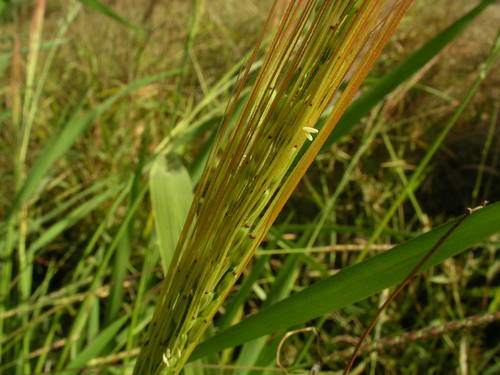
(c) Sylvain Piry, some rights reserved (CC BY-NC), uploaded by Sylvain Piry
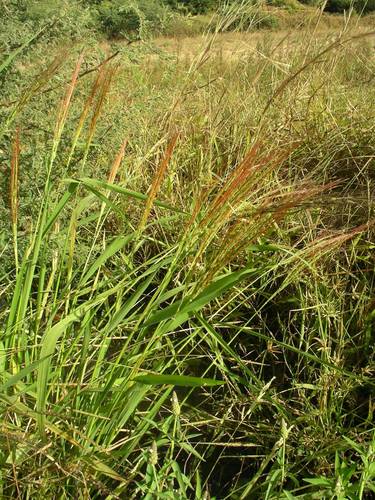
(c) Sylvain Piry, some rights reserved (CC BY-NC), uploaded by Sylvain Piry
What to Eat
Edible parts: Seeds, Cereal
The grain is eaten cooked and is used in kreb, a traditional grain mixture consumed in Sudan. It is sometimes sold in local markets.
Where to Find It
A tropical plant. Kano State, northern Nigeria. It grows in water. It grows in shallow ponds. It grows in wet grass savannah. It can be in flooded rice fields. It Ethiopia it grows at about 600 m above sea level.
Africa, Botswana, Burkina Faso, Cameroon, Central Africa, Chad, Congo, Côte d'Ivoire, East Africa, Ethiopia, Gambia, Ghana, Guinea, Guinée, Guinea-Bissau, Ivory Coast, Liberia, Mauritania, Nigeria, Senegal, Sierra Leone, Southern Africa, South Sudan, Sudan, Tanzania, Uganda, West Africa, Zambia, Zimbabwe,
How to Identify
An annual cereal grass. It grows 60-120 cm tall. There are 3-8 nodes. It produces aerial roots from the lower nodes. The stems are spongy. The flower panicles are 20-35 cm long by 3-8 cm wide. There are many flowers. The grains fall off easily.
How to Grow
Requires an open, sunny position. Prefers clay or black cotton soils. Succeeds in deep water, but grows best in shallow water. The plant is often considered to be a weed within its native range, where it is often found growing amongst rice.
Propagation: Seed. The seed of wild rice less than 12 months old often exhibits strong dormancy, which implies (though this has not been established) that the seed retains its viability for a considerable period. Heat treatment is generally effective in breaking dormancy - alternating temperatures between 34°c for 16 hours then 11°c for 8 hours is usually effective, though the time taken varies between species. Surface sow the seed in light shade and do not allow to dry out. Seed should germinate within 7 days at 30°c. Prick out 2 - 3 seedlings into individual pots when large enough to handle and, after a few days, move to a sunny position. Grow on until large enough to plant out.
Other Uses
The plant is related to the cultivated African rice (Oryza glaberrima) and can be used in breeding programmes with both that species and the Asian rice (Oryza sativa).
Wikipedia
Source ↗Oryza barthii, also called Barth's rice, wild rice, or African wild rice, is a grass in the rice genus Oryza. It is an annual, erect to semierect grass. It has leaves with a short ligule (<13 millimetres (33⁄64 in)), and panicles that are compact to open, rarely having secondary branching. The inflorescence structure are large spikelets, 7.7–12.3 millimetres (39⁄128–31⁄64 in) long and 2.3–3.5 millimetres (23⁄256–35⁄256 in) wide, with strong awns (up to 20 centimetres (8 in) long), usually red. The inflorescences have anthers 1.5–3 millimetres (15⁄256–15⁄128 in) long. This wild rice grows in sub-Saharan Africa, and is found in mopane or savanna woodland, savanna or fadama. O. barthii grows in deep water, seasonally flooded land, stagnant water, and slowly flowing water or pools; it prefers clay or black cotton soils (vertisol), and is found in open habitats. It is the progenitor of cultivated Oryza glaberrima, African rice. It has nodal roots hosting nitrogen fixing, photosynthetic strains of Bradyrhizobium. The sequenced genome of O. barthii was published in 2014. This species is one of the AA species, the domesticated rices and their wild relatives.
Production
It is harvested into baskets without cutting.
Other Information
It is sometimes sold in local markets.
Notes
There are about 20 Oryza species. This is a diploid species with AgAg genome.
Names & Synonyms
Alumo, Bau, Bororo, Shinkafar gyado, Wild rice
References (18)
- Abbiw, D.K., 1990, Useful Plants of Ghana. West African uses of wild and cultivated plants. Intermediate Technology Publications and the Royal Botanic Gardens, Kew. p 26
- Awas, T., 1997, A Study on the Ecology and Ethnobotany of Non-cultivated Food Plants and Wild Relatives of Cultivated crops in Gambella Region, Southwestern Ethiopia. Addis Ababa University. p 78
- Belem, M., et al, 2017, Strategy of Conservation and Protection of Wild Edible Plants Diversity in Burkina Faso. ANADOLU 27 (2) 2017, 82- 90
- Bull. Mus. Hist. Nat. (Paris) 16:405. 1910
- Chang, T.T., 1979, Rice, in Simmonds N.W.,(ed), Crop Plant Evolution. Longmans. London. p 98
- Dalziel, J. M., 1937, The Useful plants of west tropical Africa. Crown Agents for the Colonies London.
- Facciola, S., 1998, Cornucopia 2: a Source Book of Edible Plants. Kampong Publications, p 177
- Fowler, D. G., 2007, Zambian Plants: Their Vernacular Names and Uses. Kew. p 71
- Gallagher, D. E., 2010, Farming beyond the escarpment: Society, Environment, and Mobility in Precolonial Southeastern Burkina Faso. PhD University of Michigan.
- Grivetti, L. E., 1980, Agricultural development: present and potential role of edible wild plants. Part 2: Sub-Saharan Africa, Report to the Department of State Agency for International Development. p 28, p 41 (As Oryza breviligulata)
- Jardin, C., 1970, List of Foods Used In Africa, FAO Nutrition Information Document Series No 2.p 4 (Also as Oryza breviligulata)
- Lulekal, E., et al, 2011, Wild edible plants in Ethiopia: a review on their potential to combat food insecurity. Afrika Focus - Vol. 24, No 2. pp 71-121
- MORTIMORE,
- National Research Council, 1996, Lost Crops of Africa. Volume 1: Grains/ National Academy Press, Washington, D.C. p 36, 271, p 258 (As Oryza breviligulata)
- Peters, C. R., O'Brien, E. M., and Drummond, R.B., 1992, Edible Wild plants of Sub-saharan Africa. Kew. p 24
- Roger, D. D., et al, 2012, Nutritional properties of “Bush Meals” from North Cameroon’s Biodiversity. Advances in Applied Science Research, 2012, 3 (3):1482-1493
- Uphof,
- World Checklist of Useful Plant Species 2020. Royal Botanic Gardens, Kew


