Amorphophallus consimilis
Blume
Apaty, Gingi

(c) Lucy Keith-Diagne, some rights reserved (CC BY), uploaded by Lucy Keith-Diagne

no rights reserved, uploaded by Sara L Giles
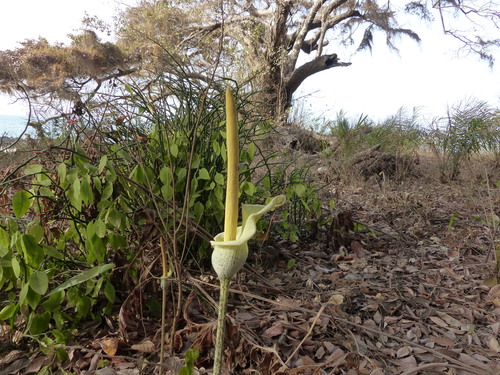
(c) paulocatry, some rights reserved (CC BY-NC)
What to Eat
Edible parts: Tubers - young, Corm, Root
Young tubers are eaten after extensive processing—pounded and boiled together with leaves of Cissus gracilis and Spondias mombin.
Where to Find It
A tropical plant.
Africa, Guinea, Guinée, Senegal, West Africa,
How to Identify
A herb. It has a flattened tuber 4-7 cm across and 2-4 cm high. It has an irregular shape. The surface is rough or scaly. The flower appears before the leaf. The leaf is 60-80 cm tall. The leaf stalk can be 25-50 cm tall and up to 1 cm across. It has dark purple spots. The leaf blade is 30-45 cm across and divided twice into leaflets. The end leaflets are 7-12 cm long by 3-5 cm wide. The flowering stalk can be 20-45 cm tall. The spathe is 5-11 cm long and with a vase shape with a constriction. The flowers are close together along the spadix in 3 spirals. The fruit are berries with single seeds
Notes
There are about 170-200 Amorphophallus species.
Names & Synonyms
References (3)
- Famine foods
- FERRY
- Lim, T. K., 2015, Edible Medicinal and Non Medicinal Plants. Volume 9, Modified Stems, Roots, Bulbs. Springer p 8


