Amorphophallus dracontioides
(Engl.) N. E. Br.
Gwazar giwa, Kinciyar
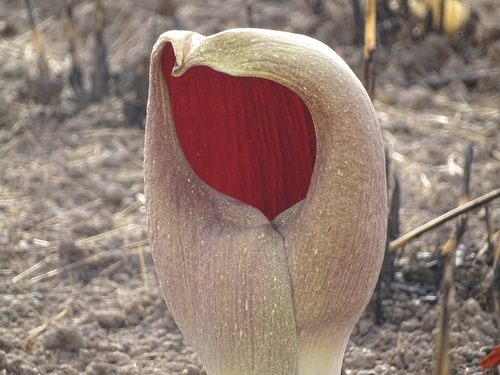
(c) ONG OeBenin, some rights reserved (CC BY-NC), uploaded by ONG OeBenin
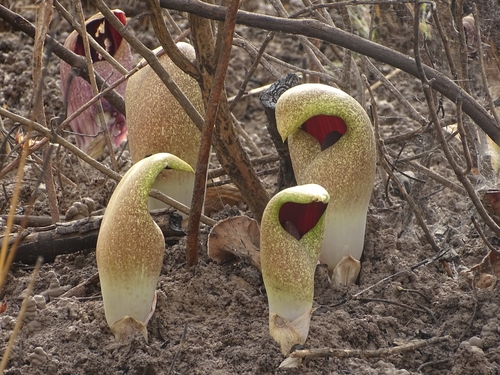
(c) AMADOU BAHLEMAN FARID, some rights reserved (CC BY-NC), uploaded by AMADOU BAHLEMAN FARID

(c) AMADOU BAHLEMAN FARID, some rights reserved (CC BY-NC), uploaded by AMADOU BAHLEMAN FARID
What to Eat
Edible parts: Corms, Tuber, Root
The corms and tubers are eaten as a famine food after extensive processing—they are cut, washed, and boiled for one or two days to remove acrid oxalates.
Known Hazards
Where to Find It
It is a tropical plant. It grows in seasonally wet grassland.
Africa, Burkina Faso, Central Africa, Congo, Ghana, Nigeria, West Africa,
How to Identify
A herb. It has a disk shaped tuber. This is 10-25 cm across and 5-15 cm high. It is grey brown on the outside and white inside. It produces round offsets. The leaf is up to 1.2 m tall on a stalk 40-100 cm long and 1-2 cm across. It has purple spots on which near the base and then becomes purple. The leaf blade is 50-100 cm across and divided into leaflets. These are 9-30 cm long by 1-3 cm wide. The flower appears before the leaf. The flowering stalk is 5-30 cm long by 1-2 cm wide. It is purple with green spots. The spathe is 10-45 cm high and with a hood over the spadix. The spathe is nearly closed. The spadix is 1-2 cm long. The flowers are congested. The fruit are single seeded berries. The flower has the smell of rotten meat. This attracts flied that pollinate it.
Medicinal Uses
This species's root has been used medicinally for hemorrhoids, and breaking down venomous stings/bites.
Wikipedia
Source ↗Amorphophallus dracontioides or the Dragons Football is a species of plant in the genus Amorphophallus ranging from Ghana to Nigeria.
Other Information
A famine food.
Notes
There are about 170-200 Amorphophallus species.
Names & Synonyms
References (12)
- Abbiw, D.K., 1990, Useful Plants of Ghana. West African uses of wild and cultivated plants. Intermediate Technology Publications and the Royal Botanic Gardens, Kew. p 31
- Bircher, A. G. & Bircher, W. H., 2000, Encyclopedia of Fruit Trees and Edible Flowering Plants in Egypt and the Subtropics. AUC Press. p 24
- Busson, 1965,
- Dalziel, J. M., 1937, The Useful plants of west tropical Africa. Crown Agents for the Colonies London.
- Gallagher, D. E., 2010, Farming beyond the escarpment: Society, Environment, and Mobility in Precolonial Southeastern Burkina Faso. PhD University of Michigan.
- Grivetti, L. E., 1980, Agricultural development: present and potential role of edible wild plants. Part 2: Sub-Saharan Africa, Report to the Department of State Agency for International Development. p 24, 32
- IRVINE,
- Jardin, C., 1970, List of Foods Used In Africa, FAO Nutrition Information Document Series No 2.p 11
- Lim, T. K., 2015, Edible Medicinal and Non Medicinal Plants. Volume 9, Modified Stems, Roots, Bulbs. Springer p 8
- MORTIMORE
- Morton, J.K., 1961, West African Lilies and Orchids. Longmans. p 43
- Peters, C. R., O'Brien, E. M., and Drummond, R.B., 1992, Edible Wild plants of Sub-saharan Africa. Kew. p 11


