Amorphophallus konjac
K. Koch
Devil's tongue, Snake palm, Umbrella arum
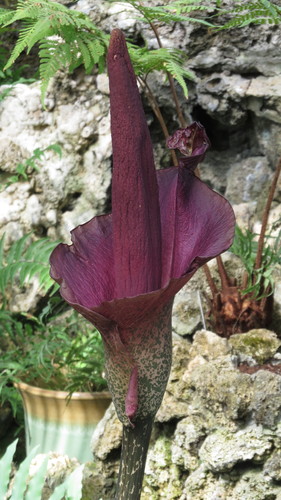
no rights reserved, uploaded by Adam Kranz

(c) Gregory Mihaich, some rights reserved (CC BY-NC-SA), uploaded by Gregory Mihaich
What to Eat
Edible parts: Tuber, Corm, Flower stalks, Vegetable, Roots, Leaves
The corm must be thoroughly boiled or baked before eating, as it is acrid when raw. Very large — up to 30cm in diameter — in Japan the brown tubers are peeled, cooked, and pounded to extract starch, which is then solidified with dissolved limestone into an edible gel called 'Konnyaku'. This flour is valued for its ability to clean the digestive tract without acting as a laxative. The root is very high in water and low in calories, making it a promoted diet food in North America. Especially just before the foliage declines prior to dormancy, the tubers are a rich source of mannan, a polysaccharide of mannose and glucose; the mannose is extracted and widely used in foods for diabetics. Glucomannan, a soluble fibre formed from mannan and glucose, cannot be metabolized by the human body but is metabolized by intestinal bacteria. In the digestive system it absorbs up to 200 times its weight in water without negative effects, providing a feeling of fullness useful for weight loss, and also relieving constipation and irritable bowel syndrome while reducing serum cholesterol levels. Glucomannan is also widely used as an emulsifier and stabilizer in foods and drinks.
Known Hazards
Where to Find It
A tropical plant. It is less tropical than Amorphophallus paenifolius var. campanulatus. It grows up to 3,000 m altitude in Vietnam. It suits hardiness zones 10-12. In Yunnan.
Asia, Australia, China, Hawaii, India, Indochina, Japan, Korea, Laos, Philippines, SE Asia, USA, Vietnam,
How to Identify
A large herb which keeps growing from year to year. The tuber is round and 30 cm across. It produces long rhizomes off the side. These are 50 cm long by 3 cm thick. There is a single leaf. The leaf stalk is smooth and dull pink. It is 1 m long. It has dark green and white spots. The leaf blade is very divided. The blade can be 2 m across. The leaflets are pointed and 3-10 cm long by 2.6 cm wide. The flower stalk can be 1.1 m long and coloured like the leaf stalk. The bract around the flower is broadly triangular and funnel shaped. It is 10-60 cm long and 10-55 cm across. It has a wavy edge. The outer surface is dull and brown-green. with darker green spots. It is red-brown inside. The flower spike is like a narrow cone and 0.15-1.1 m long. It can give off a smell like rotten meat for a few days.
Nutrition Score: 27/100
| Part | Moisture | kJ | kcal | Protein | Vit A | Vit C | Iron | Zinc |
|---|---|---|---|---|---|---|---|---|
| Corm | 78.8 | 394 | 94 | 1.2 | — | — | 0.6 | — |
How to Grow
Plants can tolerate a minimum temperature of 15c during the growing season, though the optimum range is 20 - 25c. The best crops are produced on deep, fertile, alluvial soils that are slightly acid. Dislikes heavy clay soils. Plants require some shade, especially when young. Members of this genus generally require a moist but well-drained, humus-rich, fertile soil and a position in dappled shade. The plant produces one enormous leaf and one flowering stem annually. When ripe for pollination, the flowers have a foetid smell to attract carrion flies and midges. This smell disappears once the flower has been pollinated. The tubers are planted 15cm deep. Like many species in the family Araceae, this plant has the ability to heat the flowering spadix as the pollen becomes ready for fertilization. This heat greatly increases the strength of the aroma released by the plant, thus attracting more pollinating insects. It can also have the effect of making the insects more active, thus increasing the level of fertilization.
Propagation: Seed — best sown in a pot in a warm greenhouse as soon as it is ripe, with the pot sealed in a plastic bag to retain moisture. Germination usually occurs within 1–8 months at 24°C. When large enough to handle, prick seedlings out into individual pots and grow on in the greenhouse for at least a couple of years. Plant out in late spring or early summer after the last expected frosts, providing protection such as a cloche until the plants are growing away strongly. Division of offsets is possible, though offsets are rarely produced.
Medicinal Uses
The root is oxytocic and sialagogue, and is used in the treatment of cancer. Glucomannan, a soluble fibre obtained from the tuber, cannot be metabolized by the human body but is metabolized by intestinal bacteria. In the digestive system it absorbs up to 200 times its weight in water without negative effects, helping with weight loss, relieving constipation and irritable bowel syndrome, and reducing serum cholesterol levels. The flowers are febrifuge.
Other Uses
In Japan, a cultivation system known as jinjenjo is practised, in which plants are grown within a natural plant community and heavily mulched with grain straw or wild herbs. Plants grown this way are remarkably free from pests and diseases. The largest tubers are harvested at the end of the year, with the rest left in the ground for subsequent harvests. The plant has insecticidal properties. Glucomannan obtained from the tuber has gelling and film-forming properties and is widely used as an emulsifier and stabilizer in foods, drinks, cosmetics, and the pharmaceutical industry. It is also used as a non-clay drilling fluid in the diamond and oil industries. The plant can be used as ground cover. Special uses include food forest applications.
Wikipedia
Source ↗Amorphophallus konjac, commonly known as konnyaku or konjac, is a species of flowering plant in the family Araceae. In English, it is also referred to as devil's tongue, voodoo lily, snake palm, or elephant yam. The perennial species forms a corm, the stem of which produces a purplish flower. It is native to China and is cultivated in East and Southeast Asia. Food made from the corm is known by its Japanese name, konnyaku. It can be made into white or black cake, as well as a kind of noodle called shirataki.
Other Information
Cultivated for its edible tuber in Japan.
Notes
There are about 170 to 200 Amorphophallus species. Root (Fresh weight) Water: 97.4 Calories: 8 Protein: 0.1 Fat: 0 Carbohydrate: 2.3 Fibre: 0.1 Ash: 0.2 Calcium: 17 Phosphorus: 7 Iron: 0.3 Leaves (Dry weight) Water: 0 Calories: 308 Protein: 3.8 Fat: 0 Carbohydrate: 88.5 Fibre: 3.8 Ash: 7.7 Calcium: 654 Phosphorus: 269 Iron: 11.5
Names & Synonyms
Bulei, Jia mo, Kembang bangke, Konjaku, Konnyaku
References (29)
- Ambasta S.P. (Ed.), 2000, The Useful Plants of India. CSIR India. p 36 (As Amorphophallus rivieri)
- Arora, R. K., 2014, Diversity in Underutilized Plant Species - An Asia-Pacific Perspective. Bioversity International. p 23
- Brickell, C. (Ed.), 1999, The Royal Horticultural Society A-Z Encyclopedia of Garden Plants. Convent Garden Books. p 109 (As Amorphophallus rivieri var. konjac )
- Brown, D., 2000, Aroids. Plants of the Arum family. Timber Press. (Second edition) p 265 (Also as Amorphophallus nanus)
- Burkill, I.H., 1966, A Dictionary of the Economic Products of the Malay Peninsula. Ministry of Agriculture and Cooperatives, Kuala Lumpur, Malaysia. Vol 1 (A-H) p 139 (As Amorphophallus rivieri)
- Cundall, P., (ed.), 2004, Gardening Australia: flora: the gardener's bible. ABC Books. p 147
- Facciola, S., 1998, Cornucopia 2: a Source Book of Edible Plants. Kampong Publications, p 23 (As Amorphophallus rivieri)
- Food Composition Tables for use in East Asia FAO http://www.fao.org/infoods/directory No. 137
- Fu, Yongneng, et al, 2003, Relocating Plants from Swidden Fallows to Gardens in Southwestern China. Economic Botany, 57(3): 389-402
- Geng, Y., et al, 2016, Traditional knowledge and its transmission of wild edibles used by the Naxi in Baidi Village, northwest Yunnan province. Journal of Ethnobiology and Ethnomedicine. 12:10
- Heywood, V.H., Brummitt, R.K., Culham, A., and Seberg, O., 2007, Flowering Plant Families of the World. Royal Botanical Gardens, Kew. p 348
- Hibbert, M., 2002, The Aussie Plant Finder 2002, Florilegium. p 25 (As Amorphophallus rivieri var. konjac)
- Hu, Shiu-ying, 2005, Food Plants of China. The Chinese University Press. p 305 (As Amorphophallus mairei) p 304 (As Amorphophallus rivieri)
- Kay, D.E., 1973, Root Crops, Digest 2, Tropical Products Institute, London, p 61 (As Amorphophallus rivieri var. konjac )
- Li Heng, Araceae, Flora of China.
- Lim, T. K., 2015, Edible Medicinal and Non Medicinal Plants. Volume 9, Modified Stems, Roots, Bulbs. Springer p 8
- Long, Chun-Lin, 1998, Ethnobotany of Amorphophallus of China. Acta Botanica Yunnanica. Suppl. 10: 89-92 (As Amorphophallus nanus)
- Luo, B., et al, 2019, Wild edible plants collected by Hani from terraced rice paddy agroecosystem in Honghe Prefecture, Yunnan, China. Journal of Ethnobiology and Ethnomedicine 15:56
- Martin, F.W. & Ruberte, R.M., 1979, Edible Leaves of the Tropics. Antillian College Press, Mayaguez, Puerto Rico. p 176 (As Amorphophallus rivieri var. konjac )
- Plants for a Future database, The Field, Penpol, Lostwithiel, Cornwall, PL22 0NG, UK. http://www.scs.leeds.ac.uk/pfaf/. (As Amorphophallus rivieri)
- Purseglove, J.W., 1972, Tropical Crops. Monocotyledons. Longmans p 59 (As Amorphophallus rivieri)
- Solomon, C., 2001, Encyclopedia of Asian Food. New Holland. p 120
- Sukarya, D. G., (Ed.) 2013, 3,500 Plant Species of the Botanic Gardens of Indonesia. LIPI p 1062
- Terra, G.J.A., 1973, Tropical Vegetables. Communication 54e Royal Tropical Institute, Amsterdam, p 23 (As Amorphophallus rivieri var. konjac )
- USDA, ARS, National Genetic Resources Program. Germplasm Resources Information Network - (GRIN). [Online Database] National Germplasm Resources Laboratory, Beltsville, Maryland. Available: www.ars-grin.gov/cgi-bin/npgs/html/econ.pl (10 April 2000)
- Wiersema, J. H. & Leon, B., 2013, World Economic Plants. A Standard Reference CRC Press. 2nd Ed. p 47
- Wochenschr. Gaurtnerei Pflanzenk. 1:262. 1858
- World Checklist of Useful Plant Species 2020. Royal Botanic Gardens, Kew
- Zeven, A. C. & de West, J. M. J., 1982, Dictionary of cultivated plants and their regions of diversity. Wageningen. p 49 (As Amorphophallus rivieri)


