Amorphophallus muelleri
Prain
Elling konjac
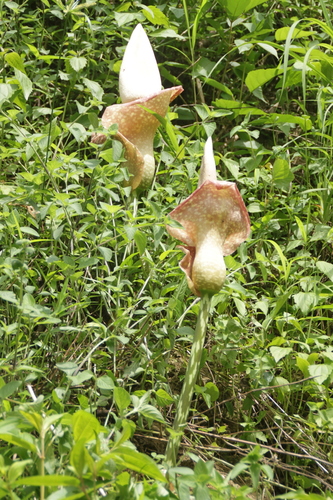
(c) Andi Siady Hamzah, some rights reserved (CC BY-NC), uploaded by Andi Siady Hamzah

(c) anggasakti, some rights reserved (CC BY-NC)

(c) anggasakti, some rights reserved (CC BY-NC)
What to Eat
Edible parts: Tubers, Corm, Root, Stem
Root - cooked. The corm must be thoroughly boiled or baked, it is acrid when raw (see notes above on 'Known Hazards'). The fresh corms are turned into curd, or are chopped then dried. The curd is relatively tasteless, but it absorbs flavours well and so can be used as a carbohydrate element in a wide range of other foods. Especially just before the foliage declines prior to dormancy, the tubers are a rich source of mannan, a polysaccharide of mannose and glucose. The mannose is extracted and widely used in foods for diabetics. Glucomannan, a soluble fibre formed from mannan and glucose, cannot be metabolized by the human body, but is metabolized by intestinal bacteria. Inside the digestive system, glucomannan absorbs up to 200 times its weight in water without any negative action upon the digestive system. It therefore can give a feeling of fullness and be of use to aid in weight loss, it also relieves constipation and irritable bowel syndrome, as well as reducing serum cholesterol levels. Glucomannan is widely used as an emulsifier and stabilizer in foods and drinks.
Known Hazards
Where to Find It
A tropical plant. It grows in shady areas between 200-1,000 m above sea level.
Andamans, Asia, India, Indochina, Indonesia, Myanmar, SE Asia, Thailand,
How to Identify
A taro family plant that forms a large tuber (corm). The tuber is 20-28 cm across. It is dark brown and smooth. This herb produces a large single leaf each year. The leaf stalk is 140 cm tall. It is smooth and pale green to brown with whitish spots or patches. The leaves are pale green and slightly shiny with pale red edges. Bulbils develop in the axils of the leaflets. The flowers are along a fleshy axis 8-30 cm long. They are brownish purple or greyish green fruit. The fruit are bright red.
Nutrition Score: 18/100
| Part | Moisture | kJ | kcal | Protein | Vit A | Vit C | Iron | Zinc |
|---|---|---|---|---|---|---|---|---|
| Corm | 80.3 | — | — | 3.8 | — | 0.9 | — | — |
How to Grow
It can be grown by small tubers or bulbils. Tubers are dormant and this must be broken before plants grow. It can be grown from seed.
Propagation: Seed - usually germinates easily and well.
Medicinal Uses
Glucomannan, a soluble fibre obtained from the tuber, cannot be metabolized by the human body, but is metabolized by intestinal bacteria. Inside the digestive system, glucomannan absorbs up to 200 times its weight in water without any negative action upon the digestive system. It therefore can give a feeling of fullness and be of use to aid in weight loss, it also relieves constipation and irritable bowel syndrome, as well as reducing serum cholesterol levels.
Other Uses
Glucomannan, obtained from the tuber, has a wide range of used in various industries. It has gelling and film-forming properties and is widely used as an emulsifier and stabilizer in foods, drinks, cosmetics and the pharmaceutical industry. It is also used as a non-clay drilling fluid in the diamond and oil industries.
Notes
There are about 170-200 Amorphophallus species.
Names & Synonyms
Acung, Badur, Iles-iles, Kerubut, Porang, Wa-u
References (11)
- Brown, D., 2000, Aroids. Plants of the Arum family. Timber Press. (Second edition) p 269
- Ivancic (As Amorphophallus oncophyllus)
- J. Asiat. Soc. Bengal, Pt. 2, Nat. Hist. 62(2,2):80. 1893 Aug (Prain ex J. D. Hooker, Fl. Brit. India 6:516. 1893 Sep)
- Kay, D.E., 1973, Root Crops, Digest 2, Tropical Products Institute, London, p 61
- Lim, T. K., 2015, Edible Medicinal and Non Medicinal Plants. Volume 9, Modified Stems, Roots, Bulbs. Springer p 8
- Mansfield's encyclopedia of agricultural and horticultural crops. p 2323
- Onwueme, I. C., 1978, The Tropical Tuber Crops. Wiley, p 199 (Also as Amorphophallus oncophyllus)
- Shin, T., et al, 2018, Traditional knowledge of wild edible plants with special emphasis on medicinal uses in Southern Shan State, Myanmar. Journal of Ethnobiology and Ethnomedicine (2018) 14:48
- Sukarya, D. G., (Ed.) 2013, 3,500 Plant Species of the Botanic Gardens of Indonesia. LIPI p 1062
- Suwardi, A. B., 2018, Nutritional Evaluation of Some Wild Edible Tuberous Plants as Alternative Foods. Innovare Journal of Food Science, Vol. 6, Issue 2.
- Trimanto, & Hapsari L., 2016, Botanical survey in thirteen montane forests of Bawean Island Nature Reserve, East Java Indonesia: Conservation status, bioprospecting and potential tourism. Biodiversitas 17: 832-846.


