Oxalis stricta
L.
Yellow Woodsorrel, Sour grass
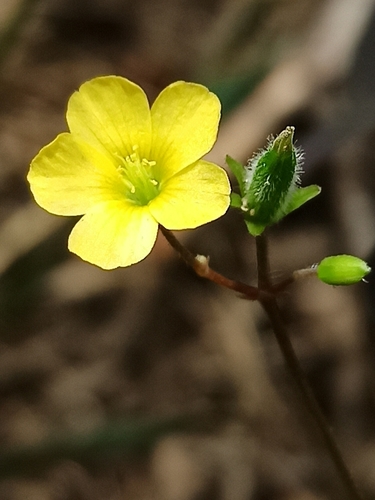
(c) asja_bogina, some rights reserved (CC BY-NC)

(c) Sergey Mayorov, some rights reserved (CC BY-NC), uploaded by Sergey Mayorov

(c) Bill Keim, some rights reserved (CC BY)
What to Eat
Edible parts: Leaves, Seeds, Pods, Roots, Flowers
The leaves are edible raw or cooked with a pleasant acid flavour and can also be chewed as a thirst quencher. Use in moderation. Flowers can be added raw to salads. Young seedpods are edible raw. The root is also edible, though no further details are recorded. A lemon-flavoured drink can be made from the leaves.
Known Hazards
Where to Find It
It is a temperate plant. In China it grows in forests and ravines between 400-1,500 m above sea level.
Africa, Balkans, Bosnia, Cameroon, Canada, Central Africa, China, Europe, Japan, Korea, North America, Pakistan, Romania, Russia, USA,
How to Identify
An upright herb. It has an underground stem or rhizome. It has a taproot. It is hairy. The stems are 30 cm tall. They form roots at the nodes. The leaves have 3 heart shaped leaflets. The leaflets have a crease in the centre. The flowers are yellow.
Nutrition
| Part | Moisture | kJ | kcal | Protein | Vit A | Vit C | Iron | Zinc |
|---|---|---|---|---|---|---|---|---|
| Leaves | — | — | — | — | 79 | — | — | — |
How to Grow
Easily grown in a sandy soil in a warm dry position. Very closely related to O. corniculata, and seen as no more than a variety of that species by some botanists. This variety differs from O. corniculata by stems erect, not rooting at nodes; branched or not.
Propagation: Seed is best sown as soon as ripe in a cold frame. Prick out seedlings into individual pots when large enough to handle and plant out in summer. If enough seed is available, it can be sown in situ during spring.
Medicinal Uses
An infusion of the plant has been used to treat fevers, stomach cramps, and nausea. A poultice of the plant has been applied to reduce swellings.
Other Uses
Boiling up the whole plant yields a yellow to orange dye.
Wikipedia
Source ↗Oxalis stricta, called the common yellow woodsorrel (or simply yellow woodsorrel), common yellow oxalis, or upright yellow-sorrel is a herbaceous plant.
Notes
There are about 500 Oxalis species.
Names & Synonyms
Stoloniferous woodsorrel, Tarookay, Zuta soca
References (17)
- Beckstrom-Sternberg, Stephen M., and James A. Duke. "The Foodplant Database." http://probe.nalusda.gov:8300/cgi-bin/browse/foodplantdb.(ACEDB version 4.0 - data version July 1994)
- Duke, J.A., 1992, Handbook of Edible Weeds. CRC Press. p 140
- Facciola, S., 1998, Cornucopia 2: a Source Book of Edible Plants. Kampong Publications, p 165
- Hwang, H., et al, 2013, A Study on the Flora of 15 Islands in the Western Sea of Jeollanamdo Province, Korea. Journal of Asia-Pacific Biodiversity Vol. 6, No. 2 281-310
- Kermath, B. M., et al, 2014, Food Plants in the Americas: A survey of the domesticated, cultivated and wild plants used for Human food in North, Central and South America and the Caribbean. On line draft. p 598
- Lim, T. K., 2015, Edible Medicinal and Non Medicinal Plants. Volume 9, Modified Stems, Roots, Bulbs. Springer p 61
- Luczaj, L., et al, 2015, Wild food plants and fungi used by Ukrainians in the western part of the Maramureş region in Romania. Acta Soc Bot Pol 84(3):339–346
- MacKinnon, A., et al, 2009, Edible & Medicinal Plants of Canada. Lone Pine. p 223 (Also as Oxalis dillenii)
- Mercy, N. A., et al, 2016, Survey of Wild Vegetables in the Lebialem Highlands of South Western Cameroon. Journal of Plant Sciences 4(6): 172-184
- Moerman, D. F., 2010, Native American Ethnobotany. Timber Press. p 374
- Plants for a Future database, The Field, Penpol, Lostwithiel, Cornwall, PL22 0NG, UK. http://www.scs.leeds.ac.uk/pfaf/
- Sp. pl. 1:435. 1753
- Redzic, S. J., 2006, Wild Edible Plants and their Traditional Use in the Human Nutrition in Bosnia-Herzegovina. Ecology of Food and Nutrition, 45:189-232
- Shad, A. A., Shah, H. U., & Bakht, J., 2013, Ethnobotanical Assessment and Nutritive Potential of Wild Food Plants. The Journal of Animal & Plant Sciences, 23(1) pp. 92-97
- Uphof,
- www.wildediblefood.com
- Zennie, T.M. and Ogzewalla, C.D., 1974, Ascorbic Acid and Vitamin A content of Edible Wild Plants of Ohio and Kentucky.


