Oxalis triangularis
A.St.-Hilaire
Shamrock, White wood-sorrel
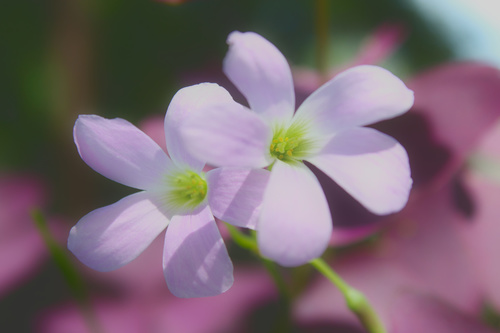
(c) Bryan Agosto, some rights reserved (CC BY-NC), uploaded by Bryan Agosto
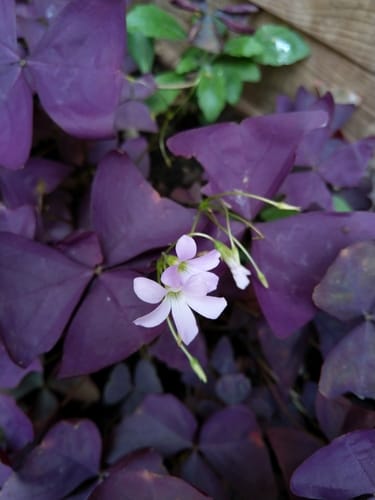
(c) wintovka, some rights reserved (CC BY-NC)

(c) Максим Исмайлов, some rights reserved (CC BY-NC), uploaded by Максим Исмайлов
What to Eat
Edible parts: Flowers, Leaves, Root
The leaves are edible raw or cooked with a pleasant acid flavour. Use in moderation. The flowers are also edible raw, making a pleasant and decorative addition to the salad bowl — most children adore eating them raw. The root can be eaten raw or cooked; it grows up to 5cm long and 15mm wide, and is crisp and juicy with a pleasant, sweet, mild flavour.
Known Hazards
Where to Find It
A subtropical plant. It can grow in low light intensity. In Argentina it grows from sea level to 1,000 m above sea level. It suits hardiness zones 8-11.
Argentina, Australia, Bolivia, Brazil*, Hawaii, North America, Pacific, Paraguay, Peru, South America*, USA,
How to Identify
A herb. It does not have a stem but has a branching, scaly rhizome. The leaves have 3 leaflets. They are triangle shaped. The leaves are deep purple. The leaf stalks can be 25 cm long. The flowers are white or pink and nodding. The fruit is spindle shaped and almost 2 cm long. There are 5-10 seeds.
How to Grow
Easily grown in a sandy soil in a warm dry position in sun or light shade. Grows well in a dry shady corner. Plants are not very cold-hardy in Britain, tolerating temperatures down to about -3°c. Given a suitable position, it should succeed outdoors at least in the mildest parts of the country. It should be possible to grow it even in the colder areas by digging up the bulbs in the autumn after the top growth has been cut down by frosts, storing them in a cool but frost-free place and replanting them in mid to late spring. There are two main forms of this plant, ssp triangularis has smaller, green leaves and is, in our experience, slightly the hardier of the two. Ssp papilionacea has larger, dark purple leaves and is considered the more ornamental.
Propagation: Seed is best sown as soon as ripe in a cold frame. Note that seed from one subspecies does not always come true — on at least one occasion the purple-leaved form has been grown from seed of the green-leaved form that had definitely not been cross-pollinated. Prick out seedlings into individual pots when large enough to handle and grow on in a greenhouse through their first winter before planting out in late spring or early summer. For division in spring, larger divisions can go directly into their permanent positions. Smaller divisions are better potted up and grown on in light shade in a cold frame until well established before planting out in late spring or early summer.
Medicinal Uses
None known
Other Uses
None known
Wikipedia
Source ↗Oxalis triangularis, commonly called false shamrock, is a species of perennial plant in the family Oxalidaceae. It is native to several countries in southern South America. This woodsorrel is typically grown as a houseplant but can be grown outside in USDA climate zones 8a–11, preferably in light shade. The deep maroon leaves are trifoliate, like species in the clover genus Trifolium which are commonly called shamrock, hence the name "false shamrock". The leaves fold down at night, when disturbed, and when in harsh sunlight. The white or pale pink five-petalled flowers also close at night.
Notes
There are about 500 Oxalis species.
Names & Synonyms
Trevo-roxo
References (5)
- Cundall, P., (ed.), 2004, Gardening Australia: flora: the gardener's bible. ABC Books. p 966
- Kinupp, V. F., 2007, Plantas alimenticias nao-convencionais da regiao metropolitana de Porto Alegre, RS, Brazil p 89
- Kew Plants of the World Online
- Plants for a Future database, The Field, Penpol, Lostwithiel, Cornwall, PL22 0NG, UK. http://www.scs.leeds.ac.uk/pfaf/
- Staples, G.W. and Herbst, D.R., 2005, A tropical Garden Flora. Bishop Museum Press, Honolulu, Hawaii. p 448 (Drawing)


