Oxalis tuberosa
Molina
Oca

(c) Søren Holt, some rights reserved (CC BY-NC-SA)
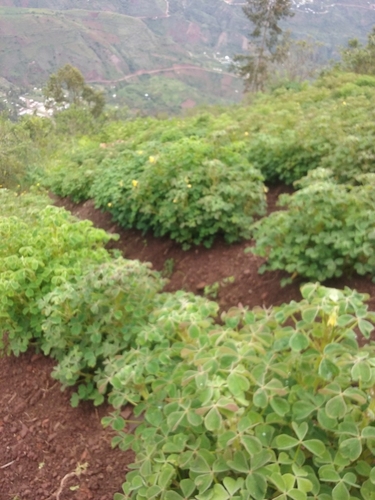
no rights reserved, uploaded by Luis Capeletti

(c) Arthur Chapman, some rights reserved (CC BY-NC-SA)
What to Eat
Edible parts: Flowers, Leaves, Root, Tubers, Vegetable
The tubers can be eaten raw or cooked and have an acid, lemon-like flavour when first harvested. Left out in the sun, they become sweet — in some varieties so sweet that they are said to resemble dried figs and are sold as fruits in local markets in South America. The cooked root is delicious whether in its sweet or acid form and can be boiled, baked, or prepared in similar ways to potatoes. Good-sized tubers reach 8cm or more in length. The slightly waxy skin makes them very easy to clean. Tubers contain approximately 70–80% moisture, 11–22% carbohydrate, 1% fat, 1% fibre, and 1% ash. The carbohydrate is rich in sugar and easy to digest. Acid types contain up to 500ppm oxalic acid, while sweet forms contain much less oxalic acid than is found in potatoes. Young leaves and flowers are also edible raw or cooked but are of poor quality. Use in moderation.
Known Hazards
Where to Find It
A temperate plant. It mostly grows in the Andes from Colombia to Chile at between 3,500 and 3,800 m altitude. The plant is frost hardy. They grow in the high altitude tropics. (2,800 - 4,560 m in the Andes). In Argentina it grows between 1,200-2,800 m above sea level. In the hot tropical lowlands, tubers perish quickly. A daylength of 9 hours is best for tuber formation. Vegetative top growth occurs under long day lengths. It suits hardiness zones 7-11.
Andes, Argentina, Australia, Bolivia*, Britain, Central America, Chile, Colombia, Ecuador, Europe, Mexico, New Zealand, North America, Pacific, Papua New Guinea, PNG, Peru, South America, Tasmania, USA, Venezuela,
How to Identify
A small annual herb up to 30 cm high with leaves of 3 leaflets. The stems are round and succulent. The leaves are spirally arranged. The flowers are orange-yellow. Three different kinds of flowers occur associated with three different kinds of tubers. The tubers have scales which cover long deep eyes. Tubers vary considerably in shape. The tubers are wrinkled and vary in colour between red, orange, yellow, or white. Some varieties have bitter tubers. They are about 5-8 cm long and 2-4 cm across. The plant rarely sets seed in the field but seed can be produced by self pollinating. When seed form, they occur in 5 celled locules with 1-3 tiny seeds in each.
Nutrition Score: 25/100
| Part | Moisture | kJ | kcal | Protein | Vit A | Vit C | Iron | Zinc |
|---|---|---|---|---|---|---|---|---|
| Tubers | 83.4 | 255 | 61 | 2.1 | — | — | — | — |
How to Grow
Prefers a light rich soil in a warm sunny position. Tolerates a pH range from 5.3 to 7.8. Plants succeed in areas with an average rainfall ranging from 570 - 2150mm per year. Oka is widely cultivated in the Andes for its edible tubers, there are many named varieties. This species has an excellent potential as a major root crop in temperate zones, it has the potential to yield as highly as potatoes but does not have the susceptibility to pests and diseases that are a bugbane for potato growers. Plants are slightly more hardy than the potato, tolerating light frosts but the top-growth being severely damaged or killed by temperatures much below freezing. The main drawback is that development of the tubers is initiated by the number of hours of daylight in a day. In Britain this means that tubers do not begin to form until after the 21st of September and, if there are early frosts in the autumn, yields will be low. There are possibly some forms in southern Chile that are not sensitive to daylength, these will be more suitable to higher latitudes such as Britain. It is said that the varieties with white tubers are bitter because they contain calcium oxylate crystals whilst those with tubers that are of other colours are sweet. However, we are growing one variety with white tubers and it most certainly is not bitter. Yields tend to average about 7 - 10 tonnes per hectare but experimentally yields of 40 tonnes per hectare have been achieved. Earthing up the growing stems as they start to form tubers can increase yields significantly.
Propagation: Seed is best sown as soon as ripe in a cold frame. Prick out seedlings into individual pots when large enough to handle and plant out in late spring or early summer. Seed is not usually produced in Britain. Harvest tubers in late autumn after frosts have killed the top growth, store in a cool, dry, frost-free place, and plant out in April. For basal cuttings in spring, harvest shoots with plenty of underground stem when they are about 8–10cm above ground, pot into individual pots, and keep in light shade in a cold frame or greenhouse until rooting well before planting out in summer.
Medicinal Uses
None known
Other Uses
None known
Wikipedia
Source ↗Oxalis tuberosa is a perennial herbaceous plant that overwinters as underground stem tubers. These tubers are known as uqa in Quechua, oca in Spanish, yams in New Zealand and several other alternative names. The plant was brought into cultivation in the central and southern Andes for its tubers, which are used as a root vegetable. The plant is not known in the wild, but populations of wild Oxalis species that bear smaller tubers are known from four areas of the central Andean region. Oca was introduced to Europe in 1830 as a competitor to the potato, and to New Zealand as early as 1860. In New Zealand, oca has become a popular table vegetable and is called yams (although not a true yam). It is available in various colors, including yellow, orange, pink, apricot, and traditional red.
Production
Tubers mature in about 8 months. Average yields in the Andes are about 3.7 t / ha. After digging tubers are cured in the sun for several days.
Other Information
It is a commercially cultivated vegetable. "Stew without chunu is like life without love!" It has only recently been introduced to Papua New Guinea to try it out. It is an important food in high altitude areas in the Andes.
Notes
There are about 500 Oxalis species.
Names & Synonyms
New Zealand yam, Peru, Samoa, Oqa, Apio blanca, Cuiba, Cuiva, Huisisai, Ibias, Macachin, Miquichi, New Zealand yam, Quiba, Ok'a, Apilla, Ibia, Ruba, Timbo, Quiba, Papa roja, Papa colorada, Papa extranjera, Truffette acide
References (39)
- Castillo, R. O., 1995, Plant Genetic Resources in the Andes: Impact, Conservation, and Management. Crop Science 35:355-360
- Cheifetz, A., (ed), 1999, 500 popular vegetables, herbs, fruits and nuts for Australian Gardeners. Random House p 83
- Crawford, M., 2012, How to grow Perennial Vegetables. Green Books. p 141
- Cundall, P., (ed.), 2004, Gardening Australia: flora: the gardener's bible. ABC Books. p 966
- Facciola, S., 1998, Cornucopia 2: a Source Book of Edible Plants. Kampong Publications, p 165
- Food Composition tables for International use http://www.fao.org/vegetables No. 76
- Franquemont, C., et al, 1990, The Ethnobotany of Chinchero, an Andean Community in Southern Peru. Fieldiana Botany No. 24 p 81
- French, B.R., 1986, Food Plants of Papua New Guinea, A Compendium. Asia Pacific Science Foundation p 22
- Hedrick, U.P., 1919, (Ed.), Sturtevant's edible plants of the world. p 456 (Also as Oxalis crassicaulis)
- Hermandez Bermejo, J.E., and Leon, J. (Eds.), 1994, Neglected Crops. 1492 from a different perspective. FAO Plant Production and Protection Series No 26. FAO, Rome. p 20, 151
- Hibbert, M., 2002, The Aussie Plant Finder 2002, Florilegium. p 216
- Kay, D.E., 1973, Root Crops, Digest 2, Tropical Products Institute, London, p 96
- Kays, S. J., and Dias, J. C. S., 1995, Common Names of Commercially Cultivated Vegetables of the World in 15 languages. Economic Botany, Vol. 49, No. 2, pp. 115-152
- Kermath, B. M., et al, 2014, Food Plants in the Americas: A survey of the domesticated, cultivated and wild plants used for Human food in North, Central and South America and the Caribbean. On line draft. p 599
- Kiple, K.F. & Ornelas, K.C., (eds), 2000, The Cambridge World History of Food. CUP p 1824
- Leon-Lobos, P., et al, 2022, Patterns of Traditional and Modern Uses of Wild Edible Native Plants of Chile: Challenges and Future Perspectives. Plants (Basel) v 11 (6) Table S1
- Lim, T. K., 2015, Edible Medicinal and Non Medicinal Plants. Volume 9, Modified Stems, Roots, Bulbs. Springer p 62
- Macbride. J. F., 1949, Flora of Peru. Geraniaceae. Field Museum Natural History. Chicago. p 545
- Macmillan, H.F. (Revised Barlow, H.S., et al), 1991, Tropical Planting and Gardening. Sixth edition. Malayan Nature Society. Kuala Lumpur. p 365
- Martin, F.W. & Ruberte, R.M., 1979, Edible Leaves of the Tropics. Antillian College Press, Mayaguez, Puerto Rico. p 209
- Morley, B. & Everard, B., 1970, Wild Flowers of the World. Ebury press. Plate 171
- Plants for a Future database, The Field, Penpol, Lostwithiel, Cornwall, PL22 0NG, UK. http://www.scs.leeds.ac.uk/pfaf/
- PROSEA handbook Volume 9 Plants yielding non-seed carbohydrates. p 177
- Purseglove, J.W., 1968, Tropical Crops Dicotyledons, Longmans. p 638
- Sag. stor. nat. Chili 132. 1782
- Schneider, E., 2001, Vegetables from Amaranth to Zucchini: The essential reference. HarperCollins. p 425
- Smith, K., 1998. Growing Uncommon Fruits and Vegetables. New Holland. p 31
- Smith, N., Mori, S.A., et al, 2004, Flowering Plants of the Neotropics. Princeton. p 283
- Smith, P.M., 1979, Oca, in Simmonds, N.W., (ed), Crop Plant Evolution. Longmans. London. p 317
- Solomon, C., 2001, Encyclopedia of Asian Food. New Holland. p 414
- Tapia, M. E., The role of under-utilised plant species with regard to increased food security and improved health of poor poeople, in mountain regions. IIAP-PNUD/Peru
- Terra, G.J.A., 1973, Tropical Vegetables. Communication 54e Royal Tropical Institute, Amsterdam, p 64
- Torre, de la, L., et al, 2008, Enciclopedia de las Plantas Útiles del Ecuador. Herbario QCA. Pontificia Universidad Católica del Ecuador. p 483
- Ulian, T., et al, 2020, Unlocking plant resources to support food security and promote sustainable agriculture. Plants, People, Planet. 2020;2:421–445.
- USDA, ARS, National Genetic Resources Program. Germplasm Resources Information Network - (GRIN). [Online Database] National Germplasm Resources Laboratory, Beltsville, Maryland. Available: www.ars-grin.gov/cgi-bin/npgs/html/econ.pl (10 April 2000)
- van Wyk, B., 2005, Food Plants of the World. An illustrated guide. Timber press. p 271
- Wiersema, J. H. & Leon, B., 2013, World Economic Plants. A Standard Reference CRC Press. 2nd Ed. p 486
- Wikipedia
- World Checklist of Useful Plant Species 2020. Royal Botanic Gardens, Kew


