Oxalis violacea
Linn.
Violet wood sorrel

(c) walkmic, some rights reserved (CC BY-NC)
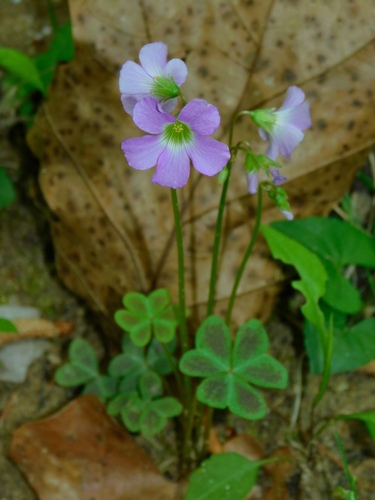
(c) Michael J. Papay, some rights reserved (CC BY), uploaded by Michael J. Papay
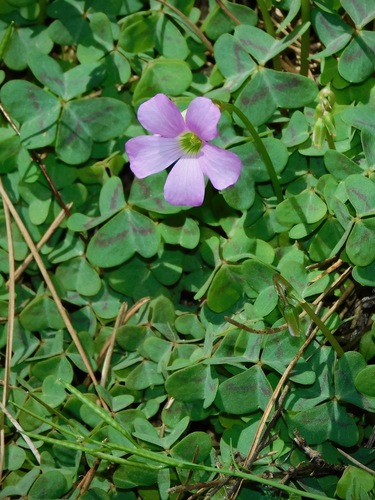
(c) Michael J. Papay, some rights reserved (CC BY), uploaded by Michael J. Papay
What to Eat
Edible parts: Leaves, Flowers, Stalks, Roots, Leaves - tea
The leaves have an acid, salty flavour and can be eaten raw in salads and sandwiches or cooked as a potherb. Use in moderation. The flowers are edible raw and make an attractive and tasty garnish for salads. The root can be eaten raw or cooked. A lemon-flavoured drink can also be made from the leaves.
Known Hazards
Where to Find It
It is a cool temperate plant. It grows in open forests and along banks. It is often on sandy soils. It suits hardiness zone 3.
Asia, Australia, Dominican Republic, India, North America, Slovenia, Taiwan, USA, West Indies,
How to Identify
A herb which keeps growing from year to year. It is an erect, delicate plant. It grows 40 cm tall. The leaves grow from the base and have long stems. The leaves are divided into 3 leaflets. They are grey-green or bluish-grey above and a reddish-purple underneath. The leaves fold downwards and together at night and on cloudy days. There are 4-19 flowers at the end of each stem. They are pinkish-purple. The eye of the flower is usually a darker purple. The lobes of the petals spread out wide. They are 12-20 mm long. There are 5 petals and 10 stamens.
How to Grow
Easily grown in a moisture-retentive humus-rich soil in shade or dappled sunlight. Succeeds in dry soils. Grows well in a wild or woodland garden.
Propagation: Seed is best sown as soon as ripe in a cold frame. Prick out seedlings into individual pots when large enough to handle and plant out in late spring or early summer. For division in spring, larger divisions can go directly into their permanent positions. Smaller divisions are better potted up and grown on in light shade in a cold frame until well established before planting out in late spring or early summer.
Medicinal Uses
The plant is used as an anthelmintic, antiemetic, blood purifier, and as a cancer salve. A cold infusion is used to stop vomiting. An infusion taken internally is considered a blood purifier and is said to be a treatment in the early stages of cancer. An infusion of the plant is both drunk and used as a wash to treat children with hookworm. An infusion of the leaves mixed with oil can be applied as a salve on sores.
Other Uses
None known
Wikipedia
Source ↗Oxalis violacea, the violet wood-sorrel, is a perennial plant and herb in the family Oxalidaceae. It is native to the eastern and central United States.
Notes
There are about 500 Oxalis species. The leaves are rich in Vitamin C.
Names & Synonyms
Deteljica
References (12)
- Beckstrom-Sternberg, Stephen M., and James A. Duke. "The Foodplant Database." http://probe.nalusda.gov:8300/cgi-bin/browse/foodplantdb.(ACEDB version 4.0 - data version July 1994)
- Facciola, S., 1998, Cornucopia 2: a Source Book of Edible Plants. Kampong Publications, p 165
- Hedrick, U.P., 1919, (Ed.), Sturtevant's edible plants of the world. p 457
- http://www.botanic-gardens-ljubljana.com/en/plants
- Kermath, B. M., et al, 2014, Food Plants in the Americas: A survey of the domesticated, cultivated and wild plants used for Human food in North, Central and South America and the Caribbean. On line draft. p 599
- Kiple, K.F. & Ornelas, K.C., (eds), 2000, The Cambridge World History of Food. CUP p 1883
- Kuo, W. H. J., (Ed.) Taiwan's Ethnobotanical Database (1900-2000), http://tk.agron.ntu.edu.tw/ethnobot/DB1.htm
- Loughmiller, C & L., 1985, Texas Wildflowers. A Field Guide. University of Texas, Austin. p 183
- Moerman, D. F., 2010, Native American Ethnobotany. Timber Press. p 374
- Paczkowska, G . & Chapman, A.R., 2000, The Western Australian Flora. A Descriptive Calatogue. Western Australian Herbarium. p 415
- Plants for a Future database, The Field, Penpol, Lostwithiel, Cornwall, PL22 0NG, UK. http://www.scs.leeds.ac.uk/pfaf/
- Sp. pl. 1:434. 1753


