Amorphophallus sylvaticus
(Roxb.) Kunth.
Vajra-kanda
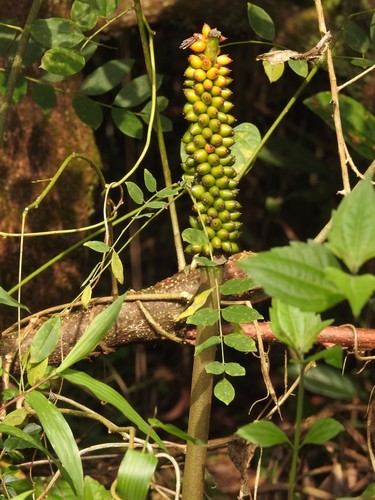
(c) Manoj Karingamadathil, some rights reserved (CC BY-SA), uploaded by Manoj Karingamadathil

(c) searipple, some rights reserved (CC BY-NC), uploaded by searipple
What to Eat
Edible parts: Tubers, Corms, Leaves, Petioles, Roots, Vegetable
The corms are cut into small pieces and boiled with tamarind leaves to remove the pungent taste, then fried, made into porridge, or used in pickles. Young leaves and leaf stalks are cooked and eaten.
Where to Find It
A tropical plant. It grows on the Deccan in India. It grows in partly evergreen forests.
Asia, India, Northeastern India, Sri Lanka,
How to Identify
A taro family herb. The corm is 5 cm across. The leaf stalk is 40 cm long. It is green to purple with spots or blemishes. It produces a single leaf that is divided into leaflets. The flower is surrounded by a white spathe. This is 6 cm long. It is cream outside and red inside. The spike like flower is 10-20 cm long. It turns yellow or orange.
Medicinal Uses
Listed as a popular food in traditional use.
Wikipedia
Source ↗Amorphophallus sylvaticus is a flowering plant species in India. This is used in herbal medicine.
Other Information
It is a popular food.
Notes
There are about 170-200 Amorphophallus species.
Names & Synonyms
Ban ole, Habit hensarku, Jangli suran, Kaattuchenai, Kattukarunai keerai, Olodor, Vanakanda
References (14)
- Ambasta, S.P. (Ed.), 2000, The Useful Plants of India. CSIR India. p 36
- Arinathan, V., et al, 2007, Wild edibles used by Palliyars of the western Ghats, Tamil Nadu. Indian Journal of Traditional Knowledge. 6(1) pp 163-168
- Baro, D., Baruah, S. and Borthukar, S. K. 2015, Documentation on wild vegetables of Baksa district, BTAD (Assam). Scholars Research Library. Archives of Applied Science Research, 2015, 7 (9):19-27
- Devarkar, V. D., et al, 2011, Dietary and Medicinal Significance of Wild Vegetables from Osmanabad Region, Maharashtra (India). Life sciences Leaflets 11:317-332.
- Lim, T. K., 2015, Edible Medicinal and Non Medicinal Plants. Volume 9, Modified Stems, Roots, Bulbs. Springer p 9, 80
- Marandi, R. R. & Britto, S. J., 2015, Medicinal Properties of Edible Weeds of Crop Fields and Wild plants Eaten by Oraon Tribals of Latehar District, Jharkhand. International Journal of Life Science and Pharma Research. Vo. 5. (2) April 2015
- Mishra, M., 2013, Utilization of wild tuberous plants in extreme environmental condition: A Case of Baiga Tribe of Central India. The Journal of Ethnobiology and Traditional Medicine. Photon 118 (2013) 366-372
- Narzary, H., et al, 2013, Wild Edible Vegetables Consumed by Bodo tribe of Kokrajhar District (Assam), North-East India. Archives of Applied Science Research, 5(5): 182-190
- Phangchopi, U., et al, 2015, Diversity of wild edible plants in Marat Longri Wildlife Sanctuary, Assam. Indian Journal of Natural Products and Resources Vol. 6(4), December 2015 pp. 305-313
- Rajkalkshmi, P. et al, 2001, Total carotenoid and beta-carotene contents of forest green leafy vegetables consumed by tribals of south India. Plant Foods for Human Nutrition 56:225-238
- Tamil herbs, 2007, Edible Plants of the Tropical Dry Evergreen Forest.
- Teron, R. & Borthakur, S. K., 2016, Edible Medicines: An Exploration of Medicinal Plants in Dietary Practices of Karbi Tribal Population of Assam, Northeast India. In Mondal, N. & Sen, J.(Ed.) Nutrition and Health among tribal populations of India. p 149
- WATT
- WATT (As Synantherias sylvatica)


