Amorphophallus variabilis
Bl.
Pink lily, Stinking Snakeskin Lily
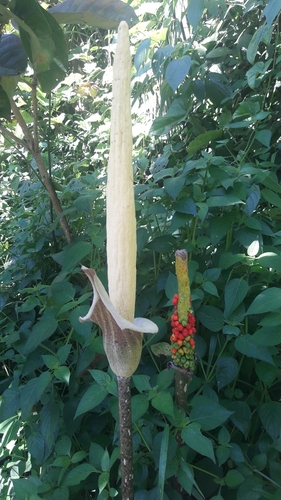
(c) Shalahuddin Averroes Supartha, some rights reserved (CC BY-NC), uploaded by Shalahuddin Averroes Supartha
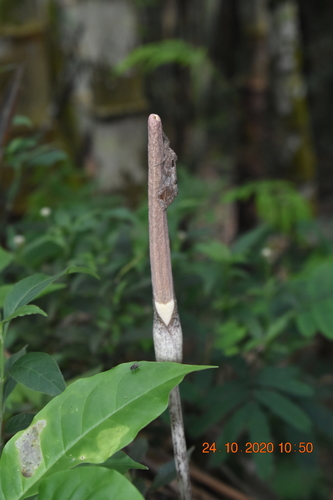
(c) Lukito H. K. Hadi, some rights reserved (CC BY-NC), uploaded by Lukito H. K. Hadi
What to Eat
Edible parts: Tubers, Root, Corm, Leaves, Fruit
Tubers - cooked. The tuber must be thoroughly boiled or baked to destroy an acrimonious principle (See notes on 'Known Hazards' above). The tubers can be peeled, cooked and then pounded to extract their starch, which is solidified with dissolved limestone into an edible gel called 'Konnyaku'. Konnyaku is a type of flour valued for its use in many dietary products. The flour is valued for its ability to clean the digestive tract without being a laxative. The white tuber can up to 15cm in diameter and 8cm long, weighing up to 1.5 kg. Each year it produces rhizomatous, spindle-shaped offsets 10 - 15mm long. Young shoots - cooked. The shoots must be thoroughly boiled or baked to destroy an acrimonious principle (See notes on 'Known Hazards' above).
Known Hazards
Where to Find It
It is a tropical plant. It grows in teak forests and disturbed forests up to 900 m above sea level. It suits shady locations. It grows amongst limestone rocks. It is damaged by drought and frost.
Asia, Australia, Indonesia*, Myanmar, SE Asia,
How to Identify
A plant with a flattened root tuber which is 15 cm across. The leaf stalk is mottled green and white. The surface of the stalk is raised and roughened. It is up to 1 m long. There leaf occurs singly and is expanded to 1 m wide. It is divided into lobes about 4 cm long. The flower stem is 10 cm long. The spike of flowers is closely arranged around the central axis. Those at the base are female and those above are male. The flower spike is 20-25 cm long. The top part is a reddish-brown bladder like part. The flower produces berries which are about 1.5 cm across. The flowers give off a very strong bad smell which attracts flies to pollinate the plant.
How to Grow
It can be grown from seed or from small tubers attached to the plant.
Propagation: Seed - usually germinates easily and well. Division of offsets.
Medicinal Uses
Traditional uses mention consumption of the tubers and stems.
Notes
There are about 170-200 Amorphophallus species.
Names & Synonyms
Acung, Kembang bangkai
References (8)
- Bodkin, F., 1991, Encyclopedia Botanica. Cornstalk publishing, p 76
- Burkill, I.H., 1966, A Dictionary of the Economic Products of the Malay Peninsula. Ministry of Agriculture and Cooperatives, Kuala Lumpur, Malaysia. Vol 1 (A-H) p141
- Elliot, W.R., & Jones, D.L., 1982, Encyclopedia of Australian Plants suitable for cultivation. Vol 2. Lothian. p 185
- Lembaga Biologi Nasional, 1977, Ubi-Ubian, Balai Pustaka, Jakarta. p 10
- Lim, T. K., 2015, Edible Medicinal and Non Medicinal Plants. Volume 9, Modified Stems, Roots, Bulbs. Springer p 9
- Sukarya, D. G., (Ed.) 2013, 3,500 Plant Species of the Botanic Gardens of Indonesia. LIPI p 1062
- Trimanto, & Hapsari L., 2016, Botanical survey in thirteen montane forests of Bawean Island Nature Reserve, East Java Indonesia: Conservation status, bioprospecting and potential tourism. Biodiversitas 17: 832-846.
- World Checklist of Useful Plant Species 2020. Royal Botanic Gardens, Kew


