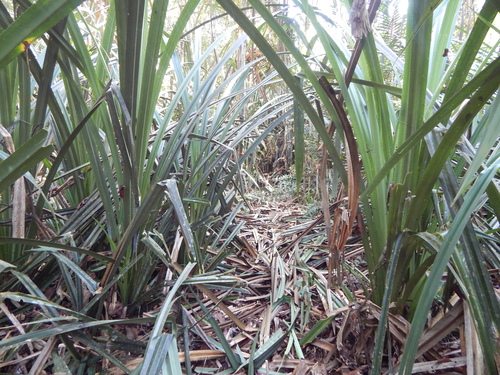
Pandanus aquaticus
F. Muell.
River pandanus, River screwpine, Water Pandan

(c) Genevieve Early, some rights reserved (CC BY), uploaded by Genevieve Early
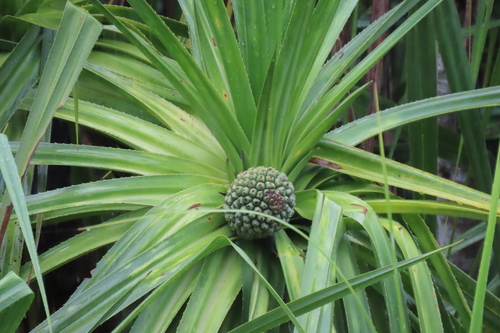
(c) probreviceps, some rights reserved (CC BY-NC)

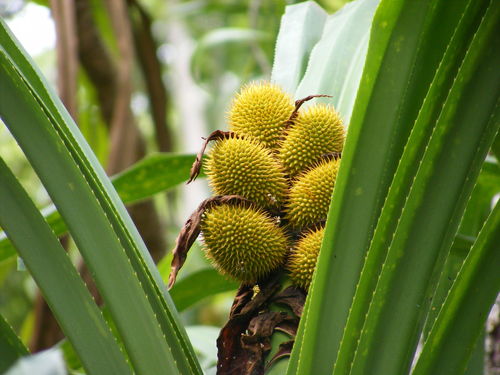
(c) Genevieve Early, some rights reserved (CC BY), uploaded by Genevieve Early
What to Eat
Edible parts: Fruit
Fruit - it needs to be cooked to destroy a deleterious substance. The cylindrical fruit is a syncarp made up of a number of individual drupes. Individual drupes are hard, orange woody wedges 5 - 10cm long - each containing a few, slender seeds. Each wedge has a fleshy base imbued with a sweet-smelling, orange pulp. Seed - raw or cooked. A delicious nutty flavour when eaten raw or cooked, though they are fiddly to extract. Seeds contain 44 - 50% fat and 20 - 34% protein. Inner base of young leaves - raw.
Where to Find It
A tropical plant. It grows in shallow water along the edges of streams. It requires a sunny position and an abundance of water. In the Cairns Botanical Gardens. It suits hardiness zones 11-12.
Australia*,
How to Identify
A tall shrub or small tree. It can grow singly or form a slump. It mat or may not have prop roots. The leaves are long and narrow. They are 100-140 cm long and 5-6 cm wide. The leaves can be strap like or slightly triangular. There are brown-tipped spines long the edge. The male flower arrangement is branched and 20-30 cm long. There is a whitish bract below each flower branch. The male flower spikes are 4.5 cm long. The male flowers are pale yellow. The female flower arrangement is unbranched. They have 100 cm white bracts below them. The fruiting head is 10-15 cm across. They ripen yellow. The drupes separate and are 3-4 cm long by 0.5-0.9 cm wide and are club shaped. They are fleshy when ripe. The seeds are 0.6 cm long.
How to Grow
Plants can be grown from fresh seed.
Propagation: Seed - best pre-soaked for 24 hours prior to sowing.
Other Uses
The tough, fibrous leaves are used for weaving bags, cloaks etc. The leaves, which are usually tough and fibrous, are long, narrow and sword-shaped and can easily be split into strips for weaving. The soft trunks have been lashed together to make rafts.
Wikipedia
Source ↗Pandanus aquaticus (native name andjimdjim) is a species of Pandanus in the family Pandanaceae, endemic to the more humid regions of Northern Territory of Australia. It is confined to the river shallows and areas subject to flooding. It is a small tree growing to about 6 metres (20 ft) height. As with most pandans it has downward-arching prop roots, which in this case can be permanently in water like a mangrove.
Notes
There are about 600 Pandanus species. They grow in the tropics.
Names & Synonyms
Gandjandjal
References (15)
- Brock, J., 1993, Native Plants of Northern Australia, Reed. p 275
- Crawford, I. M., 1982, Traditional Aboriginal Plant Resources in the Kalumburu Area: Aspects in Ethno-economics. Records of the Western Australian Museum Supplement No. 15
- Cronin, L., 1989, The Concise Australian Flora. Reed. p 250
- Cundall, P., (ed.), 2004, Gardening Australia: flora: the gardener's bible. ABC Books. p 978
- Elliot, W.R., & Jones, D.L., 1997, Encyclopedia of Australian Plants suitable for cultivation. Vol 7. Lothian. p 151 (Drawing)
- Etherington, K., & Imwold, D., (Eds), 2001, Botanica's Trees & Shrubs. The illustrated A-Z of over 8500 trees and shrubs. Random House, Australia. p 508
- Hearne, D.A., & Rance, S.J., 1975, Trees for Darwin and Northern Australia. AGPS, Canberra p 91
- Hibbert, M., 2002, The Aussie Plant Finder 2002, Florilegium. p 218
- Kenneally, K.E., Edinger, D. C., and Willing T., 1996, Broome and Beyond, Plants and People of the Dampier Peninsula, Kimberley, Western Australia. Department of Conservation and Land Management. p 214
- Lazarides, M. & Hince, B., 1993, Handbook of Economic Plants of Australia, CSIRO. p 179
- Paczkowska, G. & Chapman, A.R., 2000, The Western Australian Flora. A Descriptive Catalogue. Western Australian Herbarium. p 92
- Townsend, K., 1994, Across the Top. Gardening with Australian Plants in the tropics. Society for Growing Australian Plants, Townsville Branch Inc. p 308
- Wheeler, J.R.(ed.), 1992, Flora of the Kimberley Region. CALM, Western Australian Herbarium, p 1251
- Wightman, Glenn et al. 1992, Mangarrayi Ethnobotany: Aboriginal Plant Use from the Elsey Area Northern Australia. Northern Territory Botanical Bulletin No 15. Parks and Wildlife Commission of the Northern Territory. p 38.
- Wightman, G. & Brown, J., 1994, Jawoyn Plant Identikit, Common Useful Plants in the Katherine Area of Northern Australia. Conservation Commission Northern Territory. p 31