Pandanus basedowii
C.W. Wright
Rock pandanus, Sandstone Screw Pine

(c) dhfischer, some rights reserved (CC BY), uploaded by dhfischer
(c) Thilo Krueger, some rights reserved (CC BY-NC)
(c) Thilo Krueger, some rights reserved (CC BY-NC)
What to Eat
Edible parts: Kernel, Seeds, Nuts
The roasted seeds (kernels) are eaten.
Where to Find It
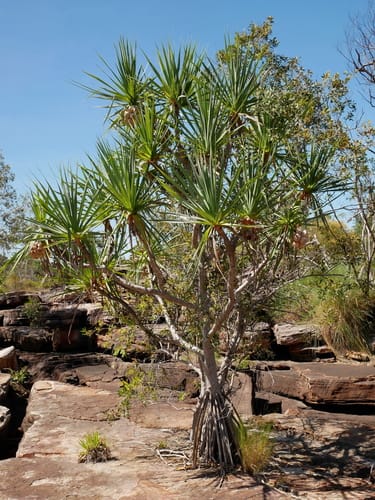
A tropical and subtropical plant. It needs a sunny position. They need well-drained soil. It grows on rocky cliffs in Arnhem land in Australia.
Australia*,
How to Identify
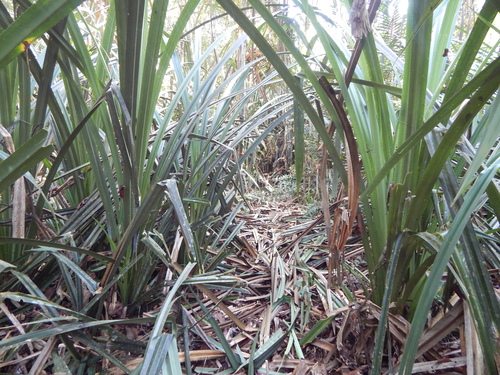
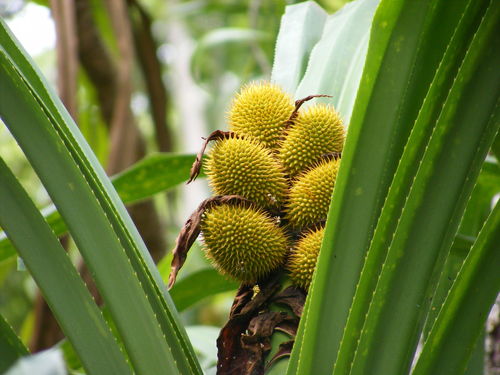
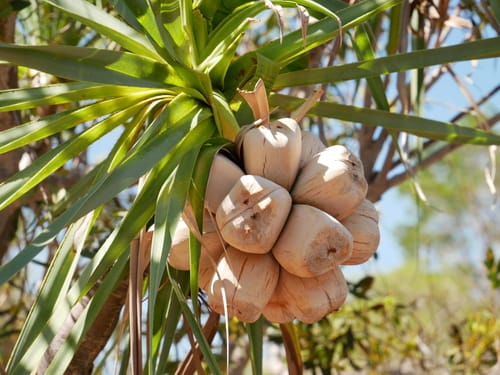
A medium shrub or small tree. It grows 4-7 m tall and spreads 2-4 m wide. It has a rounded crown. The branches are often horizontal. It has prop roots. The leaves are strap-shaped and 30-80 cm long by 1-5 cm wide. They are dull green, stiff, leathery and with spines along the lower edge. The tip is drawn out. The male flower arrangement is branched and 10-20 cm long. The male spike is 2-3 cm long and with whitish bracts below them. The female flower arrangement is unbranched with whitish bracts. The fruiting head is 15-20 cm across. It is more or less round. It is light in weight and cream-brown. There are about 10 fingers in a fruiting head. Each contains 1 or 2 seeds. The seeds are 2.5 cm long.
How to Grow
Plants can be grown from fresh seed.
Notes
There are about 600 Pandanus species. They grow in the tropics.
References (7)
- Brock, J., 1993, Native Plants of Northern Australia, Reed. p 273, 276
- Cherikoff V. & Isaacs, J., The Bush Food Handbook. How to gather, grow, process and cook Australian Wild Foods. Ti Tree Press, Australia p 200
- Elliot, W.R., & Jones, D.L., 1997, Encyclopedia of Australian Plants suitable for cultivation. Vol 7. Lothian. p 151, 152 (Photo & drawing)
- Hibbert, M., 2002, The Aussie Plant Finder 2002, Florilegium. p 218
- Holliday, I., 1989, A Field Guide to Australian Trees. Hamlyn. p 278
- Lazarides, M. & Hince, B., 1993, Handbook of Economic Plants of Australia, CSIRO. p 179
- Low, T., 1991, Wild Food Plants of Australia. Australian Nature FieldGuide, Angus & Robertson. p 42