Pandanus brosimos
Merrill & Perry
Wild karuka
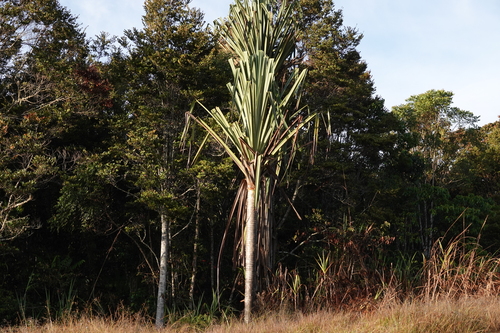
(c) Jonathan M, some rights reserved (CC BY-NC), uploaded by Jonathan M
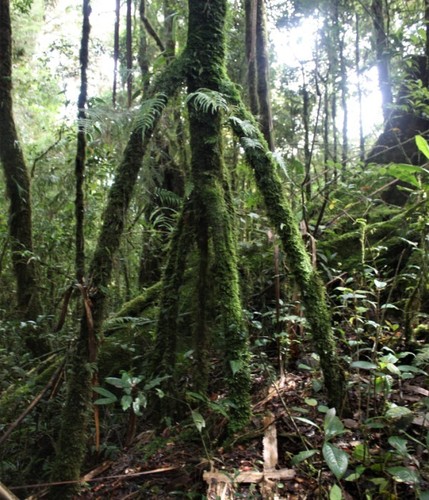
(c) Zig Madycki, some rights reserved (CC BY-NC-ND), uploaded by Zig Madycki

(c) J.R. Kuethe, some rights reserved (CC BY-NC)
What to Eat
Edible parts: Nuts, Seed
The kernel of the nuts is eaten, with nuts sometimes buried in the ground to soften their hard shells before consumption.
Where to Find It
A tropical plant. The usual range is from 2500 to 3100 m altitude. Some are transplanted to lower altitudes.
Asia, Indonesia, Pacific, Papua New Guinea, PNG, SE Asia,
How to Identify
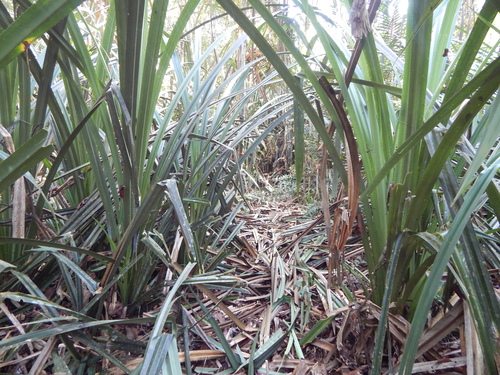
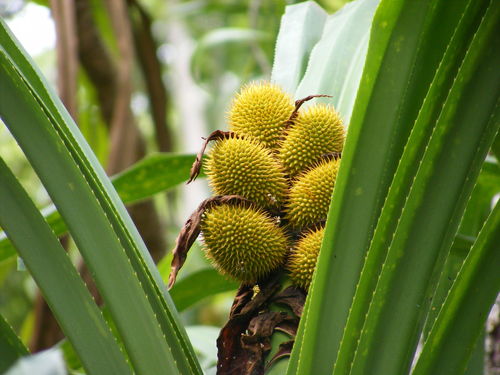
A screwpine with erect leaves which are normally not bent at the tip. The wild karuka plant looks a lot like the cultivated karuka except that the leaves are bigger and normally they point straight up instead of bending over at the top. The trunk of the tree is straight like a palm but it can have some branches near the top. The leaves are long and have thorns along the edge. Dead leaves normally hand down around the top of the tree. The leaves are close together. The leaves at the centre turn red then white at fruiting time. The fruit is a round cluster of nuts. The ends of the individual nuts come to a sharper point than in cultivated karuka. The shell of the nuts is very hard. The large fruit is made up of about 1000 nuts. The fruit hangs on a stalk against the trunk. Different varieties of wild karuka are recognised. These have different shaped nuts. Other small differences are also noticed by village growers. As a wild karuka plant is getting ready to produce a bunch of nuts the leaves at the top of the tree go tightly together and stick straight up. Then the top of the leaves become a red colour (With cultivated karuka the top of the leaves change to a white colour.)
Nutrition Score: 23/100
| Part | Moisture | kJ | kcal | Protein | Vit A | Vit C | Iron | Zinc |
|---|---|---|---|---|---|---|---|---|
| Nuts | 10 | — | — | 8.5 | — | — | — | — |
How to Grow
Trees are normally self sown but some are transplanted. Self sown plants are weeded, protected and owned. The wild karuka is disemminated throughout the high altitudinal forest as single widely spread trees and the dispersal agent is claimed to be marsupials (tree kangaroos etc). Some are transplanted to lower altitudes. The fruiting is seasonal and often a good season occurs every second year. Individual people within the clan are given permission to look after different sections or trees and these people clear the bush near the base of the tree and build traps to stop tree kangaroos.
Propagation: Seed - best pre-soaked for 24 hours prior to sowing.
Other Uses
Although we have seen no specific records for this species, the leaves of most members of this genus are used locally for weaving a range of items such as mats, bags and baskets. The leaves, which are usually tough and fibrous, are long, narrow and sword-shaped and can easily be split into strips for weaving. The leaves of this species can be up to 3.5 metres long and 18cm wide at the base.
Wikipedia
Source ↗Pandanus brosimos, the wild karuka, is a species of tree in the family Pandanaceae, endemic to New Guinea. Along with Pandanus julianettii, it is widely harvested in New Guinea as a traditional food source. Many local ethnic groups make use of pandanus languages (a special avoidance language) when harvesting the nuts. It was first formally described by Elmer Drew Merrill and Lily May Perry in 1940.
Production
The fruiting is seasonal and often a good season occurs every second year.
Other Information
In Papua New Guinea, an important wild harvested nut for people with land at the right altitude. It is cultivated.
Notes
There are about 600 Pandanus species. They grow in the tropics.
Names & Synonyms
Agia
References (15)
- Bourke, M., 1995, Edible Indigenous Nuts in Papua New Guinea. In South Pacific Indigenous Nuts. ACIAR Proceedings No 69, Canberra. p 46
- Bourke, R. M., Altitudinal limits of 230 economic crop species in Papua New Guinea. Terra australis 32.
- Clarke, W.C. & Thaman, R.R., 1993, Agroforestry in the Pacific Islands: Systems for sustainability. United Nations University Press. New York. p 251
- French, B.R., 1986, Food Plants of Papua New Guinea, A Compendium. Asia Pacific Science Foundation p 159
- Massal, E. and Barrau, J., 1973, Food Plants of the South Sea Islands. SPC Technical Paper No 94. Nounea, New Caledonia. p 27
- Hide, R. L., (Ed.) 1984, Research Report of the Simbu Land Use Project. Vol.V1 South Simbu: Studies in Demography, Nutrition, and Subsistence. p 441
- Hyndman, D. C., 1984, Ethnobotany of Wopkaimin Pandanus: Significant Papua New Guinea Plant Resource. Economic Botany 38(3) pp. 287-303
- PROSEA (Plant Resources of South East Asia) handbook, Volume 2, 1991, Edible fruits and nut. p 240
- Purseglove, J.W., 1972, Tropical Crops. Monocotyledons. Longmans p 512
- Sillitoe, P. 1995, An Ethnobotanical Account of the Plant Resources of the Wola Region, Southern Highlands Province, Papua New Guinea. J. Ethnobiol. 15(2): 201-235
- Walter, A. & Sam C., 2002, Fruits of Oceania. ACIAR Monograph No. 85. Canberra. p 218, 281
- Wickens, G.E., 1995, Edible Nuts. FAO Non-wood forest products. FAO, Rome. p172
- World Checklist of Useful Plant Species 2020. Royal Botanic Gardens, Kew
- www.pngplants.org
- Zeven, A. C. & de West, J. M. J., 1982, Dictionary of cultivated plants and their regions of diversity. Wageningen. p 61