Pandanus conicus
H. St John
Mace Screw Pine
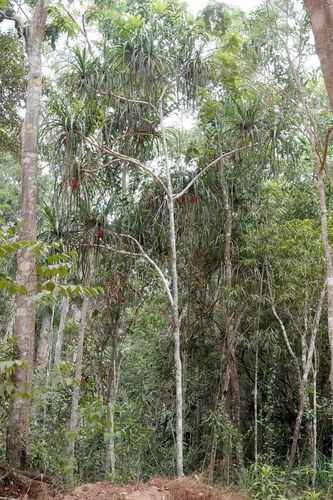
(c) Pete Woodall, some rights reserved (CC BY-NC), uploaded by Pete Woodall
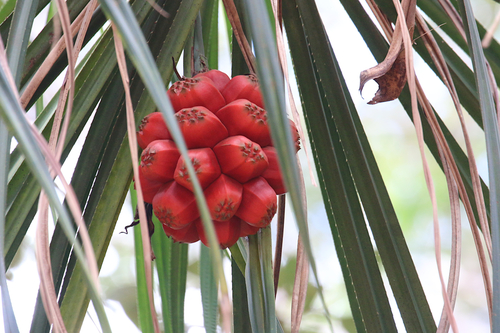
(c) leithallb, some rights reserved (CC BY-NC), uploaded by leithallb
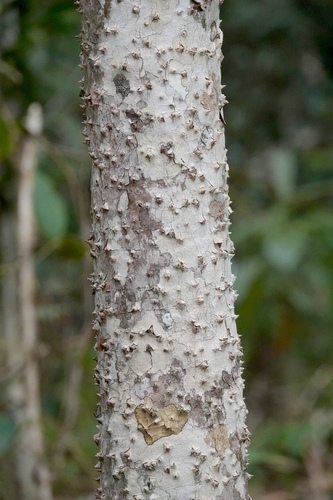
(c) Pete Woodall, some rights reserved (CC BY-NC), uploaded by Pete Woodall
What to Eat
Edible parts: Fruit
The fruit is edible, though it can irritate the throat and mouth.
Known Hazards
Where to Find It
It is a tropical plant. It grows naturally in rainforests in NE Queensland in Australia. It grows near mangroves and up to 400 m altitude. In Townsville Anderson BG.
Australia*,
How to Identify
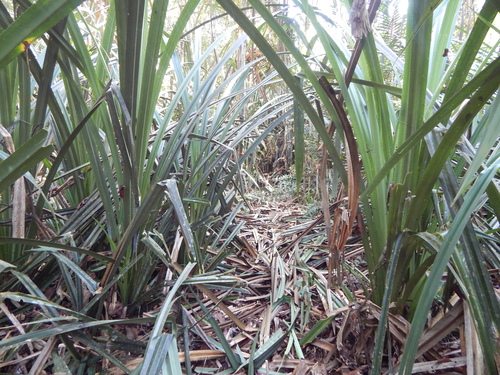
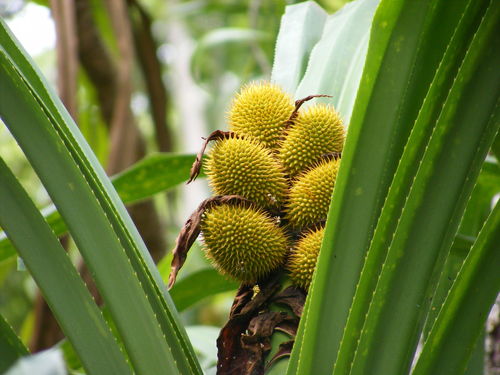
A tree which grows up to 6-10 m high and spreads 3-5 m wide. It has a few branches. The trunk is covered with flat spines. It has prop roots. The leaves are simple and about 3 m long by 4-6 cm wide. The edges of the leaves have teeth. There are also teeth on the midrib towards the end of the leaf. The male flower is branched. It is 30-40 cm long. It hangs over and has white bracts. The male spike is 8-10 cm long. The female flowering stalk is not branched. The fruiting heads are 15-24 cm long by 11-16 cm wide. They occur singly and hang down. It ripens to orange or red. The fruit is edible. The seeds are 1.2-1.4 cm long.
How to Grow
It can be grown from seed and from stolons or runners.
Wikipedia
Source ↗Pandanus conicus, commonly known as screw palm, is a species of plants in the family Pandanaceae found only in Queensland, Australia. It is a slim tree up to 10 m (33 ft) tall with spreading branches, and the trunk bears numerous small spiny "warts". The leaves may be up to 2 m (6 ft 7 in) long and 3.5 cm (1.4 in) wide, with sharp spines on the margins. They are arranged in densely clustered whorls at the ends of the branches. The plant inhabits rainforest and vine thickets on the east coast of the northern half of Cape York Peninsula, south to about Coen. This species is dioecious, meaning that pistillate (functionally female) and staminate (functionally male) flowers are borne on separate plants. It was first described in 1960 by American botanist Harold St. John.
Notes
There are about 600 Pandanus species. They grow in the tropics.
Names & Synonyms
References (5)
- Cooper W & Cooper W T, 1994, Fruits of the Rain Forest. RD Press p 212
- Cooper, W. and Cooper, W., 2004, Fruits of the Australian Tropical Rainforest. Nokomis Editions, Victoria, Australia. p 384
- Elliot, W.R., & Jones, D.L., 1997, Encyclopedia of Australian Plants suitable for cultivation. Vol 7. Lothian. p 152, 154 (Photo)
- Jones D, L, 1986, Ornamental Rainforest Plants in Australia, Reed Books, p 278
- Pacific Sci. 14:234, 1960