Pandanus conoideus
Lamarck
Marita, red fruit pandan

(c) Jialiang Gao, some rights reserved (CC BY-SA)
(c) albert1961, some rights reserved (CC BY-NC)
(c) ob1963, some rights reserved (CC BY-NC)
What to Eat
Edible parts: Fruit, Spice
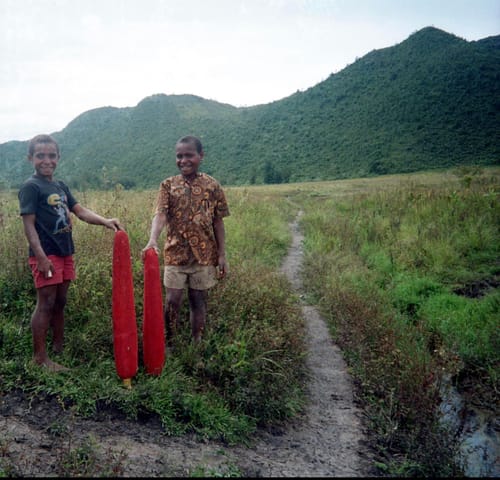
The red fruit is high in oil. To prepare, a ripe marita fruit is split into 3 sections along its length, the central yellow stalk and pith are removed, and the outer hard red layer is cooked — preferably using hot stones, though boiling in a saucepan is also practised. After cooking for about half an hour, the hard pits are squeezed out and water is added to make an oily red soup. This soup is eaten on its own, dipped with green leaves or sago, or consumed with a spoon made from a marita leaf. Some people suck the cooked juice directly from the seeds. The oily juice is also used as a cooking medium. The pits and seeds are discarded, typically fed to pigs. A harvested fruit keeps for about one week; once cooked, it should be consumed within approximately 12 hours.
Where to Find It
A tropical plant. It grows throughout PNG from sea level up to 1650 m altitude. It becomes common above 500 m. It can be up to 2,500 m above sea level. It occurs in Papua Province in Indonesia and in Maluku. In Townsville Botanical Gardens.
Asia, Australia, Indonesia, Pacific, Papua New Guinea*, PNG, SE Asia, Solomon Islands, Vanuatu, West Papua,
How to Identify
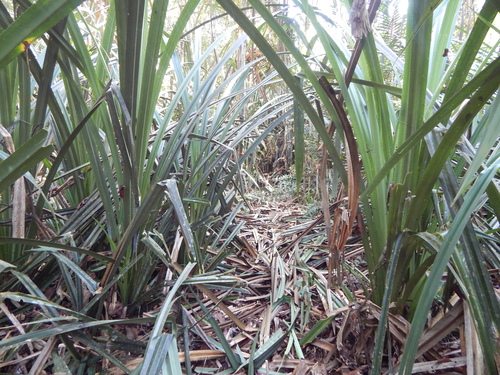
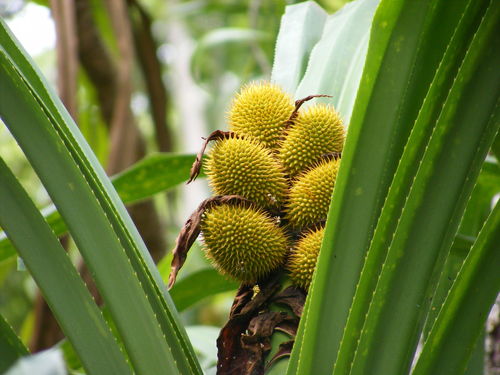
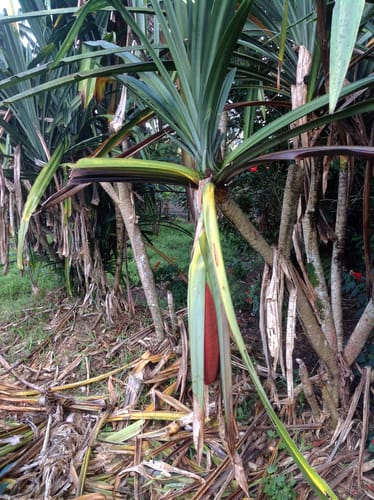
A short much branched screwpine with many prop roots. The prop roots have prickles. Trees may have up to 8 or 10 main branches. Trees grow up to about 5 metres tall. There are many short sharp spikes on the trunk and branches. The leaves are between 1 and 2 metres long and about 10 cm wide. The leaves grow opposite each other but are twisted to look like a spiral. There are thorns along the edges of the leaf. It produces a large (1 m long) dark red to yellow fruit with a hard rough/spiky surface. The fruit is hard and has small lumps or spikes over the surface. The fruit grows at the ends of the branches between the leaves and it has 3 straight leaf like bracts along the edges.There are many cultivated varieties.
How to Grow
Marita pandanus are normally planted from suckers or cuttings. The cuttings are using ends of branches. Suckers produce more quickly. A new shoot normally sprouts out of the branch just below where the end was cut off. The cutting will soon develop roots and become established when it is planted. A more popular method is to use a sucker or shoot growing from the plant down near the ground. The sucker is separated from the parent plant then replanted in its new place. These suckers grow more quickly and can bear fruit after 18 months to 2 years. A cutting off a branch may take up to 4 or 5 years before it produces a fruit. Marita is often planted along the roads and walking tracks. It is also planted in most gardens and serves as a reminder that the land is owned by the person who planted the marita. So plants are dispersed instead of being grown in a plantation. A marita fruit is harvested when the colour starts to change to a brighter red or yellow. Sometimes it also starts to crack slightly at this stage. The fruit is cut from the branch. The ripe fruit is cooked then the juice mixed with water to make a sauce. To do this, a ripe marita fruit is normally split into 3 sections along its length. Then the central yellow stalk and pith area are dug out. The outside hard red layer is then cooked. Preferably it is cooked using hot stones although sometimes it is boiled in a saucepan. After cooking for about half an hour the hard pits are squeezed from the soft red juice by squeezing through the hands. Water is added to make an oily red soup. The soup is then eaten. Sometimes it is eaten by dipping green leaves or sago into the soup. At other times it is eaten with a spoon made from the marita leaf. Some people just suck the cooked juice from the seeds. As well, some people use the oily juice to cook food in. The pits or seeds are thrown away, normally to pigs. A harvested marita fruit will only keep for about one week. After cooking it will only last for about 12 hours.
Propagation: Propagation is normally done from suckers or cuttings taken from branch ends. Suckers establish more quickly than cuttings. After a branch cutting is taken, a new shoot typically sprouts just below the cut, which soon develops roots when planted. Suckers are separated from the parent plant and replanted; these can bear fruit in as little as 18 months to 2 years. Branch cuttings may take up to 4–5 years before producing fruit.
Medicinal Uses
Traditionally used as a supplement for skin and eye health, and as a worm treatment. The variant merah panjang (long red) is specifically used for these purposes.
Other Uses
Leaves, stem bark, and roots are used to make rope, seat covers, and sleeping mats. The plant is also used in the handicraft industry for rope and yarn production. Leaves are woven into mats, and young leaves serve as a substitute cigarette wrap.
Wikipedia
Source ↗Pandanus conoideus is a plant in the Pandanus family from New Guinea. Its fruit is eaten in Papua New Guinea and Papua, Indonesia. The fruit has several names: marata, marita in Papua New Guinea local language, kuansu in Dani of Wamena or buah merah ("red fruit") in common Indonesian. The fruit is typically prepared by splitting it, wrapping it in leaves, and cooking it in an earth oven, making it a traditional delicacy. Fruits of the pandanus family have specific characteristics that distinguish them from other fruits, including their very concentrated red color, indicating that the fruits are rich in beta carotene.
Production
Marita is a seasonal crop but the fruiting season is not a short clearly marked one. The main season goes from about October to March but individual trees can bear almost throughout the year. Near the sea the marita season is longer and more spread out but as the places increase in altitude above sea level the season becomes more distinct. The marita season is an important occasion. During the season people often use marita twice a day.
Other Information
In Papua New Guinea, a popular and common seasonal food in mid altitudinal zones.
Notes
There are about 600 Pandanus species. They grow in the tropics.
Names & Synonyms
Abare, Abo, Aga, Alakape, Anga, Awom mangkaki, Awone mangkaki, Awone waransir, Besbes, Bunam, Bunumia, Deg, Hase, Katai, Ka yo, Kleba, Koba, Kobokana, Oga, Oka, Pandan buah merah, Pandan seran, Pangu, Saik, Saj, Saun, Siho, Sihu, Sina, Si-tararak, Supa, Vurume, Wabel
References (26)
- Marita references Pandanus conoideus
- Altschul, S.V.R., 1973, Drugs and Foods from Little-known Plants. Notes in Harvard University Herbaria. Harvard Univ. Press. Massachusetts. no. 1
- Blench, R., 2004, Fruits and Arboriculture in the Indo-Pacific Region. Indo-Pacific Prehistory Association Bulletin 24. (Taipei Papers Volume 2) p 39
- Borrell, O.W., 1989, An Annotated Checklist of the Flora of Kairiru Island, New Guinea. Marcellin College, Victoria Australia. p 39, 100 +2,
- Burkill, I.H., 1966, A Dictionary of the Economic Products of the Malay Peninsula. Ministry of Agriculture and Cooperatives, Kuala Lumpur, Malaysia. Vol 2 (I-Z) p 1673
- French, B.R., 1986, Food Plants of Papua New Guinea, A Compendium. Asia Pacific Science Foundation p 210, p 162 (As Pandanus englerianus)
- Gillaumin, R., 1954, Les Plantes utiles des Nouvelles-Hebrides (fin et complement) In: Journal d'agriculture tropicale et de botanique appliquee Vol. 1, No. 10-12 pp 453-460 (As Pandanus cominsii)
- Hide, R., et al, 1979, A checklist of some plants in the territory of the Sinasina Nimai (Simbai Province, Papua New Guinea), with notes on their uses. Department Anthropology, University of Aukland
- Keim, A.P., 2009, Pandanaceae ofthe island of Yapen, Papua (West New Guinea). Blumea 54, 2009: 255-266
- Hyndman, D. C., 1984, Ethnobotany of Wopkaimin Pandanus: Significant Papua New Guinea Plant Resource. Economic Botany 38(3) pp. 287-303
- Leach, G. J., 1988, Bush Food Plants of the Blackwater and Karawari Rivers Area, East Sepik Province, Papua New Guinea. Science in New Guinea 14(2). p 103
- Lebot, V. & Sam, C., Green desert or ‘all you can eat’? How diverse and edible was the flora of Vanuatu before human introductions?. Terra australis 52 p 411 (As Pandanus cominsii)
- Lepofsky, D., 1992, Arboriculture in the Mussau Islands, Bismarck Archipelago. Economic Botany, Vol 46, No. 2, pp. 192-211, (Also as Pandanus englerianus)
- Milliken, W., 2000, Ethnobotany of the Yali of West Papua. Royal Botanic Garden, Edinburgh (near Baliem)
- Peekel, P.G., 1984, (Translation E.E.Henty), Flora of the Bismarck Archipelago for Naturalists, Division of Botany, Lae, PNG. p 42, 43 (As Pandanus englerianus)
- PROSEA handbook Volume 13 Spices. p 278
- PROSEA (Plant Resources of South East Asia) handbook, Volume 2, 1991, Edible fruits and nut. p 240, p 242 (As Pandanus cominsii). Also (As Pandanus englerianus). (Also as Pandanus hollrungii), (As Pandanus magnificus)
- Sillitoe, P. 1995, An Ethnobotanical Account of the Plant Resources of the Wola Region, Southern Highlands Province, Papua New Guinea. J. Ethnobiol. 15(2): 201-235
- Stone, B., 1974, Bot. Jahr.
- Sukarya, D. G., (Ed.) 2013, 3,500 Plant Species of the Botanic Gardens of Indonesia. LIPI p 742
- Tarepe, and Bourke, M., 1992,
- Walter, A. & Sam C., 2002, Fruits of Oceania. ACIAR Monograph No. 85. Canberra. p 210, 281 (Also as Pandanus magnificus)
- Wickens, G.E., 1995, Edible Nuts. FAO Non-wood forest products. FAO, Rome. p172
- Wiriadinata, H., 1995, Ethnobotany of Economic Plants in the Baliem Valley, Jayawijaya, Irian Jaya, Indonesian Institute of Science, Bogor, Indonesia
- World Checklist of Useful Plant Species 2020. Royal Botanic Gardens, Kew
- www.pngplants.org (As Pandanus cominsii); (Also as Pandanus englerianus), (As Pandanus hollrungii),