Pandanus dubius
Sprengler
Bakong, Knob-fruited screwpine
(c) Shelomi Doyle, some rights reserved (CC BY), uploaded by Shelomi Doyle
(c) aaronboswell, some rights reserved (CC BY-NC), uploaded by aaronboswell
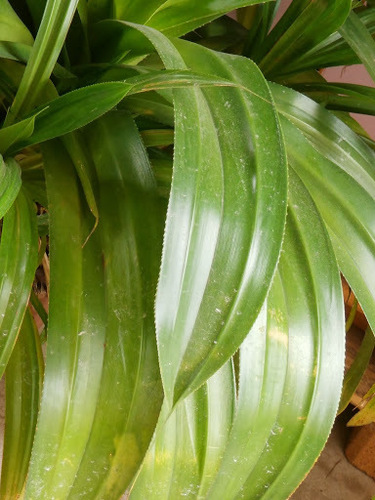
(c) 106611639464075912591, some rights reserved (CC BY-NC-SA), uploaded by 106611639464075912591
What to Eat
Edible parts: Nuts, Seeds
Like other species of pandanus, the leaves of bakong are commonly harvested for weaving mats and other handicrafts in the Philippines, Halmahera, the Bismarck Archipelago, and the Solomon Islands. Fibers from the roots can also be made into ropes or twine. The white seeds are edible and taste like coconuts. The flesh of the fruits can also be cooked and eaten. They are eaten in Guam, the Philippines, and Rota Island. Bakong are also commonly cultivated as ornamentals.
Where to Find It
A tropical plant. They are widely distributed in wooded areas along the seashore of Mindanao in the Philippines. It is a coastal plant. It grows on coral atolls. In the Cairns Botanical Gardens. In Townsville Anderson BG.
Andamans, Asia, Australia, Fiji, Guam, Hawaii, India, Indonesia, Kiribati, Malaysia, Mariana Islands, Micronesia, Niue, Pacific*, Palau, Papua New Guinea, PNG, Philippines, Pohnpei, Rotuma, SE Asia, Solomon Islands, Tonga, Tuvalu, USA, Vanuatu,
How to Identify
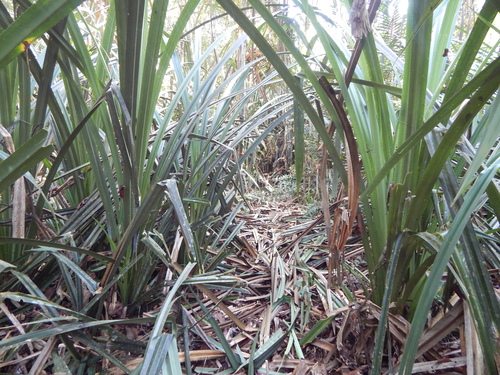
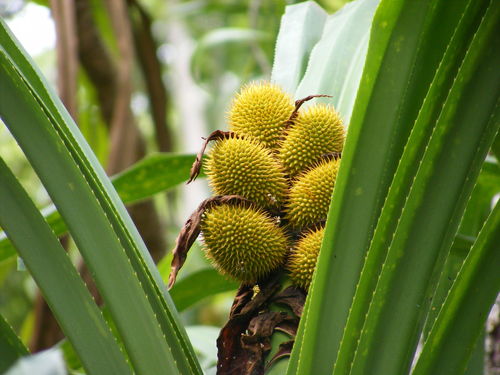
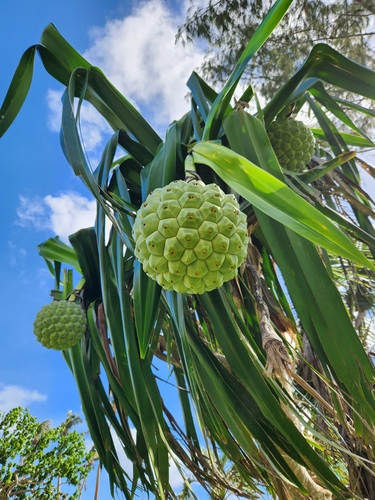
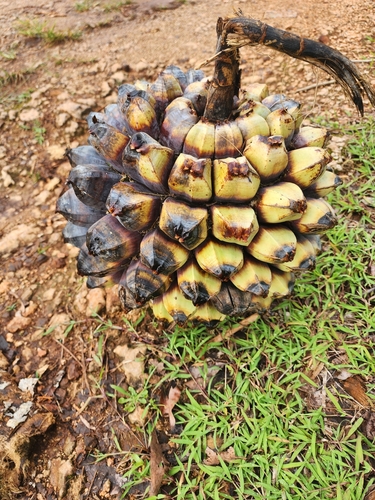
A large erect and branched screwpine with long stilt or prop roots. The trunk has sharp prickles. The roots are covered with vertical rows of pores. The leaves are numerous and spirally arranged and crowded towards the ends of branches. The leaves are broad (20 cm) and about 2 m long with sharp thorns. The edges and midrib are covered with spines. It has a long fruit stalk. It can be 60-80 cm long. It has a large roughly round heavy fruit about 30 cm across. The seeds are large and white. They are edible. They are 1-1.5 cm long. The fruit has about 50 fibrous segments.
How to Grow
It can be grown from seeds. It is usually grown from large cuttings of the ends of branches. The fruit are ready to eat when the fruit looses its white mat like appearance and becomes green.
Propagation: Seed - best pre-soaked for 24 hours prior to sowing.
Medicinal Uses
The young shoots are used in the treatment of food poisoning.
Other Uses
The waxy leaves are dried and woven into water-resistant mats. The leaves are used for coarse mats and wicker-work, and also for roofing and for making umbrellas. Fibres from the brace-roots are made into cordage, which is used for the seats of chairs, beds etc. The leaves are used as a wrapping material when preparing (i.e. cooking) sago - the starch is enwrapped with the leaves and is then baked. The entire fruit cluster is often used for fiesta decoration.
Wikipedia
Source ↗Pandanus dubius, commonly known as bakong or knob-fruited screwpine, is a species of Pandanus (screwpine) native to Island Southeast Asia, New Guinea, and the Western Pacific islands (Melanesia and Micronesia), and possibly also to the Andaman and Nicobar Islands.
Notes
There are about 600 Pandanus species. They grow in the tropics.
Names & Synonyms
Aum, Bidur, Boku, Bou, Fa'u da'i, Fao, Faudai, Faum, Fom, Haun lainulun, Hosoa, Kaufa tolo, Kaufadai, Keora, Kipar-n-ai, Kipar en wai, Lau, Lou lou, Meu-yok, Mweng kaki, Navaka, Na vaku, Nonivo, Nyiu nailo, Pafung, Pahong, Pakoa, Pandan pantai, Pandan wong, Pohk, Poko, Poroporo, Taboan, Te kaina, Tekaureiko, Tobi, Tone, Toto, Cadra, Vahara, Vaum
References (32)
- Ambasta, S.P. (Ed.), 2000, The Useful Plants of India. CSIR India. p 423 (As Pandanus andamanensium)
- Arora, K., Indigenous Forest Management in the Andaman and Nicobar Islands, India. (As Pandanus andamanensium)
- Awasthi, A.K., 1991, Ethnobotanical studies of the Negrito Islanders of Andaman Islands, India - The Great Andamanese. Economic Botany 45(2) pp274-280 (As Pandanus andamanensium)
- Blench, R., 2004, Fruits and Arboriculture in the Indo-Pacific Region. Indo-Pacific Prehistory Association Bulletin 24. (Taipei Papers Volume 2) p 39
- Borrell, O.W., 1989, An Annotated Checklist of the Flora of Kairiru Island, New Guinea. Marcellin College, Victoria Australia. p 39, 100+4
- Burkill, I.H., 1966, A Dictionary of the Economic Products of the Malay Peninsula. Ministry of Agriculture and Cooperatives, Kuala Lumpur, Malaysia. Vol 2 (I-Z) p 1673 (As Pandanus andamanensium)
- Clarke, W.C. & Thaman, R.R., 1993, Agroforestry in the Pacific Islands: Systems for sustainability. United Nations University Press. New York. p 253
- Dobriyal, M. J. R. & Dobriyal, R., 2014, Non Wood Forest Produce an Option for Ethnic Food and Nutritional Security in India. Int. J. of Usuf. Mngt. 15(1):17-37 (As Pandanus andamanensium)
- Elevitch, C.R.(ed.), 2006, Traditional Trees of the Pacific Islands: Their Culture, Environment and Use. Permanent Agriculture Resources, Holualoa, Hawaii. p 567
- French, B.R., 2010, Food Plants of Solomon Islands. A Compendium. Food Plants International Inc. p 180
- French, B.R., 2010, Food Plants of Solomon Islands. A Compendium. Food Plants International Inc. p 179 (As Pandanus compressus)
- Henderson, C.P. and I.R.Hancock, 1988, A Guide to the Useful Plants of the Solomon Islands. Res. Dept. Min of Ag. & Lands. Honiara, Solomon Islands. p 80 (As Pandanus compressus)
- Henderson, C.P. and Hancock, I.R., 1988, A Guide to the Useful Plants of Solomon Islands. Res. Dept. Ministry of Agriculture and Lands, Honiara, Solomon Islands, p 80
- Keim, A.P., 2009, Pandanaceae ofthe island of Yapen, Papua (West New Guinea). Blumea 54, 2009: 255-266
- Lebot, V. & Sam, C., Green desert or ‘all you can eat’? How diverse and edible was the flora of Vanuatu before human introductions?. Terra australis 52 p 409 (As Pandanus compressus)
- Lepofsky, D., 1992, Arboriculture in the Mussau Islands, Bismarck Archipelago. Economic Botany, Vol 46, No. 2, pp. 192-211
- Monsalud, M.R., Tongacan, A.L., Lopez, F.R., & Lagrimas, M.Q., 1966, Edible Wild Plants in Philippine Forests. Philippine Journal of Science. p 529
- Peekel, P.G., 1984, (Translation E.E.Henty), Flora of the Bismarck Archipelago for Naturalists, Division of Botany, Lae, PNG. p 41, 40
- PROSEA (Plant Resources of South East Asia) handbook, Volume 2, 1991, Edible fruits and nut. p 241
- Purseglove, J.W., 1972, Tropical Crops. Monocotyledons. Longmans p 512 (As Pandanus andamanensium)
- Singh, H.B., Arora R.K.,1978, Wild edible Plants of India. Indian Council of Agricultural Research, New Delhi. p 77 (As Pandanus andamanensium)
- Staples, G.W. and Herbst, D.R., 2005, A tropical Garden Flora. Bishop Museum Press, Honolulu, Hawaii. p 740
- Sukarya, D. G., (Ed.) 2013, 3,500 Plant Species of the Botanic Gardens of Indonesia. LIPI p 742
- Syst. veg. 3:897. 1826
- Stone, B. C., 1970, The Flora of Guam. A Manual for the Identification of the Vascular Plants of the Island. Micronesica. Journal of the University of Guam. p 146
- USDA, ARS, National Genetic Resources Program. Germplasm Resources Information Network - GRIN). [Online Database] National Germplasm Resources Laboratory, Beltsville, Maryland. Available: www.ars-grin.gov/cgi-bin/npgs/html/econ.pl (10 April 2000)
- Walter, A & Sam, C., 1995, Indigenous Nut Trees in Vanuatu: Ethnobotany and Variability. In South Pacific Indigenous Nuts. ACIAR Proceedings No 69. Canberra. p 57
- Walter, A. & Sam C., 2002, Fruits of Oceania. ACIAR Monograph No. 85. Canberra. p 212, 281
- Wiersema, J. H. & Leon, B., 2013, World Economic Plants. A Standard Reference CRC Press. 2nd Ed. p 491
- World Checklist of Useful Plant Species 2020. Royal Botanic Gardens, Kew
- www.pngplants.org
- www.manoa.hawaii.edu/botany/plants of micronesia