Pandanus leram
Voigt
Nicobar breadfruit

(c) Dinesh Valke, some rights reserved (CC BY-SA)
What to Eat
Edible parts: Nuts, Fruit
The fruit is typically boiled and eaten cooked. The lower portion of the fruit can be processed into flour for making bread.
Where to Find It
A tropical plant. It suits the lowlands. It grows in coastal areas.
Andamans, Asia, India, Indonesia, Maldives, Nicobar Islands, SE Asia, Sri Lanka,
How to Identify
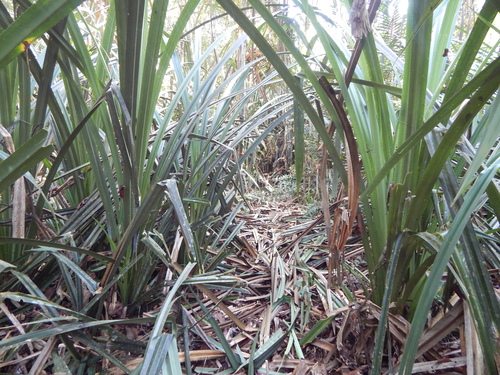
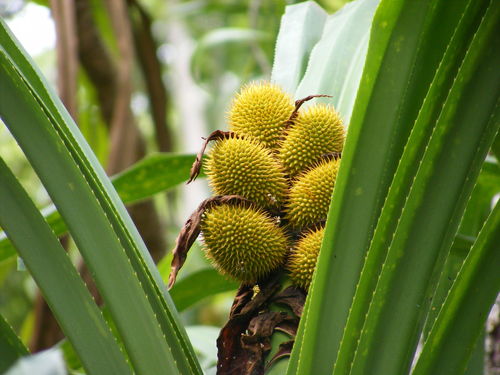
A large branched tree. It has aerial prop roots. The leaves are very large. They can be 10-15 cm wide. There are prickles along the edges and midrib. The bracts around the flower are cream. Trees are separately male and female. The male tree has a very large flower. The female flower develops a large round head made up of individual nuts. These are clustered in groups. These can be 12-15 cm long. The outside is yellow or orange.
How to Grow
They are grown from stem cuttings.
Propagation: Seed - best pre-soaked for 24 hours prior to sowing. This species propagates readily from seed. Cuttings taken from side branches.
Medicinal Uses
The tender young leaves are pounded with coconut oil and rubbed on the body to remove fatigue
Other Uses
The leaves are used for thatching, making mats etc. The fibrous portions of the drupes are combed out into a kind of brush which is used for removing dust from the feet. The dried fruit with fibres are used as tooth brushes. The dissected split leaves are made into brooms
Wikipedia
Source ↗Pandanus leram is a pandan or screw pine, belonging to the family Pandanaceae. It is native to the Andaman Islands and Nicobar Islands south of Myanmar, and the southern coasts of Sumatra and western Java, in Indonesia. The tree grows up to 21 m (69 ft) in height (exceeded only by Pandanus julienettei and Pandanus antaresensis, both of New Guinea). The linear leaves are up to 5.5 m (18 ft) long and 12.5 cm (4.9 in) in width (exceeded only by Pandanus laxespicatus). The fruit, termed a "syncardium", (a type of multiple fruit) weighs 14–18 kg (31–40 lb) and be up to thirty inches (76 centimeters) in length.
Notes
There are about 600 Pandanus species. They grow in the tropics.
Names & Synonyms
Pandan wong, Larohm, Melori
References (14)
- Ambasta, S.P. (Ed.), 2000, The Useful Plants of India. CSIR India. p 423
- Arora, R. K., 2014, Diversity in Underutilized Plant Species - An Asia-Pacific Perspective. Bioversity International. p 106
- Asiat. Res. 3:163. 1792
- Burkill, I.H., 1966, A Dictionary of the Economic Products of the Malay Peninsula. Ministry of Agriculture and Cooperatives, Kuala Lumpur, Malaysia. Vol 2 (I-Z) p 1673
- Dobriyal, M. J. R. & Dobriyal, R., 2014, Non Wood Forest Produce an Option for Ethnic Food and Nutritional Security in India. Int. J. of Usuf. Mngt. 15(1):17-37
- Hedrick, U.P., 1919, (Ed.), Sturtevant's edible plants of the world. p 460
- Martin, F. W., et al, 1987, Perennial Edible Fruits of the Tropics. USDA Handbook 642 p 49
- Menninger, E.A., 1977, Edible Nuts of the World. Horticultural Books. Florida p 145
- PROSEA (Plant Resources of South East Asia) handbook, Volume 2, 1991, Edible fruits and nut. p 240
- PROSEA handbook Volume 9 Plants yielding non-seed carbohydrates. p 189
- Purseglove, J.W., 1972, Tropical Crops. Monocotyledons. Longmans p 512
- Singh, H.B., Arora R.K.,1978, Wild edible Plants of India. Indian Council of Agricultural Research, New Delhi. p 68
- Walter, A. & Sam C., 2002, Fruits of Oceania. ACIAR Monograph No. 85. Canberra. p 218
- World Checklist of Useful Plant Species 2020. Royal Botanic Gardens, Kew