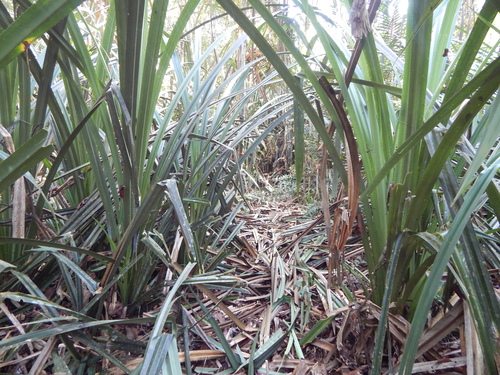
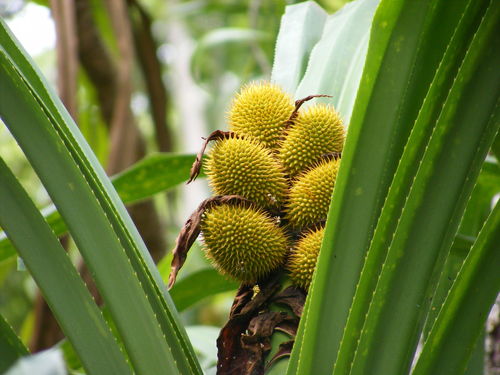
Pandanus odorifer
(Forssk.) Kuntze
Fragrant screwpine

(c) Eiger Leng, some rights reserved (CC BY-NC), uploaded by Eiger Leng
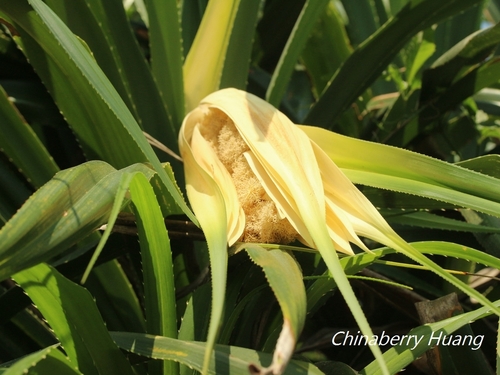
(c) Lijin Huang (紫楝), some rights reserved (CC BY-NC), uploaded by Lijin Huang (紫楝)

(c) Cheng-Tao Lin, some rights reserved (CC BY-NC), uploaded by Cheng-Tao Lin
What to Eat
Edible parts: Leaves, Spice, Fruit, Shoot, Seeds, Flower buds
The fleshy base of the fruit is eaten raw or by sucking, and the kernels are eaten raw or lightly cooked. The growing shoots are eaten after thorough washing in salt water. Young tender leaves near the flower are eaten raw or cooked and used to flavour drinks and desserts. Drinks are made using the male flower.
Known Hazards
Where to Find It
A tropical plant. Plants occur in coastal areas especially just behind the shoreline. They grow along the coasts in India. It grows at Mumbai. It grows in damp soil. It suits hardiness zones 11-12. (This plant is similar to and often confused with Pandanus tectorius which grows in the Pacific and has been taken elsewhere.)
Andamans, Asia, Australia, Bangladesh, Hawaii, India, Indochina, Indonesia, Malaysia, Maldives, Mauritius, Micronesia, Middle East, Myanmar, Northeastern India, Pacific, Papua New Guinea, PNG, Philippines, Polynesia, Saudi Arabia, SE Asia, Seychelles, Sri Lanka, Taiwan, Thailand, USA, Vietnam,
How to Identify
A screwpine or erect branched shrub 3 to 5 m high. The trunk has several prop roots. The leaves are spirally crowded towards the ends of branches and covered with waxy powder. They are up to 1.5 m long and 3 to 5 cm wide. The edge of the leaf and the midrib have sharp spiny teeth pointing towards the end of the leaf. Trees are of one sex. The male flowers are in loose spike of flowers with a fleshy axis and enclosed by a spathe. These have several 5-10 cm long spikes along them. The female flowers are solitary and 5 cm across. The fruit are alone and hang down. They are rounded and 20 cm long. They are composed of 50 to 75 fibrous fleshy fruit with a stone in the centre. They are somewhat angular with fruit in groups of 6-7 forming a large cluster. There are several forms or kinds which vary in details.
How to Grow
Plants are normally self sown. They can be grown from seed or suckers.
Propagation: Seed - best pre-soaked for 24 hours prior to sowing. Cuttings of lateral shoots. Suckers.
Medicinal Uses
The plant possibly has anti-cancer properties and is rich in alpha-tocopherol (Vitamin E), containing 24.65 mg per 100 g dry weight.
Other Uses
An essential oil with a hyacinth-ylang ylang aroma is obtained from the male flower bracts. It is used in perfumery and skin preparations. It is used as an addition to sandalwood oil (from Santalum spp.). A popular perfume, known as 'kewda attar' is obtained from the flowers. Various parts of the plant are used as ingredients in commercial cosmetic preparations as antioxidants, hair and skin conditioners, and stabilizers. The leaves, which are composed of tough longitudinal, white, glossy fibres, are employed for covering huts, making matting, cordage etc. The leaf fibres are extracted and used for making cordage and coarse yarn. The roots also are fibrous and are used by basket makers for binding. When cut into lengths and beaten out they are very commonly used as brushes for painting and whitewalling. It is possible that this root fibre might be found suitable for brush making as a substitute for bristles. Both roots and leaves may be used as paper stock. The light-brown wood is moderately hard on the outside, but very soft inside. Extensively grown as a hedge plant in the coastal districts of southern India. The plant is grown as a soil stabilizer to bind fragile soils.
Wikipedia
Source ↗Pandanus odorifer is an aromatic monocot species of plant in the family Pandanaceae, native to Polynesia, Australia, South Asia (Andaman Islands), and the Philippines, and is also found wild in southern India and Burma. It is commonly known as fragrant screw-pine.
Production
Trees flower 3-4 years after planting. The strongly scented flavouring essence is distilled from male flowers.
Other Information
Moderately common in coastal areas in Papua New Guinea, but nut only eaten in some places. In the Maldives it is significant.
Notes
There are about 600 Pandanus species. They grow in the tropics. It possibly has anti-cancer properties. It has 24.65 mg per 100 g dry weight and 13.15 mg fresh weight of alpha-tocopherol (Vitamin E).
Names & Synonyms
Ara, Fa, Gagandhul, Gajangi, Hala, Kaida, Kaina, Karikio, Kedki-keya, Kenr, Keora, Keori, Ketaki, Keteki phul, Ketki, Keura, Kevada, Kevda, Kewda, Kewoda, Kewra, Keya kathal, Keya, Kyad-agegida, Maakashikeyo, Mudu kekiya, Mugali, Ram-la-khuih, Satthapu, Talai, Tale mara, Tazkai, Thala, Thalay, Tilai
References (34)
- Ambasta, S.P. (Ed.), 2000, The Useful Plants of India. CSIR India. p 423 (As Pandanus odoratissimus)
- Arora, R. K., 2014, Diversity in Underutilized Plant Species - An Asia-Pacific Perspective. Bioversity International. p 106 (As Pandanus fascicularis)
- Bole, P.V., & Yaghani, Y., 1985, Field Guide to the Common Trees of India. OUP p 99 (As Pandanus odoratissimus)
- Bourke, M., 1995, Edible Indigenous Nuts in Papua New Guinea. In South Pacific Indigenous Nuts. ACIAR Proceedings No 69, Canberra. p 46 (As Pandanus odoratissimus)
- Bremness, L., 1994, Herbs. Collins Eyewitness Handbooks. Harper Collins. p 70 (As Pandanus odoratissimus)
- Ching, L. S. & Mohamed, S., 2001, Alpha-Tocopherol Content in 62 Edible Tropical Plants. J. Agric. Food Chem. 2001, 49, 3101−3105 (As Pandanus odorus ?)
- CURREY, (As Pandanus odoratissimus)
- Dobriyal, M. J. R. & Dobriyal, R., 2014, Non Wood Forest Produce an Option for Ethnic Food and Nutritional Security in India. Int. J. of Usuf. Mngt. 15(1):17-37 (As Pandanus odoratissimus)
- Elevitch, C.R.(ed.), 2006, Traditional Trees of the Pacific Islands: Their Culture, Environment and Use. Permanent Agriculture Resources, Holualoa, Hawaii. p 566 (As Pandanus odoratissimus)
- Etherington, K., & Imwold, D., (Eds), 2001, Botanica's Trees & Shrubs. The illustrated A-Z of over 8500 trees and shrubs. Random House, Australia. p 510 (As Pandanus odoratissimus)
- Facciola, S., 1998, Cornucopia 2: a Source Book of Edible Plants. Kampong Publications, p 165 (As Pandanus fascicularis)
- GAMMIE, (As Pandanus fascicularis)
- Hedrick, U.P., 1919, (Ed.), Sturtevant's edible plants of the world. p 460 (As Pandanus odoratissimus)
- IRVINE, (As Pandanus odoratissimus)
- Kar, A., et al, 2013, Wild Edible Plant Resources used by the Mizos of Mizoram, India. Kathmandu University Journal of Science, Engineering and Technology. Vol. 9, No. 1, July, 2013, 106-126 (As Pandanus fascicularis)
- Lamoureux, C.H., 1976, Trailside Plants of Hawaii's National Parks. Hawaii Natural History Association. p 15 (As Pandanus odoratissimus)
- Lugod, G.C. and de Padua L.S., 1979, Wild Food Plants in the Philippines. Vol. 1. Univ. of Philippines Los Banos. p 62 (As Pandanus odoratissimus)
- McMakin, P.D., 2000, Flowering Plants of Thailand. A Field Guide. White Lotus. p 79 (As Pandanus odoratissimus)
- Murakami, A. et al, 2014, Screening for the In Vitro Anti-tumor-promoting Activities of Edible Plants from Malaysia. Bioscience, Biotechnology, and Biochemistry, 64:1, 9-16. (As Pandanus odoratus Ridl.)
- Patiri, B. & Borah, A., 2007, Wild Edible Plants of Assam. Geethaki Publishers. p 152 (As Pandanus fascicularis)
- PROSEA (Plant Resources of South East Asia) handbook, Volume 2, 1991, Edible fruits and nut. p 241 (As Pandanus odoratissimus)
- Purseglove, J.W., 1972, Tropical Crops. Monocotyledons. Longmans p 513 (As Pandanus odoratissimus)
- Sahni, K.C., 2000, The Book of Indian Trees. Bombay Natural History Society. Oxford. p 186 (As Pandanus odoratissimus)
- Sarma, H., et al, 2010, Updated Estimates of Wild Edible and Threatened Plants of Assam: A Meta-analysis. International Journal of Botany 6(4): 414-423 (As Pandanus fasicularis)
- Selvam, V., 2007, Trees and shrubs of the Maldives. RAP Publication No. 2007/12 p 216 (As Pandanus odoratissimus)
- Solomon, C., 2001, Encyclopedia of Asian Food. New Holland. p 195, 269 (As Pandanus fascicularis)
- Suppl. pl. 424. 1782 ("1781") - an illegitimate, superfluous name (ICBN Art. 52) as Linnaeus f. cited the monotypic Keura Forssk. in synonymy (As Pandanus odoratissimus)
- Sujanapal, P., & Sankaran, K. V., 2016, Common Plants of Maldives. FAO & Kerala FRI, p 192
- Sukarya, D. G., (Ed.) 2013, 3,500 Plant Species of the Botanic Gardens of Indonesia. LIPI p 742
- Swaminathan, M.S., and Kochnar, S.L., 2007, An Atlas of major Flowering Trees in India. Macmillan. p 269 (As Pandanus fascicularis)
- WATT, (As Pandanus odoratissimus)
- Wiersema, J. H. & Leon, B., 2013, World Economic Plants. A Standard Reference CRC Press. 2nd Ed. p 491 (As Pandanus fascicularis)
- World Checklist of Useful Plant Species 2020. Royal Botanic Gardens, Kew
- www.pngplants.org (As Pandanus odoratissimus)