Pandanus polycephalus
Lam.
Small pandanus

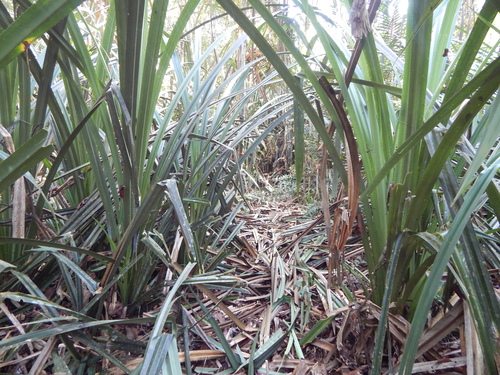
(c) Cyndy Sims Parr, some rights reserved (CC BY-SA)

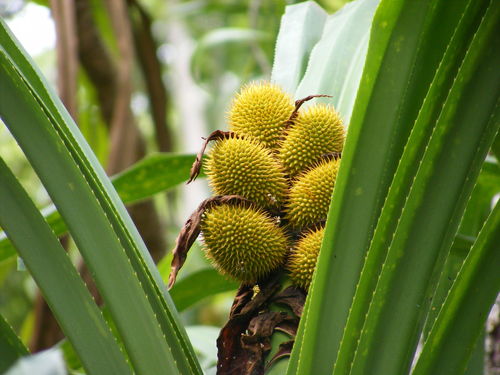
(c) Yanuar Ishaq Dc, some rights reserved (CC BY-NC-SA)
What to Eat
Edible parts: Leaves, Bracts
Young leaves - raw. The young leaves and bract are used as vegetable and eaten raw. It is probably the inner portion at the base of the leaf that is eaten. The leaves are mixed with betel nut (Areca catechu) and pepper leaves (Piper betle) and are then chewed, where they act as a mild narcotic. Although no specific records have yet been seen for this species, most members of this genus also have more or less edible fruits and seeds. The cylindrical fruit is a syncarp made up of a number of individual drupes. Individual drupes are hard, woody wedges - each containing a few, slender seeds. Each wedge has a fleshy base imbued with a sweet-smelling, orange pulp that in many species has a delicious flavour. This pulp needs to be cooked in order to destroy a deleterious substance. The seed often has a delicious nutty flavour when eaten raw or cooked, though it is fiddly to extract. Seeds contain 44 - 50% fat and 20 - 34% protein.
Where to Find It
A tropical plant. It occurs in Maluku in Indonesia. It grows near seashores in thickets. It can be in swampy places and mangroves.
Africa, Asia, Caroline Islands, East Africa, Indonesia, Madagascar, Malaysia, Pacific, Palau, Papua New Guinea, PNG, Philippines, SE Asia, Solomon Islands, Yap,
How to Identify
A small erect tree. It forms clumps. It grows 4 m tall. The stems are slender and branched. They are greyish-green and spiny. It has prop roots 40 cm long and slender. The leaves are strap like and dark green above and pale green underneath. They are in rings arranged in spirals. They are 60-85 cm long and 3-4 cm wide. They have sharp spines along the edges. Male and female flowers are on separate plants. Male flowers have a scent. The fruiting body is in a spike 30-35 cm long with 4-7 heads arranged in a group. The fruiting head is round and 7 cm long by 4.5-4.8 cm wide. The fruit is fleshy and bright red when mature.
How to Grow
Plants can be grown from seeds.
Propagation: Seed - best pre-soaked for 24 hours prior to sowing.
Medicinal Uses
The leaves are used as a treatment against food poisoning, especially from seafood (such as fishes and crabs).
Other Uses
Older leaves are used for making mats The sword-shaped leaves of this species are about 60 - 85cm long by 25 - 40mm wide at the base.
Notes
There are about 600 Pandanus species. They grow in the tropics.
Names & Synonyms
Bengea, Berel, Chertochet, Denro, Jefe, Keker lainulun, Keker maan, Liliama dowongi, Oro-oro, Pandan kecil, Panreng, Tsirika
References (10)
- Borrell, O.W., 1989, An Annotated Checklist of the Flora of Kairiru Island, New Guinea. Marcellin College, Victoria Australia. p 40
- Burkill, I.H., 1966, A Dictionary of the Economic Products of the Malay Peninsula. Ministry of Agriculture and Cooperatives, Kuala Lumpur, Malaysia. Vol 2 (I-Z) p 1673
- Encycl. 1:372. 1785
- Keim, A.P., 2009, Pandanaceae of the island of Yapen, Papua (West New Guinea). Blumea 54, 2009: 255-266
- Kitalong, A. H., DeMeo, R. A., & Holm, T., 2013, A Field Guide to the Native Trees of Palau. 2nd edition. USDA p126 (As Pandanus aimiriikensis)
- Martin, F.W. & Ruberte, R.M., 1979, Edible Leaves of the Tropics. Antillian College Press, Mayaguez, Puerto Rico. p 211
- Styger, E., et al, 1999, Indigenous fruit trees of Madagascar: potential components of agroforestry systems to improve human nutrition and restore biological diversity. Agroforestry Systems 46: 289-310 (As Pandanus freycinetioides)
- Sukarya, D. G., (Ed.) 2013, 3,500 Plant Species of the Botanic Gardens of Indonesia. LIPI p 744
- World Checklist of Useful Plant Species 2020. Royal Botanic Gardens, Kew
- www.pngplants.org