Panicum capillare
L.
Witch Grass, Old witch grass, Tumble panic grass
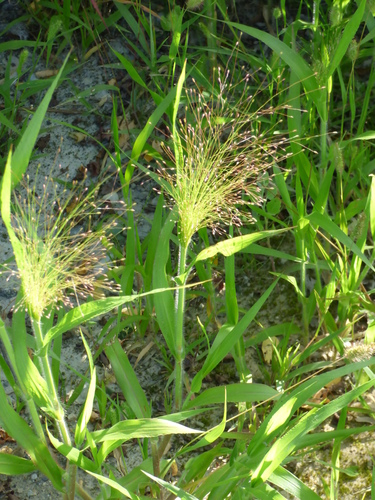
(c) Calvin Siméon, some rights reserved (CC BY-NC), uploaded by Calvin Siméon
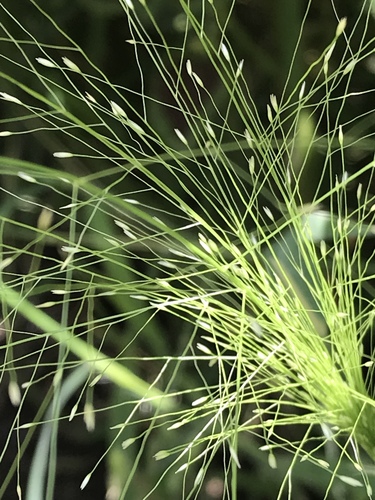
(c) brookesurlet, some rights reserved (CC BY-NC)

(c) Matt Lavin, some rights reserved (CC BY)
What to Eat
Edible parts: Seeds, Cereal
The seed can be cooked whole or ground into a flour, and is often mixed with corn. The seed is very small and fiddly to work with, but has a mild flavour and can be used like millet. In the wild, the seed stem breaks off at ripeness and the plant disperses seed by blowing away in the wind.
Where to Find It
It is a temperate plant. It requires a moderately fertile soil which is well drained and it requires full sunlight. It often grows on sand and coastal dunes. In Argentina it grows from sea level to 1,000 m above sea level.
Argentina, Australia, Britain, Chile, England, Europe, Iran, Jamaica, Middle East, North America*, Pakistan, Slovenia, South America, Tasmania, Uruguay, USA, West Indies,
How to Identify
An annual grass. It forms tufts. It grows up to 60 cm tall. It spreads to 30 cm across. The leaves are 7-30 cm long by 5-14 mm wide. They are flat. The flower panicle is broad and 15-50 cm long. The spikelets are on long thin stalks. The flowers are green.
How to Grow
Seed is sown shallowly and germinates in one week.
Propagation: Sow seed in spring in a greenhouse, barely covering it. Germination should take place within a week. Prick out seedlings into trays or individual pots and plant out after the last expected frosts.
Medicinal Uses
An infusion of the leaves has been used as an emetic. An infusion of the whole plant has been used as a weight-loss aid when dieting.
Other Uses
The grass can be made into brooms.
Wikipedia
Source ↗Panicum capillare, known by the common name witchgrass, is a species of grass. It is a native plant to most of North America from the East Coast through all of the West Coast and California. It can be found as an introduced species in Eurasia, and as a weed in gardens and landscaped areas. It grows in many types of habitat.
Notes
There are about 500 Panicum species. Possibly not naturalised in Tasmania.
Names & Synonyms
Paja voladora, Pajilla blanca, Panicum, Pasto de la per diz, Pastoa perdiz
References (14)
- Beckstrom-Sternberg, Stephen M., and James A. Duke. "The Foodplant Database." http://probe.nalusda.gov:8300/cgi-bin/browse/foodplantdb.(ACEDB version 4.0 - data version July 1994)
- Brickell, C. (Ed.), 1999, The Royal Horticultural Society A-Z Encyclopedia of Garden Plants. Convent Garden Books. p 746
- Curtis, W.M., & Morris, D.I., 1994, The Student's Flora of Tasmania. Part 4B St David's Park Publishing, Tasmania, p 334
- Flora of Pakistan. www.eFloras.org
- http://www.botanic-gardens-ljubljana.com/en/plants
- http://www.stoller-eser.com/Flora/ethnobotany_table.htm
- Hussey, B.M.J., Keighery, G.J., Cousens, R.D., Dodd, J., Lloyd, S.G., 1997, Western Weeds. A guide to the weeds of Western Australia. Plant Protection Society of Western Australia. p 60
- Lazarides, M. & Hince, B., 1993, Handbook of Economic Plants of Australia, CSIRO. p 180
- Malezas Comestibles del Cono Sur, INTA, 2009, Buernos Aires
- Moerman, D. F., 2010, Native American Ethnobotany. Timber Press. p 377
- Paczkowska, G. & Chapman, A.R., 2000, The Western Australian Flora. A Descriptive Catalogue. Western Australian Herbarium. p 111
- Plants for a Future database, The Field, Penpol, Lostwithiel, Cornwall, PL22 0NG, UK. http://www.scs.leeds.ac.uk/pfaf/
- Sp. pl. 1:58. 1753
- Tasmanian Herbarium Vascular Plants list p 87


