Panicum effusum
R. Br.
Hairy panic grass
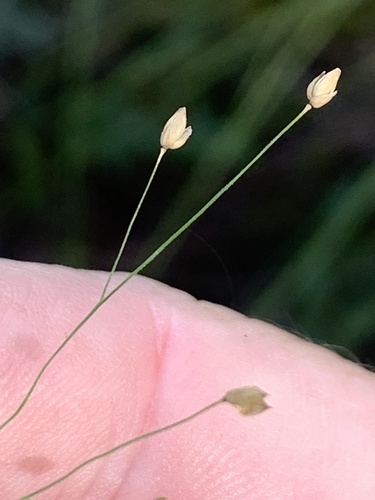
(c) Geoffrey Sinclair, some rights reserved (CC BY-NC), uploaded by Geoffrey Sinclair
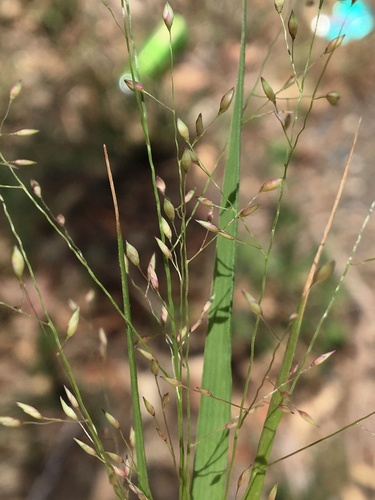
(c) Geoffrey Sinclair, some rights reserved (CC BY-NC), uploaded by Geoffrey Sinclair

(c) coanne, some rights reserved (CC BY-NC)
What to Eat
Edible parts: Seeds, Cereal
The seeds can be used to make bread and are consumed as a cereal grain.
Known Hazards
Where to Find It
It grows in tropical and subtropical places. It does best in drier sites. It can grow in arid places.
Australia*, Norfolk Island,
How to Identify
A grass which keeps growing from year to year. It forms tufts. It grows 20-60 cm long. It has long stiff spreading hairs. The leaf blade is 2-5.5 mm wide. The flower panicle is open and 10-30 cm long. At first it is enclosed in the uppermost leaf sheath. It has many branches and spreads stiffly. The spikelets are often in pairs. They are 2-3 mm long.
How to Grow
Plants are grown from seed.
Wikipedia
Source ↗Panicum effusum, commonly known as hairy panic, is a grass native to inland Australia. It occurs in every mainland state, as well as New Guinea. In dry conditions, the fast-growing grass can become a tumbleweed.
Notes
There are about 500 Panicum species.
References (15)
- Anon., 2003, Native Plants for the Fitzroy basin. Society for Growing Australian Plants Inc. (Rockhampton Branch) p 69
- Cancilla, D., 2018, Ethnobotanical and Ethnozoological Values Desktop Assessment - Eliwana Project. p 14
- Cherikoff V. & Isaacs, J., The Bush Food Handbook. How to gather, grow, process and cook Australian Wild Foods. Ti Tree Press, Australia p 190
- Dashorst, G.R.M., and Jessop, J.P., 1998, Plants of the Adelaide Plains & Hills. Botanic Gardens of Adelaide and State Herbarium. p 172
- Elliot, W.R., & Jones, D.L., 1997, Encyclopedia of Australian Plants suitable for cultivation. Vol 7. Lothian. p 162
- Flora of Australia Volume 49, Oceanic Islands 1, Australian Government Publishing Service, Canberra. (1994) p 481
- Hunter, J. T. & Sheringham, P., 2006, Vegetation and Floristics of Melville Range Nature Reserve. A Report to the New South Wales Parks and Wildlife Service. p 176
- Hunter, J.T., 2017, Is there a relationship between contemporary high Aboriginal plant resource locations and mapped vegetation communities? Cunninghamia 17:27-34. The Royal Botanic Garden Sydney. ISSN 2200 - 405X
- Lamp, C.A., Forbes, S.J. and Cade, J.W., 1990, Grasses of Temperate Australia. Inkata Press. p 214
- Latz, P.K., 1996, Bushfires and Bushtucker: Aboriginal plant use in Central Australia. IAD Press Alice Springs p 241
- Lazarides, M. & Hince, B., 1993, Handbook of Economic Plants of Australia, CSIRO. p 180
- Low, T., 1991, Wild Food Plants of Australia. Australian Nature FieldGuide, Angus & Robertson. p 158
- Paczkowska, G. & Chapman, A.R., 2000, The Western Australian Flora. A Descriptive Catalogue. Western Australian Herbarium. p 111
- Prodr. 191. 1810
- Wheeler, J.R.(ed.), 1992, Flora of the Kimberley Region. CALM, Western Australian Herbarium, p 1196


