Panicum hirticaule
J. Presl.
Sowi millet
(c) Sue Carnahan, some rights reserved (CC BY), uploaded by Sue Carnahan
(c) Jaxon Lane, some rights reserved (CC BY-NC), uploaded by Jaxon Lane

(c) Steve Jones, some rights reserved (CC BY-NC), uploaded by Steve Jones
What to Eat
Edible parts: Seeds
The seeds are ground into meal and used to make bread.
Where to Find It
A tropical plant.
Caribbean, Central America*, Costa Rica, Cuba, Ecuador, El Salvador, Guatemala, Haiti, Honduras, Mexico, Nicaragua, North America, Panama, Peru, South America*, USA, Venezuela, West Indies*,
How to Identify
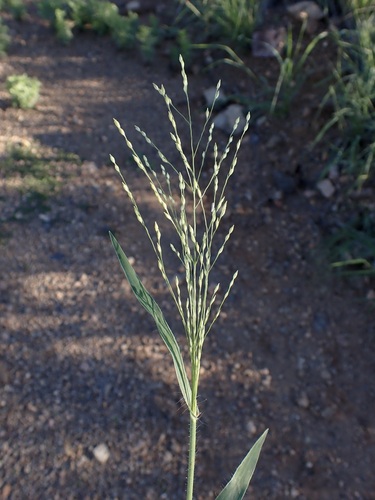
An annual millet grass. It grows 10-80 cm tall. The leaves are hairy and 15 cm long. The flowers are in a branching panicle 12 cm long. The spikelets are rounded.
Wikipedia
Source ↗Panicum hirticaule is a species of grass known by the common names Mexican panicgrass and roughstalked witchgrass. It is also known as the Sonoran millet, and is cultivated as a cereal crop in the American Southwest.
Other Information
It is occasionally cultivated.
Notes
There are about 500 Panicum species.
Names & Synonyms
Panizo cauchín, Sonora panic
References (8)
- K. B. Presl, Reliq. haenk. 1:308. 1830
- Kermath, B. M., et al, 2014, Food Plants in the Americas: A survey of the domesticated, cultivated and wild plants used for Human food in North, Central and South America and the Caribbean. On line draft. p 604
- Moerman, D. F., 2010, Native American Ethnobotany. Timber Press. p 377
- Plants of Haiti Smithsonian Institute http://botany.si.edu/antilles/West Indies
- USDA, ARS, National Genetic Resources Program. Germplasm Resources Information Network - (GRIN). [Online Database] National Germplasm Resources Laboratory, Beltsville, Maryland. Available: www.ars-grin.gov/cgi-bin/npgs/html/econ.pl (10 April 2000)
- Wiersema, J. H. & Leon, B., 2013, World Economic Plants. A Standard Reference CRC Press. 2nd Ed. p 492
- World Checklist of Useful Plant Species 2020. Royal Botanic Gardens, Kew
- Yetman, D., 2002, The Guarijios of the Sierra Madre: Hidden People of Northwestern Mexico. University of New Mexico Press. p 219


