Panicum kalaharense
Mez
Kalahari buffalo grass
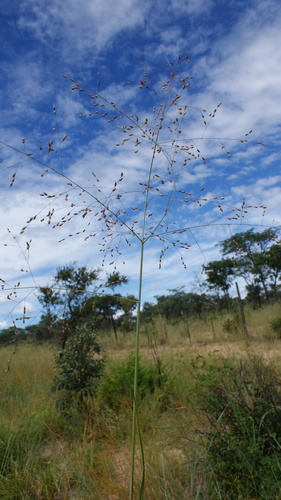
(c) Ben Strohbach, some rights reserved (CC BY-NC), uploaded by Ben Strohbach
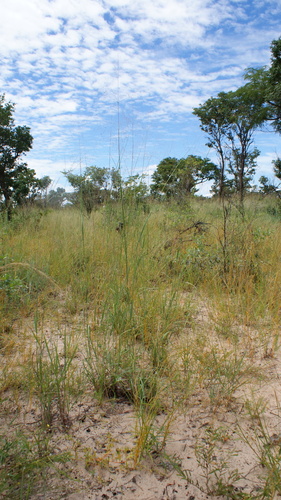
(c) Ben Strohbach, some rights reserved (CC BY-NC), uploaded by Ben Strohbach

(c) Francois du Randt, some rights reserved (CC BY-NC), uploaded by Francois du Randt
What to Eat
Edible parts: Seeds, Cereal
The seeds are used as a cereal grain and for making porridge.
Where to Find It
A subtropical plant. It grows in hot arid places. It grows in areas with an annual rainfall of 150 mm. It grows in dry sandy soils. It grows between 300-1,400 m above sea level. It can tolerate drought. It can grow in arid places.
Africa, Angola, Botswana, Central Africa, East Africa, Mozambique, Namibia, South Africa, Southern Africa, Zimbabwe,
How to Identify
A herb. It is a tussock forming grass. It has rhizomes or underground stems and keeps growing from year to year. It grows 2.5 m high.
How to Grow
A plant of drier areas in the tropics and subtropics, where it is found at elevations of 500 - 1,200 metres. It grows in areas where the mean annual rainfall is within the range 300 - 600mm. Established plants are drought resistant. Found in the wild on sandy soils. This species photosynthesizes by a more efficient method than most plants. Called the 'C4 carbon-fixation pathway', this process is particularly efficient at high temperatures, in bright sunlight and under dry conditions.
Notes
There are about 500 Panicum species.
Names & Synonyms
Ruperere
References (6)
- Bot. Jahrb. Syst. 57:187. 1921
- Jardin, C., 1970, List of Foods Used In Africa, FAO Nutrition Information Document Series No 2.p 5
- Royal Botanic Gardens, Kew (1999). Survey of Economic Plants for Arid and Semi-Arid Lands (SEPASAL) database. Published on the Internet; http://www.rbgkew.org.uk/ceb/sepasal/internet [Accessed 3rd June 2011]
- Ruiters-Welcome, A. K., 2019, Food plants of southern Africa. Ph.D. thesis. Univ. of Johannesburg p 89
- Welcome, A. K. & Van Wyk, B.-E., 2019, An inventory and analysis of the food plants of southern Africa. South African Journal of Botany 122 (2019) 136–179
- World Checklist of Useful Plant Species 2020. Royal Botanic Gardens, Kew


