Panicum miliaceum
L.
True millet, Common millet, Proso
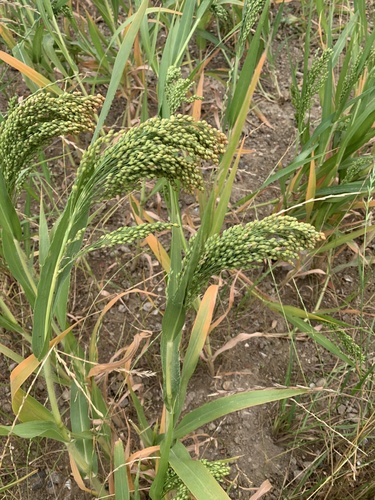
(c) nastusha, some rights reserved (CC BY-NC)

(c) Tony Rodd, some rights reserved (CC BY-NC-SA)

(c) dlbowls, some rights reserved (CC BY-NC), uploaded by dlbowls
What to Eat
Edible parts: Seeds, Cereal
The seed can be cooked whole or ground into a flour for making breads, pasta, and fermented foods such as tempeh. It has a nutty flavour and is more easily digested than many cereals because its high alkaline content counteracts acids. It is also gluten-free, making it suitable for people with coeliac disease or other gluten intolerances, though bread made from it will not rise. The seed can also be sprouted and added to salads, soups, and similar dishes. It contains approximately 10% protein and 4% fat.
Where to Find It
It is a temperate plant. It requires a moderately fertile well-drained soil in full sunlight. Once established it can tolerate heat and drought. It suits warm temperate and subtropical climates. Plants are frost sensitive. In Nepal it grows up to 2200 m altitude. It can grow in arid places. It suits hardiness zones 5-9.
Afghanistan, Africa, Albania, Argentina, Armenia, Asia, Australia, Austria, Azerbaijan, Balkans, Bangladesh, Bhutan, Botswana, Brazil, Britain, Bulgaria, Canada, Caucasus, Central Africa, Central Asia, China*, Congo, Cyprus, Czech Republic, East Africa, Egypt, Estonia, Ethiopia, Europe, France, Georgia, Germany, Greece, Guiana, Guyana, Himalayas, Hungary, India, Indochina, Indonesia, Iran, Iraq, Italy, Japan, Kazakhstan, Kenya, Korea, Kyrgystan, Latvia, Lebanon, Macedonia, Madagascar, Malawi, Manchuria, Mauritius, Mediterranean, Mexico, Middle East, Moldova, Mongolia, Morocco, Mozambique, Myanmar, Nepal, Netherlands, Niger, North Africa, North America, Northeastern India, Pakistan, Poland, Romania, Russia, Sahel, Saudi Arabia, Scandinavia, SE Asia, Serbia, Siberia, Slovakia, Slovenia, South Africa, Southern Africa, South America, Spain, Sri Lanka, Sweden, Switzerland, Syria, Taiwan, Tajikistan, Tanzania, Tasmania, Turkey, Türkiye, Turkmenistan, Ukraine, Uruguay, USA, Uzbekistan, Vietnam, West Africa, Yemen, Yugoslavia, Zambia, Zimbabwe,
How to Identify
An annual millet grass which grows up to 1 m high. It spreads to 15 cm across. It has a fibrous root system. The stalks are tufted. They are hairy at the base and on the nodes. The leaves are 30-50 cm long by 1-5 cm wide. They are narrow and flat. The edge is slightly rough with a few long hairs near the base. The seed head is much branched. The flower is yellow. The fruit is a grain. There are several races.
Nutrition Score: 52/100
| Part | Moisture | kJ | kcal | Protein | Vit A | Vit C | Iron | Zinc |
|---|---|---|---|---|---|---|---|---|
| Seeds | 9.6 | 1548 | 370 | 11 | — | — | — | — |
How to Grow
Requires a moderately fertile well-drained soil in full sun. Succeeds in ordinary garden soil. Tolerates heat and also drought when it is established. European millet is frequently cultivated in warm temperate and sub-tropical zones for its edible seed, there are many named varieties. Cultivation in Britain is somewhat problematic, the plants require good summers to do well and a dry period in late summer is required in order to ripen and dry the seed. We have had fairly good results on our trial grounds in Cornwall by starting the seed off early in a greenhouse, though this is a fairly labour-intensive method and therefore much less efficient than growing the more traditional temperate zone cereals. Yields are also considerably lower than other cereals that can be grown in this country, although the nutritional value of millets is said to be superior to wheat, oats, etc.
Propagation: Sow seed in spring in a greenhouse, covering only just lightly. Germination should occur within a week. Prick out seedlings into trays or individual pots and plant out after the last expected frosts.
Medicinal Uses
The seed is cooling and demulcent. Cooked seed is applied as a poultice for abscesses and sores, and juice from chewed seeds is applied to children's sores. The seed can also be incinerated, mixed with oil, and used as a poultice said to heal sores without leaving a scar. A decoction of the root is used as an antidote to poisoning by Momordica species, to treat haematuria in women, and as a bath for skin eruptions.
Other Uses
A starch extracted from the seed serves as a substitute for corn starch and is used for sizing textiles. The leaves provide a source of fibre used in papermaking.
Wikipedia
An annual grass growing to 1 m tall with a 0.2 m spread. Hardy to UK zone 5. Flowers July to October. Hermaphroditic and wind-pollinated. Grows in light sandy, medium loamy, and heavy clay soils with well-drained preference. Tolerates mildly acid, neutral, and basic soils. Requires full sun. Adapts to dry or moist conditions and tolerates drought.
Production
Seeds for harvest can be produced in 10 weeks.
Other Information
It is grown on 1.5 million hectares in China. It is also an important cereal in Mongolia and Korea and southern India. It is a cultivated food plant.
Notes
It suits people with Coeliacs disease because it contains no glutin. It has a high alkaline content that makes it easily digested. There are about 500 Panicum species.
Names & Synonyms
Baragu, Broomcorn millet, Chamai, Cheen, Cheena, Chena, Chenaa, Chino, Cino, Dari, Dokhan, Echte Hirse, European millet, Goto dana, Huosui, Ji, Junelo, Kadukanni, Ke, Kibi, Lu, Meneri, Miglio, Mijo, Mil, Milho miudo, Milium, Millet Panic, Nage, Nkhwanje, Panivaragu, Shu, Taang, Tai, Varagalu, Vari, Variga, Varo
References (60)
- Acharya, K. P., Paudel, P. K., 2020, Biodiversity in Karnali Province: Current Status and Conservation. Ministry of Industry, Tourism, Forest and Environment, Karnali Province Government, Surkhet, Nepal. p 31
- Ambasta, S.P. (Ed.), 2000, The Useful Plants of India. CSIR India. p 426
- Bernholt, H. et al, 2009, Plant species richness and diversity in urban and peri-urban gardens of Niamey, Niger. Agroforestry Systems 77:159-179
- Brickell, C. (Ed.), 1999, The Royal Horticultural Society A-Z Encyclopedia of Garden Plants. Convent Garden Books. p 746
- Burkill, I.H., 1966, A Dictionary of the Economic Products of the Malay Peninsula. Ministry of Agriculture and Cooperatives, Kuala Lumpur, Malaysia. Vol 2 (I-Z) p 1685
- Cobley, L.S. (rev. Steele, W.M.) 2nd Ed., 1976, An Introduction to the Botany of Tropical Crops. Longmans. p 55
- Cundall, P., (ed.), 2004, Gardening Australia: flora: the gardener's bible. ABC Books. p 979
- Curtis, W.M., & Morris, D.I., 1994, The Student's Flora of Tasmania. Part 4B St David's Park Publishing, Tasmania, p 333
- Ertug, F, Yenen Bitkiler. Resimli Türkiye Florası -I- Flora of Turkey - Ethnobotany supplement
- Esperanca, M. J., 1988. Surviving in the wild. A glance at the wild plants and their uses. Vol. 2. p 164
- Facciola, S., 1998, Cornucopia 2: a Source Book of Edible Plants. Kampong Publications, p 178
- FAO, 1988, Traditional Food Plants, FAO Food and Nutrition Paper 42. FAO Rome p 378
- Flora of Pakistan. www.eFloras.org
- Gangte, H. E., et al, 2013, Wild Edible Plants used by the Zou Tribe in Manipur, India. International Journal of Scientific and Research Publications, Volume 3, Issue 5
- Gangwar, A. K. & Ramakrishnan, P. S., 1990, Ethnobotanical Notes on Some Tribes of Arunachal Pradesh, Northeastern India. Economic Botany, Vol. 44, No. 1 pp. 94-105
- Gautam, R. S., et al, 2020, Wild Edible Fruits of Nepal. Int. J. Appl. Sci. Biotechnol. Vol 8(3): 289-304
- Guite, C., 2016, Study of wild edible plants associated with the Paite Tribe of Manipur, India. International Journal of Current Research. Vol. 8, Issue 11, pp. 40927-40932
- Hardwick, G., 2001, Economically Useful Plants for Northern Australia: Master Species List. Crusader eBooks.
- Haq, N., Anthony, K., Sarwar, M., and Ahmad, Z. (eds.), 1998, Underutilized Crops of Pakistan. Plant Genetic Resources Institute. p 16
- Heywood, V.H., Brummitt, R.K., Culham, A., and Seberg, O., 2007, Flowering Plant Families of the World. Royal Botanical Gardens, Kew. p 394
- http://www.botanic-gardens-ljubljana.com/en/plants
- Hussey, B.M.J., Keighery, G.J., Cousens, R.D., Dodd, J., Lloyd, S.G., 1997, Western Weeds. A guide to the weeds of Western Australia. Plant Protection Society of Western Australia. p 60
- Hu, Shiu-ying, 2005, Food Plants of China. The Chinese University Press. p 293
- Huxley, A. (Ed.), 1977, The Encyclopedia of the Plant Kingdom. Chartweil Books. p 184
- Jardin, C., 1970, List of Foods Used In Africa, FAO Nutrition Information Document Series No 2.p 5
- Jia, X., et al, 2022, Ethnobotany of wild edible plants in multiethnic areas of the Gansu–Ningxia–Inner Mongolia junction zone. Journal of Ethnobiology and Ethnomedicine 18:53
- Kaume, R.N., 2006. Panicum miliaceum L. [Internet] Record from Protabase. Brink, M. & Belay, G. (Editors). PROTA (Plant Resources of Tropical Africa), Wageningen, Netherlands. < http://database.prota.org/search.htm>. Accessed 20 October 2009.
- Khanal, R., et al, 2014, Documenting abundance and use of underutilized plant species in the mid hill region of Nepal. ECOPRINT 21: 63-71, 2014
- Kiple, K.F. & Ornelas, K.C., (eds), 2000, The Cambridge World History of Food. CUP p 118
- Kuo, W. H. J., (Ed.) Taiwan's Ethnobotanical Database (1900-2000), http://tk.agron.ntu.edu.tw/ethnobot/DB1.htm
- Lazarides, M. & Hince, B., 1993, Handbook of Economic Plants of Australia, CSIRO. p 180
- Macmillan, H.F. (Revised Barlow, H.S., et al), 1991, Tropical Planting and Gardening. Sixth edition. Malayan Nature Society. Kuala Lumpur. p 353
- Mal, B., S., et al, (Eds), 2010, Minor Millets in South Asia. Bioversity.
- Malezas Comestibles del Cono Sur, INTA, 2009, Buernos Aires
- Manandhar, N.P., 2002, Plants and People of Nepal. Timber Press. Portland, Oregon. p 346
- Menninger, E.A., 1977, Edible Nuts of the World. Horticultural Books. Florida p 149
- Murtem, G. & Chaudhrey, P., 2016, An ethnobotanical note on wild edible plants of Upper Eastern Himalaya, India. Brazilian Journal of Biological Sciences, 2016, v. 3, no. 5, p. 63-81
- Paczkowska, G. & Chapman, A.R., 2000, The Western Australian Flora. A Descriptive Catalogue. Western Australian Herbarium. p 111
- Plants for a Future, The Field, Penpol, Lostwithiel, Cornwall, PL22 0NG, UK. http://www.scs.leeds.ac.uk/pfaf/
- PROSEA (Plant Resources of South East Asia) handbook Volume 10 Cereals. p 116
- Purseglove, J.W., 1972, Tropical Crops. Monocotyledons. Longmans p 199
- Rajapaksha, U., 1998, Traditional Food Plants in Sri Lanka. HARTI, Sri Lanka. p 392
- Rashid, H. E., 1977, Geography of Bangladesh. Westview p 251
- Royal Botanic Gardens, Kew (1999). Survey of Economic Plants for Arid and Semi-Arid Lands (SEPASAL) database. Published on the Internet; http://www.rbgkew.org.uk/ceb/sepasal/internet [Accessed 3rd June 2011]
- Ruiters-Welcome, A. K., 2019, Food plants of southern Africa. Ph.D. thesis. Univ. of Johannesburg p 89
- Shah, S. K., 2014, Dietary contribution of underutilized minor crops and indigenous plants collected from uncultivated lands and forests in Nepal. in Promotion of Underutilized Indigenous Food Resources for Food Security and Nutrition in Asia and Pacific. FAO. Bangkok p 64
- Small, E., 2009, Top 100 Food Plants. The world's most important culinary crops. NRC Research Press. p 352
- Smith, P.M., 1979, Common Millet, in Simmonds, N.W., (ed), Crop Plant Evolution. Longmans. London. p 308
- Sp. pl. 1:58. 1753
- Tasmanian Herbarium Vascular Plants list p 87
- Tardio, J., et al, Ethnobotanical review of wild edible plants in Spain. Botanical J. Linnean Soc. 152 (2006), 27-71
- Ulian, T., et al, 2020, Unlocking plant resources to support food security and promote sustainable agriculture. Plants, People, Planet. 2020;2:421–445.
- USDA, ARS, National Genetic Resources Program. Germplasm Resources Information Network - (GRIN). [Online Database] National Germplasm Resources Laboratory, Beltsville, Maryland. Available: www.ars-grin.gov/cgi-bin/npgs/html/econ.pl (10 April 2000)
- van Wyk, B., 2005, Food Plants of the World. An illustrated guide. Timber press. p 276
- van Wyk, Be, & Gericke, N., 2007, People's plants. A Guide to Useful Plants of Southern Africa. Briza. p 10
- Welcome, A. K. & Van Wyk, B.-E., 2019, An inventory and analysis of the food plants of southern Africa. South African Journal of Botany 122 (2019) 136–179
- Wiersema, J. H. & Leon, B., 2013, World Economic Plants. A Standard Reference CRC Press. 2nd Ed. p 492
- Wilson, J.M. & Witcombe, J.R., Crops for Arid lands, in Wickens, G.E., Goodin, J.R., and Field, D.V.,(Eds.) 1985, Plants for Arid Lands. Unwin Hyman, London, p 39
- World Checklist of Useful Plant Species 2020. Royal Botanic Gardens, Kew
- Zeven, A. C. & de West, J. M. J., 1982, Dictionary of cultivated plants and their regions of diversity. Wageningen. p 36


