Panicum sonorum
Beal
Sonoran panic-grass
(c) Dan Beckman, some rights reserved (CC BY-NC)
(c) Dan Beckman, some rights reserved (CC BY-NC)
(c) Dan Beckman, some rights reserved (CC BY-NC)
What to Eat
Edible parts: Seeds, Cereal
The seed can be cooked whole or ground into a flour for making tortillas and similar foods. It has a pleasant, mild flavour and can be used in the same way as millet.
Where to Find It
A tropical plant. It grows in poor soil. It needs full sunlight and a well drained soil. It is damaged by frosts. It suits semiarid areas.
Central America, El Salvador, Honduras, Mexico, North America, USA,
How to Identify
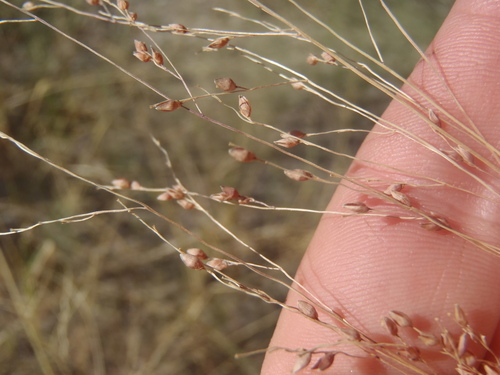
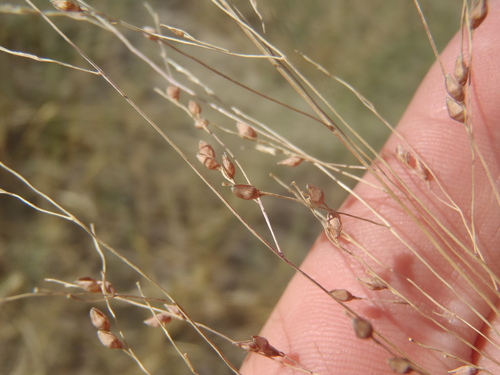
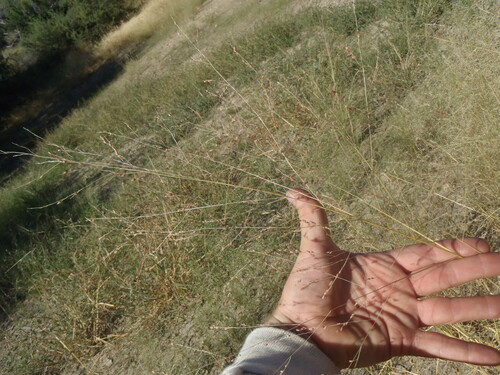
A millet grass. An annual grass up to 1 m tall. The cultivated form has larger spikelets. Now Panicum hirticaule
How to Grow
We have almost no information on this species and do not know if it will be hardy in Britain. It is cultivated on a small scale in south-western N. America for its edible seed, there is at least one named variety. The plant has a long growing season and may not produce a crop on tough soils. The following notes are based on the general needs of the genus. Prefers a moderately fertile well-drained soil in full sun. Succeeds in ordinary garden soil.
Propagation: Sow seed in spring in a greenhouse, covering only just lightly. Germination should occur within a week. Prick out seedlings into trays or individual pots and plant out after the last expected frosts.
Medicinal Uses
None known.
Other Uses
None known.
Wikipedia
An annual grass reaching 1 m tall. Hermaphroditic and wind-pollinated. Grows in light sandy, medium loamy, and heavy clay soils, preferring good drainage and tolerating poor soil. Adapts to mildly acid, neutral, and basic soils. Requires full sun. Tolerates both dry and moist conditions.
Production
Some varieties are fast growing and heat tolerant.
Other Information
An ancient crop being re-established.
Notes
There are about 500 Panicum species.
Names & Synonyms
Saui, Arrocillo, Sauwi
References (7)
- Felger, R.S., Ancient Crops for the Twenty first century, in Rickie, G.A., (ed), 1979, New Agricultural Crops, AAAS Selected Symposium 38. Westview Press, Colarado. p 10
- Grass. N. Amer. 2:130. 1896
- Hermandez Bermejo, J.E., and Leon, J. (Eds.), 1994, Neglected Crops. 1492 from a different perspective. FAO Plant Production and Protection Series No 26. FAO, Rome. p 30
- Kiple, K.F. & Ornelas, K.C., (eds), 2000, The Cambridge World History of Food. CUP p 113
- Marinelli, J. (Ed), 2004, Plant. DK. p 274
- Moerman, D. F., 2010, Native American Ethnobotany. Timber Press. p 377
- Plants for a Future database, The Field, Penpol, Lostwithiel, Cornwall, PL22 0NG, UK. http://www.scs.leeds.ac.uk/pfaf/


