Panicum turgidum
Forsk.
Turgid panic grass
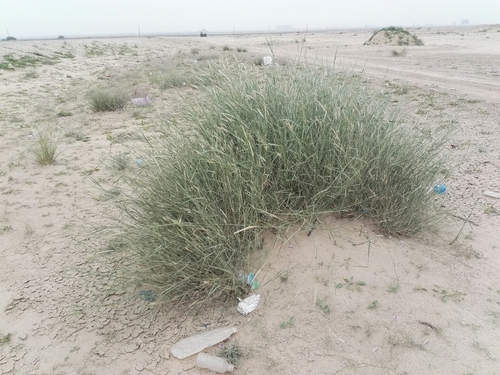
(c) Mohammad Marafi, some rights reserved (CC BY-NC), uploaded by Mohammad Marafi

(c) John Pereira, some rights reserved (CC BY-NC), uploaded by John Pereira
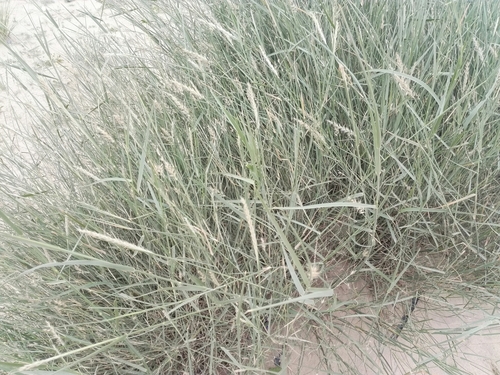
(c) Mohammad Marafi, some rights reserved (CC BY-NC), uploaded by Mohammad Marafi
What to Eat
Edible parts: Seeds, Cereal, Vegetable
The seed can be eaten as a soup or ground into a flour to make bread or porridge. The grain can also be stored against times of scarcity. In times of dearth, people raid ant nests to obtain grain the ants have stored. Young shoots have a sweet flavour. The burnt, powdered roots produce a type of soda that some people add to a tobacco quid.
Where to Find It
A tropical plant. It can grow on clay soils or sand dunes and sandy plains. It grows in the desert. It is drought resistant. It grows in areas with an annual rainfall between 30-250 mm. It can grow in alkaline soils. It can grow in arid places.
Africa, Algeria, Arabia, Asia, Australia, Bahrain, Burkina Faso, Central Africa, Chad, Cyprus, Djibouti, East Africa, Egypt, Ethiopia, Ghana, India, Iran, Iraq, Israel, Jordan, Kuwait, Lebanon, Liberia, Libya, Mali, Mauritania, Mediterranean, Middle East, Morocco, Niger, Nigeria, North Africa, Oman, Pakistan, Qatar, Sahara, Sahel, Saudi Arabia, Senegal, Socotra, Somalia, Sudan, Syria, Tunisia, United Arab Emirates, UAE, West Africa, Western Sahara, Yemen,
How to Identify
A grass that keeps growing from year to year. It forms dense tangled clumps. It grows 0.3-1 m high. The stems have angular branching. The nodes or joints are swollen. There are empty leaf sheaths at the nodes. The leaves are narrow and with sharp points. The plant can break off at ground level and blow in the wind.
How to Grow
The plant grows best in areas where the mean annual temperature is within the range 25 - 35°c, but can tolerate 8 - 40°c. It prefers a mean annual rainfall in the range 200 - 400mm, tolerating 100 - 600mm. Requires a sunny position and a very well-drained soil. Prefers a light to medium soil and is tolerant of poor soils and saline soils. The plant is extremely drought resistant. Prefers a pH in the range 6.5 - 7, but tolerates 6 - 8. In dry areas the dormant buds sprout rapidly after the onset of the rainy season and the plants stay green over a very extended period, with flowering occurring towards the end of the rainy season and during the early part of the dry season. The seeds are difficult to harvest in quantity because they mature at different times over an extended period, shatter easily and are often eaten by birds. The plant photosynthesize by a more efficient method than most plants. Called the 'C4 carbon-fixation pathway', this process is particularly efficient at high temperatures, in bright sunlight and under dry conditions. A collection of 42 accessions of Panicum turgidum is held at the International Livestock Research Institute (ILRI), Addis Ababa, Ethiopia. High grain-yielding types are particularly found in the Middle East.
Propagation: Seed does not germinate below 15°C. Surface sow or just barely cover in a very well-drained medium, ensuring the seed does not dry out. Germination is best at 25–35°C. Transplanting of seedlings is possible. Natural reproduction is mainly vegetative by stolons. Division of self-layered plants is also possible.
Medicinal Uses
Old culms, dried and powdered, are used as a wound dressing. The root is carried by female marabouts (religious teachers) in Mauritania for corporal punishment of wayward pupils. The seed is said to be antidiabetic.
Other Uses
The plant produces long, deep-penetrating, fast-growing roots that bind sand on sand dunes. It is common on the Sahel steppes, and in parts of Niger (Agades area) it forms near-pure stands on sand patches. In Sudan it dominates locust laying grounds and serves as food for young insects. The stiff straw is commonly woven into mats, baskets, and cordage, and is also used for thatching. The culms are used as firewood in desert areas. The palatability of the leaves is low but sufficient for camels and donkeys, and when young, for sheep and goats. Herdsmen in Niger report that milk becomes foul-smelling two to three days after cows have grazed on this plant.
Wikipedia
Source ↗Panicum turgidum is an old world clumping desert bunchgrass of the genus Panicum. It is a plant of arid regions across Africa and Asia, and has been introduced to other parts of the world.
Production
The seeds can be collected from ant hills.
Notes
There are about 500 Panicum species.
Names & Synonyms
Afezu, Afozo, Altumam, Bidu, Dungara, Dunqaare, Ithmam, Markouba, Markuba, Munt, Murut, Murutagas, Panic, Thamam, Thmam, Thumam, Thuman, Timam, Tumam
References (26)
- Abbiw, D.K., 1990, Useful Plants of Ghana. West African uses of wild and cultivated plants. Intermediate Technology Publications and the Royal Botanic Gardens, Kew. p 26
- Al-Sodany, Y. M., et al, 2013, Medicinal Plants in Saudi Arabia: I. Sarrwat Mountains at Taif, KSA. Academic Journal of Plant Sciences 6 (4): 134-145
- Ambasta, S.P. (Ed.), 2000, The Useful Plants of India. CSIR India. p 427
- Bidak, L. M., et al, 2015, Goods and services provided by native plants in desert ecosystems: Examples from the northwestern coastal desert of Egypt. Global Ecology and Conservation 3 (2015) 433–447
- Burkill, H. M., 1985, The useful plants of west tropical Africa, Vol. 2. Kew.
- CRÉAC'H,
- Dalziel, J. M., 1937, The Useful plants of west tropical Africa. Crown Agents for the Colonies London.
- Fl. aegypt.-arab. 18. 1775
- Flora of Pakistan. www.eFloras.org
- Grivetti, L. E., 1980, Agricultural development: present and potential role of edible wild plants. Part 2: Sub-Saharan Africa, Report to the Department of State Agency for International Development. p 28
- Grubben, G. J. H. and Denton, O. A. (eds), 2004, Plant Resources of Tropical Africa 2. Vegetables. PROTA, Wageningen, Netherlands. p 563
- GUPTA & KANODIA,
- Jardin, C., 1970, List of Foods Used In Africa, FAO Nutrition Information Document Series No 2.p 5
- Karim, F. M. & Dakheel, A, J., 2006, Salt-tolerant plants of the United Arab Emirates. 2006. International Center for Biosaline Agriculture, Dubai, UAE. p 96
- Mandaville, J. P., 2004, Bedouin ethnobotany: Plant concepts and plant use in a desert pastoral world. PhD thesis University of Arizona. p 165
- MORTIMORE,
- Nassif, F., & Tanji, A., 2013, Gathered food plants in Morocco: The long forgotten species in Ethnobotanical Research. Life Science Leaflets 3:17-54
- National Research Council, 1996, Lost crops of Africa. Volume 1 grains, p 261
- Peters, C. R., O'Brien, E. M., and Drummond, R.B., 1992, Edible Wild plants of Sub-saharan Africa. Kew. p 25
- Phillips, D.C., 1988, Wild Flowers of Bahrain. A Field Guide to Herbs, Shrubs, and Trees. Privately published. p 116
- Rivera, D. et al, 2006, Gathered Mediterranean Food Plants - Ethnobotanical Investigations and Historical Development, in Heinrich M, Müller WE, Galli C (eds): Local Mediterranean Food Plants and Nutraceuticals. Forum Nutr. Basel, Karger, 2006, vol 59, pp 18–74
- Royal Botanic Gardens, Kew (1999). Survey of Economic Plants for Arid and Semi-Arid Lands (SEPASAL) database. Published on the Internet; http://www.rbgkew.org.uk/ceb/sepasal/internet [Accessed 3rd June 2011]
- SAXENA,
- SHANKARNARAYAN & SAXENA.
- Vanderjagt, F. J., et al, 2000, The trypsin inhibitor content of 61 wild edible plant foods of Niger. Plant Foods for Human Nutrition 55: 335–346, 2000.
- World Checklist of Useful Plant Species 2020. Royal Botanic Gardens, Kew


