Panicum urvilleanum
Kunth
Desert panicgrass, Desert Panic Grass

(c) Steve Matson, some rights reserved (CC BY), uploaded by Steve Matson
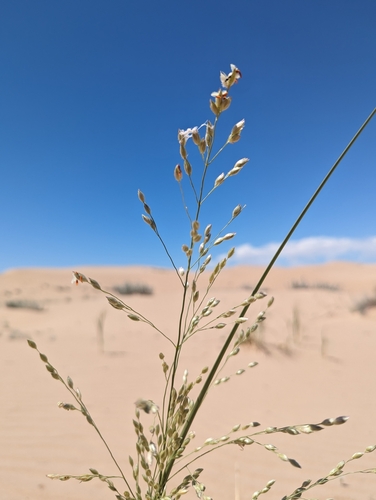
(c) Peri Lee Pipkin, some rights reserved (CC BY-NC), uploaded by Peri Lee Pipkin

(c) Chalon Boesel, some rights reserved (CC BY-NC), uploaded by Chalon Boesel
What to Eat
Edible parts: Seeds, Cereal
The seed can be cooked whole or ground into a powder and used as a flour. It has a mild flavour and can be used in the same way as millet.
Where to Find It
It is a temperate plant. It grows in sandy places in deserts. It can grow in arid places. In Argentina it grows from sea level to 2,000 m above sea level.
Argentina, Chile, North America, South America*, USA,
How to Identify
A perennial grass growing to 1 meter tall with hermaphrodite flowers pollinated by wind. Thrives in light sandy, medium loamy, and heavy clay soils that are well-drained. Tolerates mildly acidic, neutral, and basic soil pH. Requires full sun and adapts to both dry and moist conditions.
How to Grow
We have almost no information on this species and do not know if it will be hardy in Britain. The following notes are based on the general needs of the genus. Prefers a moderately fertile well-drained soil in full sun. Succeeds in ordinary garden soil.
Propagation: Sow seed in spring in a greenhouse, covering only just lightly. Germination should occur within a week. Prick out seedlings into trays or individual pots and plant out after the last expected frosts. For division in spring, larger divisions can be planted directly into their permanent positions. Smaller divisions are better potted up and grown on in light shade in a cold frame until well established, then planted out in late spring or early summer.
Medicinal Uses
None known.
Other Uses
None known.
Wikipedia
Source ↗Panicum urvilleanum is a species of grass known by the common names desert panicgrass and silky panicgrass. It is native to the southwestern United States and northern Mexico, where it grows in sandy habitat, including the dunes of the deserts. It is also known in parts of South America. This is a stoloniferous perennial grass growing up to a meter tall with hairy leaves up to 45 centimeters long. The inflorescence is a branching, spreading panicle up to 35 centimeters long bearing oval-shaped spikelets coated in downy white or silvery hairs.
Notes
There are about 500 Panicum species.
Names & Synonyms
Jaboncillo, Junquillo, Paja del salitral, Song-wal, Sangval, Tupe
References (6)
- Beckstrom-Sternberg, Stephen M., and James A. Duke. "The Foodplant Database." http://probe.nalusda.gov:8300/cgi-bin/browse/foodplantdb.(ACEDB version 4.0 - data version July 1994)
- Malezas Comestibles del Cono Sur, INTA, 2009, Buernos Aires
- Moerman, D. F., 2010, Native American Ethnobotany. Timber Press. p 377
- Plants for a Future database, The Field, Penpol, Lostwithiel, Cornwall, PL22 0NG, UK. http://www.scs.leeds.ac.uk/pfaf/
- Revis. gramin. 403, t. 115. 1831
- Saunders, C.F., 1948, Edible and Useful Wild Plants. Dover. New York. p 56


