Pappea capensis
(Spreng.) Eckl. & Zeyh.
South African Cherry, Indaba tree, Sand apple
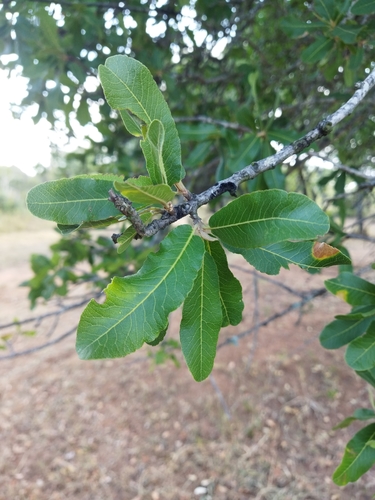
(c) pete_leroux, some rights reserved (CC BY-NC), uploaded by pete_leroux
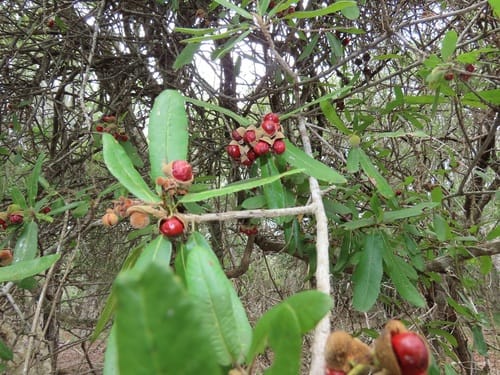
(c) magdastlucia, some rights reserved (CC BY-NC)
What to Eat
Edible parts: Fruit, Seeds, Bark - tea, Leaves, Seeds - oil
The fruit is eaten raw, dried, or made into drinks, jellies, vinegar, and beer. The seeds yield an edible oil. The inner bark is dried, grated, and brewed as tea.
Where to Find It
A tropical plant. It grows in tropical and subtropical places. It grows in the lowlands and the highlands. It suits moister places. It is often in open woodland and along rivers. It grows among rocks. Established trees can tolerate frost and drought. It grows in areas with an annual rainfall between 50-890 mm. It can grow in weakly salty soils. It grows between 30-2,400 m above sea level. It can grow in arid places. It also grows on termite mounds.
Africa, Botswana, East Africa, Eswatini, Ethiopia, Kenya, Malawi, Mozambique, Namibia, Rwanda, Somalia, South Africa, Southern Africa, Swaziland, Tanzania, Uganda, Zambia, Zimbabwe,
How to Identify
A shrub or small tree. It grows 3-9 m high. It grows taller in moist regions and is smaller in arid places. The leaves are towards the ends of twigs. The leaves are stiff, rough and simple. They can be 2.5-4 cm long and 8 mm wide in arid places and 3 times that size in most places. The base can be rounded or heart-shaped. The edges are often wavy. There are 10-12 pairs of side veins. The leaves are usually green above and paler below. The flowers are small and greenish-yellow. The male flowers are in a branched panicle and the female flowers in strings. The fruit have 3 parts 0.8-1.9 cm across. It has a hard brittle shell. It is brown and splits to show bright red flesh which lets light through. There is a brown shiny stone inside. The fruit is edible.
Nutrition
| Part | Moisture | kJ | kcal | Protein | Vit A | Vit C | Iron | Zinc |
|---|---|---|---|---|---|---|---|---|
| Fruit | 89 | — | — | — | — | — | 0.6 | 0 |
How to Grow
Plants can be grown from fresh seeds. Seeds can be collected from fruit on the tree and the flesh is removed. Seeds sown in warm weather can germinate in 2 weeks. Seedlings can be transplanted at the 4 leaf stage. Trees can be cut back and allowed to re-grow.
Propagation: Seed - should be collected from the ripe fruits. Remove the red flesh and sow immediately or store dry in an airtight container. Sow the seed in trays using a well-drained seedling mixture with some river sand added. The seed should be pressed into the medium and covered with approximately 5 mm of sand or seedling medium. Keep the trays in a warm and lightly shaded position until germination, which may take from 6 - 10 weeks under ideal conditions. The seedlings are best left in their trays until they are approximately 20 - 50 mm tall before planting out, taking care not to bruise or damage the young taproot.
Medicinal Uses
The tree has a long history of use in traditional medicine and is still commonly used today. The oil obtained from the seed is used as a purgative; a cure for ringworm; to restore hair. The leaves, bark and the oil extracted from the seed are used medicinally against baldness, ringworm, nosebleeds, chest complaints, eye infections, and venereal disease. The bark is cooked with soup to treat indigestion, stomach-ache and diarrhoea. Infusions of the bark are used by Kenyan Masai warriors to gain courage as well as an aphrodisiac and a blood-strengthening tonic.
Other Uses
A fine oil is extracted from the seeds. A fragrant, non-drying, golden yellow oil is extracted from the roasted seeds. It is used as a lubricant and for making soap. There are reports of it being used for oiling rifles. Some research has reported that the leaves are very effective in killing snails. The heartwood is light brown with a reddish tint and is not clearly demarcated from the sapwood. The wood has a twisted grain; it is hard, tough, heavy and durable. The stems seldom attain significant girth and therefore do not yield much useable wood. It is, however, used to make sticks, poles, cattle yokes, furniture and kitchen utensils. The wood is a source of fuel.
Production
Seedlings grow slowly but more quickly later.
Other Information
The fruit are eaten especially by children.
Names & Synonyms
Biiqqaa, Biqa, Bushveld cherry, Defi, Doppruim, Eceparake, Ilitshe, Imimena, Ingqalutshe, Indaba tree, Jacket plum, Kiva, Kyuua, Liatsa, Mba, Mboboyo, Molalakgaka, Mopenengwe, Mopennengwa, Moroba-diepe, Morodolodi, Mothatha, Mtundawe, Muhungulu, Mukhomanhudo, Muno we muchenya, Mupusyu, Murodolo, Muvundambado, Mwimafiguru, Oltimigomi, Omangi, Tshikavhavhe, Umgqongqongo, Umgqogpo, Umkhokhwane, Umtshulantshula, Umumena, Uzagogwane, Wild plum, Zikwakwashu
References (51)
- Acevedo-Rodriguez, P., et al, Sapindaceae in Kubitzki, K., (Ed.), 2011, The Families and Genera of Vascular Plants. Vol. 10, Springer. p 396
- Asfaw, Z. and Tadesse, M., 2001, Prospects for Sustainable Use and Development of Wild Food Plants in Ethiopia. Economic Botany, Vol. 55, No. 1, pp. 47-62
- Ashagre, M., et al, 2016, Ethnobotanical study of wild edible plants in Burji District, Segan Area Zone of Southern Nations, Nationalities and Peoples Region (SNNPR), Ethiopia. Journal of Ethnobiology and Ethnomedicine (2016) 12:32
- Bigirimana, C., et al, 2016, Utilisation of Indigenous Fruit Tree Species within the Lake Victoria Basin, Rwanda. Agricultural Science: An International Journal. (AGRIJ) Vol. 1, No. 1
- Cunningham, 1985,
- Demise, S. & Asfaw, Z., 2020, Ethno Botanical Study of Wild Edible Plants in Adola District, Southern, Ethiopia. International Journal of Research and Analytical Reviews (IJRAR) 7(2).
- Enum. pl. afric. austral. 53. 1834-1835
- Fowler, D. G., 2007, Zambian Plants: Their Vernacular Names and Uses. Kew. p 60
- Fox, F. W. & Young, M. E. N., 1982, Food from the Veld. Delta Books. p 333
- Gemedo-Dalle, T., et al, 2005, Plant Biodiversity and Ethnobotany of Borana Pastoralists in Southern Oromia, Ethiopia. Economic Botany 59(1) pp. 43-65
- Glover, 1967,
- Goode, P., 1989, Edible Plants of Uganda. FAO p 30
- Grivetti, 1976, 1979,
- Grivetti, L. E., 1980, Agricultural development: present and potential role of edible wild plants. Part 2: Sub-Saharan Africa, Report to the Department of State Agency for International Development. p 80
- https://growwild.co.za Edible Indigenous plants
- INFOODS:FAO/INFOODS Databases
- Joffe, P., 2007, Creative Gardening with Indigenous Plants. A South African Guide. Briza. p 60
- Johns, T., and Kokwaro, J.O., 1991, Food Plants of the Luo of Siayo District, Kenya. Economic Botany 45(1), pp 103-113
- Johns, T., Mhoro, E. B. and Sanaya, P., 1996, Food Plants and Masticants of the Batemi of Ngorongoro District, Tanzania. Economic Botany, Vol. 50, No. 1, pp. 115-121
- JSTOR Global Plants edible (As Sapindus pappea)
- Long, C., 2005, Swaziland's Flora - siSwati names and Uses http://www.sntc.org.sz/flora/
- Lulekal, E., et al, 2011, Wild edible plants in Ethiopia: a review on their potential to combat food insecurity. Afrika Focus - Vol. 24, No 2. pp 71-121
- Magwede, K., van Wyk, B.-E., & van Wyk, A. E., 2019, An inventory of Vhavenḓa useful plants. South African Journal of Botany 122 (2019) 57–89
- Malaisse, F., 1997, Se nourrir en floret claire africaine. Approche ecologique et nutritionnelle. CTA., p 65
- Mannheimer, C. A. & Curtis. B.A. (eds), 2009, Le Roux and Muller's Field Guide to the Trees and Shrubs of Namibia. Windhoek: Macmillan Education Namibia. p 300
- Mason, 1971,
- Maundu, P. et al, 1999, Traditional Food Plants of Kenya. National Museum of Kenya. 288p
- Mbuvi, M. T. E., et al, 2019, Annonated checklist of plant species of Loita Forest Narok County, Kenya. Int. J. Adv. Res. Biol. Sci. (2019). 6(3): 54-110
- Mbuya, L.P., Msanga, H.P., Ruffo, C.K., Birnie, A & Tengnas, B., 1994, Useful Trees and Shrubs for Tanzania. Regional Soil Conservation Unit. Technical Handbook No 6. p 376
- Motlhanka, D. M. T., et al, 2008, Edible Indigenous Fruit Plants of Eastern Botswana. International Journal of Poultry Science. 7(5): 457-460
- Mutie, F. G., 2020, Conservation of Wild Food Plants and Their Potential for Combatting Food Insecurity in Kenya as Exemplified by the Drylands of Kitui County. Plants 2020, 9, 1017
- Mutie, F. M., et al, 2023, Important Medicinal and Food Taxa (Orders and Families) in Kenya, Based on Three Quantitative Approaches. Plants 2023, 12, 1145
- Palgrave, K.C., 1996, Trees of Southern Africa. Struik Publishers. p 534
- Palmer, E and Pitman, N., 1972, Trees of Southern Africa. Vol. 2. A.A. Balkema, Cape Town p 1357
- Peters, C. R., O'Brien, E. M., and Drummond, R.B., 1992, Edible Wild plants of Sub-saharan Africa. Kew. p 181
- Roodt, V., 1998, Trees & Shrubs of the Okavango Delta. Medicinal Uses and Nutritional value. The Shell Field Guide Series: Part 1. Shell Botswana. p 197
- Royal Botanic Gardens, Kew (1999). Survey of Economic Plants for Arid and Semi-Arid Lands (SEPASAL) database. Published on the Internet; http://www.rbgkew.org.uk/ceb/sepasal/internet [Accessed 10th June 2011]
- Ruffo, C. K., Birnie, A. & Tengnas, B., 2002, Edible Wild Plants of Tanzania. RELMA p 508
- Ruiters-Welcome, A. K., 2019, Food plants of southern Africa. Ph.D. thesis. Univ. of Johannesburg p 100
- Schmidt, E., Lotter, M., & McCleland, W., 2007, Trees and shrubs of Mpumalanga and Kruger National Park. Jacana Media p 372
- Shava, S., 2000, The Use of Indigenous Plants as Food by a Rural Community in the Eastern Cape: an Educational Exploration. Masters Thesis Rhodes University. p 66
- Tredgold, M.H., 1986, Food Plants of Zimbabwe. Mambo Press. p 114
- van Wyk, Be., & Gericke, N., 2007, People's plants. A Guide to Useful Plants of Southern Africa. Briza. p 50
- van Wyk, B, van Wyk, P, and van Wyk B., 2000, Photographic guide to Trees of Southern Africa. Briza. p 10, 225
- van Wyk, B-E., 2011, The potential of South African plants in the development of new food and beverage products. South African Journal of Botany 77 (2011) 857–868
- Venter, F & J., 2009, Making the most of Indigenous Trees. Briza. p 224
- Wehmeyer, A. S, 1986, Edible Wild Plants of Southern Africa. Data on the Nutrient Contents of over 300 species
- Welcome, A. K. & Van Wyk, B.-E., 2019, An inventory and analysis of the food plants of southern Africa. South African Journal of Botany 122 (2019) 136–179
- Williamson, J., 2005, Useful Plants of Malawi. 3rd. Edition. Mdadzi Book Trust. p 187
- World Checklist of Useful Plant Species 2020. Royal Botanic Gardens, Kew
- www.zimbabweflora.co.zw 2011