Ampelocissus multistriata
(Baker) Planch.
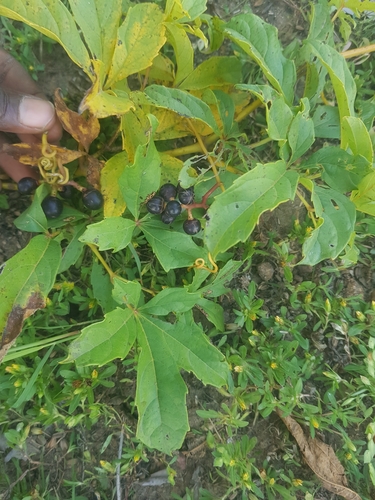
(c) Umar Musa, some rights reserved (CC BY-NC), uploaded by Umar Musa
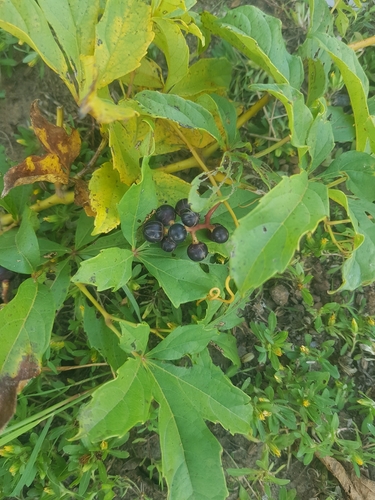
(c) Umar Musa, some rights reserved (CC BY-NC), uploaded by Umar Musa
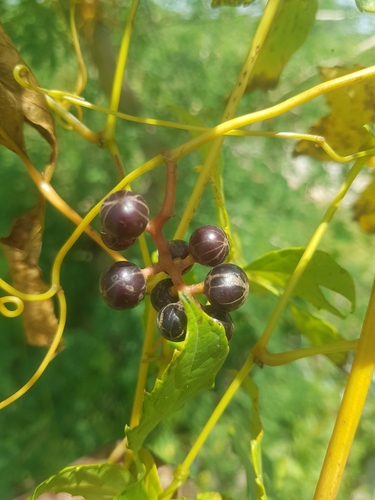
(c) Umar Musa, some rights reserved (CC BY-NC), uploaded by Umar Musa
What to Eat
Edible parts: Fruit, Seeds
Both the fruit and seeds are edible.
Where to Find It
A tropical plant. It grows in savanna scrub. It grows along rivers.
Africa, Burkina Faso, Cameroon, Central Africa, Central African Republic, CAR, Chad, Congo, East Africa, Gambia, Guinea, Guinée, Guinea-Bissau, Malawi, Mali, Mozambique, Nigeria, Senegal, Southern Africa, Sudan, Tanzania, West Africa, Zambia,
How to Identify
A large climber. The stems are hollow and have fine lines along them. The leaves have 5 leaflets. They can be simple and have 5 lobes. The leaflet blade is 22 cm long by 11 cm wide. The side leaflets are smaller. The flowers are in a branched cluster. They are on a stalk 11 cm long. There are tendrils below the flower stalk. The fruit is about 1 cm long. They are narrowly oval. The seeds are dark brown and 9 mm long by 4 mm wide.
Notes
There are about 95 Ampelocissus species.
Names & Synonyms
Dirindiri, Funhalon, Galavumba, Me, Perupe
References (8)
- Bircher, A. G. & Bircher, W. H., 2000, Encyclopedia of Fruit Trees and Edible Flowering Plants in Egypt and the Subtropics. AUC Press. p 25
- Bongers, F. et al (Eds), Forest Climbing Plants of West Africa: Diversity, Ecology and Management. CABI (As Ampelocissus pentaphylla)
- Burkill, H. M., 1985, The useful plants of west tropical Africa, Vol. 5. Kew.
- Dalziel, J. M., 1937, The Useful plants of west tropical Africa. Crown Agents for the Colonies London. (As Ampelocissus pentaphylla)
- Jardin, C., 1970, List of Foods Used In Africa, FAO Nutrition Information Document Series No 2.p 119
- Peters, C. R., O'Brien, E. M., and Drummond, R.B., 1992, Edible Wild plants of Sub-saharan Africa. Kew. p 200 (As Ampelocissus pentaphylla)
- White, F., Dowsett-Lemaire, F. and Chapman, J. D., 2001, Evergreen Forest Flora of Malawi. Kew. p 596
- World Checklist of Useful Plant Species 2020. Royal Botanic Gardens, Kew


