Passiflora actinia
Hook.
Passion flower
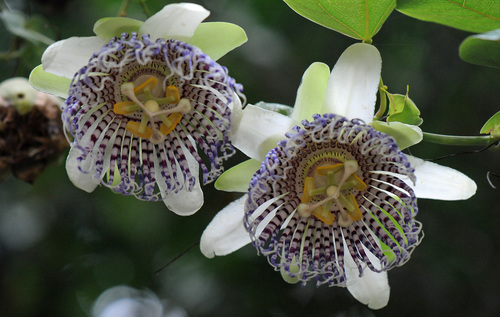
(c) Todd Boland, some rights reserved (CC BY), uploaded by Todd Boland

(c) Pedro Lotti Carvalho Dias, some rights reserved (CC BY-NC), uploaded by Pedro Lotti Carvalho Dias

(c) Lucianolll, some rights reserved (CC BY-SA)
What to Eat
Edible parts: Fruit
Fruit - raw or cooked. A sweet flavour that is greatly appreciated. The fruit has a very fragrant pulp. The yellow, ovoid to subglobose fruit is around 35 - 50mm in diameter.
Where to Find It
A tropical plant. It grows above 350 m above sea level. They are best in a moist, humus rich soil that is well-drained. A temperature of about 16°C is best for flowering.
Brazil*, South America,
How to Identify
A slender, wiry climbing shrub. The stems can be 10 m long. They scramble over the ground or climb over other plants by coiling tendrils. The fruit is yellowish.
Nutrition Score: 40/100
| Part | Moisture | kJ | kcal | Protein | Vit A | Vit C | Iron | Zinc |
|---|---|---|---|---|---|---|---|---|
| Fruit | 76.6 | 320 | 76 | 1.9 | — | 18.4 | 0.6 | 0.9 |
How to Grow
Plants are tolerant of temperatures that occasionally go down to about -5°c for short periods and so can possibly be grown outdoors in the mildest areas of the country. The top growth will be killed by the cold, but so long as the root is well mulched and is in a very well-drained soil, it should grow back in the spring. The plant is very suitable for growing in pots in a conservatory or even in a south-facing window. Plants produce tendrils and climb by attaching these to other plants. If fruit is required, specially when the plant is growing indoors, it is best to hand pollinate using pollen from a flower that has been open for 12 hours to pollinate a newly opened flower before midday. The flowers open in sunny weather and do not open on dull cloudy days. Plants are very tolerant of pruning and can be cut back to ground level if required to rejuvenate the plant. Any pruning is best carried out in the spring. Plants in this genus are notably resistant to honey fungus.
Propagation: Pre-soak the seed for 12 hours in warm water and then sow in late winter or early spring in a warm greenhouse. If sown in January and grown on fast it can flower and fruit in its first year. The seed germinates in 1 - 12 months at 20°c. Prick out the seedlings into individual pots when they are large enough to handle. If intending to grow plants outdoors, it is best to keep them in the greenhouse for their first winter and plant them out into their permanent positions in late spring or early summer, after the last expected frosts. Mulch the roots well in late autumn to protect them from the cold. Cuttings of young shoots, 15cm with a heel, in spring. Leaf bud cuttings in spring. Cuttings of fully mature wood in early summer - takes 3 months with a high percentage success rate.
Medicinal Uses
None known
Other Uses
This species may be suitable as a rootstock for P. alata and P. quadrangularis, potentially conferring greater hardiness and a dwarfing effect on grafted plants.
Wikipedia
Source ↗Passiflora actinia, also known as the sea anemone passion flower is a species of passion flower (passionfruit) of the Passifloraceae. It flowers mainly in early spring, producing white, mauve (purple), and blue flowers about 9 cm wide. Passiflora actinia is an evergreen vine. Native to Brazil, it is a relatively cold tolerant passion flower, and can be seen in gardens in England. Its edible fruit (a passionfruit) is golden orange when ripe, and about 10 cm long. Passion fruit is a good source of nutrients, especially fiber, vitamin C, and provitamin A. A single purple passion fruit contains (1Trusted Source): Calories: 17 Fiber: 2 grams Vitamin C: 9% of the Daily Value (DV) Vitamin A: 8% of the DV Iron: 2% of the DV Potassium: 2% of the D Its specific name might be in reference to the scientific name of the sea anemones (Actiniara), since it resembles one.
Notes
Over 200 species of fruit bearing Passiflora are recorded in Brazil. At least 50-60 are used as food. There are about 525 Passiflora species. They are mostly in the tropics and subtropics.
Names & Synonyms
Maracuja-do-mato, Maracuja-redondo-da-serra
References (7)
- Brack, P., et al, 2020, Frutas nativas do Rio Grande do Sul, Brasil: riqueza e potencial alimentício. Native fruits of Rio Grande do Sul, Brazil: richness and potential as food. Rodriguésia 71: e03102018.
- Brazil: Biodiversity for Food and Nutrition. http://www.b4fn.org/countries/brazil/
- Coradin, L. et al (Eds), 2011, Especies Nativas da Flora Brasileira de Valor Economico Atual ou Potencial. Brasilia MMA. p 189
- Kermath, B. M., et al, 2014, Food Plants in the Americas: A survey of the domesticated, cultivated and wild plants used for Human food in North, Central and South America and the Caribbean. On line draft. p 610
- Kinupp, V. F., 2007, Plantas alimenticias nao-convencionais da regiao metropolitana de Porto Alegre, RS, Brazil p 89
- Plants for a Future database, The Field, Penpol, Lostwithiel, Cornwall, PL22 0NG, UK. http://www.scs.leeds.ac.uk/pfaf/
- Ulmer, T., & MacDougal, J.M., 2004, Passiflora Passionflowers of the World. Timber Press. p 69


