Passiflora alata
Curtis ex Aiton
Fragrant granadilla, Winged-stem passion flower

(c) Alex Popovkin, Bahia, Brazil, some rights reserved (CC BY)
(c) Kai Squires, some rights reserved (CC BY), uploaded by Kai Squires

(c) Mónica, some rights reserved (CC BY-NC), uploaded by Mónica
What to Eat
Edible parts: Fruit
Fruit - raw. The large yellow fruit has an agreeable flavour. Insipid. A juicy pulp with a pleasant, sweet flavour. It is much appreciated for making drinks. The greenish-yellow to light yellow, obovoid, ellipsoid or pyriform fruit is around 8 - 11cm long and 5 - 8cm wide.
Where to Find It
A tropical plant. It grows naturally on levees along the coast and in forests near the Atlantic in Brazil. In Argentina it grows from sea level to 1,600 m above sea level. It suits hardiness zones 10-12.
Amazon, Andes, Argentina, Australia, Brazil*, Colombia, Cuba, Paraguay, Peru, South America, West Indies,
How to Identify
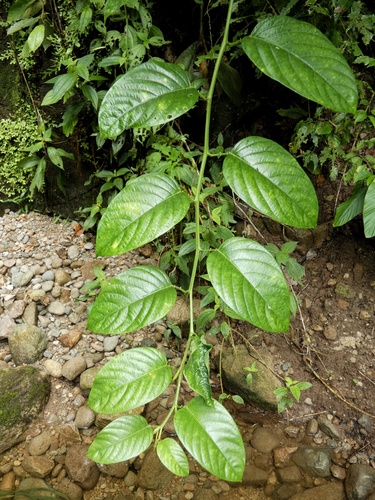
A climbing plant. It grows 6 m high and spreads 2.4-6 m wide. The stems have wings. The leaves are simple and oval and pointed. They are 15 cm long. The edges can have fine teeth. The flowers are 12 cm across and have a scent. The petals are red with purple and white banded filaments. The fruit are oval to pear shaped. They are yellow and 10 cm long. They are edible. It is like a giant granadilla.
Nutrition Score: 34/100
| Part | Moisture | kJ | kcal | Protein | Vit A | Vit C | Iron | Zinc |
|---|---|---|---|---|---|---|---|---|
| Fruit | 84.1 | 259 | 59 | 1.4 | — | 24.7 | 1.1 | — |
How to Grow
Plants can be grown from seed.
Propagation: Seed - best sown as soon as it is ripe along with the pulp which will help break down the seed coat and speed up germination. Stored seed should be soaked for 24 hours in warm water and germination time can be reduced if the seed is then mixed with the juice of a fresh passion fruit (of any species). Even so, it can take 12 months for stored seed to germinate. Place the seed tray in a shady position, maintaining a temperature around 19 - 24°c. Prick the seedlings out into individual containers as soon as they are large enough to handle and plant out when large enough. Cuttings of young shoots, taken at the nodes. The cuttings root best in a neutral to slightly acid compost, but 100% sharp sand also produces good results. Cuttings of fully mature wood taken at a node. They can take 3 months, but there is usually a high percentage. Layering. Very easy. Air layering.
Medicinal Uses
In Brazil, P. alata is officially recognized as a phytomedicine, and was included in first edition of Brazilian Pharmacopoeia in 1929. It is well known in folk medicine throughout South America, though the exact pharmacological composition of the plant is little understood and requires more study.
Other Uses
An extract of the fruits is used as an ingredient in commercial cosmetic preparations as a hair conditioner. An extract of the leaves is used as an ingredient in commercial cosmetic preparations as a akin conditioner.
Wikipedia
Source ↗Passiflora alata, the winged-stem passion flower, is a species of flowering plant. It is an evergreen vine, growing to 6 m (20 ft) or more, which bears an edible type of passion fruit. It is native to the Amazon, from Peru to eastern Brazil.
Other Information
It is a cultivated food plant.
Notes
There are about 400 Passiflora species.
Names & Synonyms
Maracuja grande, Maracuja, Maracuja-acu, Macaruja-melao, Wingstem passionfruit
References (22)
- Bernal, R., et al, (Eds), 2016, Catalogo de Plantas y Liquenes de Colombia, Volumen 2, Magnoliaceae a Zygophyllaceae. Universidad Nacional de Colombia. p 2531
- Bodkin, F., 1991, Encyclopedia Botanica. Cornstalk publishing, p 764
- Bortolotto, I. M., et al, 2018, Lista preliminar das plantas alimenticias nativas de Mato Grosso do Sul, Brasil. Iheringia, Serie Botanica, Porto Alegre, 73 (supl.):101-116
- Curtis ex Aiton
- Brickell, C. (Ed.), 1999, The Royal Horticultural Society A-Z Encyclopedia of Garden Plants. Convent Garden Books. p 754
- Cundall, P., (ed.), 2004, Gardening Australia: flora: the gardener's bible. ABC Books. p 990
- Facciola, S., 1998, Cornucopia 2: a Source Book of Edible Plants. Kampong Publications, p 166
- Hedrick, U.P., 1919, (Ed.), Sturtevant's edible plants of the world. p 465
- Heywood, V.H., Brummitt, R.K., Culham, A., and Seberg, O. 2007, Flowering Plant Families of the World. Royal Botanical Gardens, Kew. p 245
- Hibbert, M., 2002, The Aussie Plant Finder 2002, Florilegium. p 219
- Hunter, D., et al, 2019, The potential of neglected and underutilized species for improving diets and nutrition. Planta (2019) 250:709-729
- Kermath, B. M., et al, 2014, Food Plants in the Americas: A survey of the domesticated, cultivated and wild plants used for Human food in North, Central and South America and the Caribbean. On line draft. p 610
- Kinupp, V. F., 2007, Plantas alimenticias nao-convencionais da regiao metropolitana de Porto Alegre, RS, Brazil p 89
- Kujawska, M. & Luczaj, L., 2015, Wild Edible Plants Used by the Polish Community in Misiones, Argentina. Human Ecology 43:855-869
- Lorenzi, H., Bacher, L., Lacerda, M. & Sartori, S., 2006, Brazilian Fruits & Cultivated Exotics. Sao Paulo, Instituto Plantarum de Estuados da Flora Ltda. p 252
- Miguel, E., et al, 1989, A checklist of the cultivated plants of Cuba. Kulturpflanze 37. 1989, 211-357
- NYBG herbarium "edible"
- Recher, P, 2001, Fruit Spirit Botanical Gardens Plant Index. www.nrg.com.au/~recher/ seedlist.html p 3
- Roa, J. A. G. & Boada, D. S. G., 2018, Fundación para el Fortalecimiento de la Fruticultura y Plantas Alimenticias no Convencionales en Colombia.
- Ulmer, T., & MacDougal, J.M., 2004, Passiflora Passionflowers of the World. Timber Press. p 69
- Uphof,
- van Wyk, B., 2005, Food Plants of the World. An illustrated guide. Timber press. p 280


