Passiflora herbertiana
Ker Gawl.
Passionflower, Native passionfruit
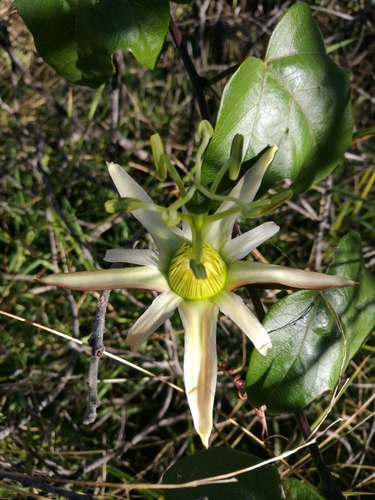
(c) Caroline Cheung, some rights reserved (CC BY-NC-SA), uploaded by Caroline Cheung

(c) Caroline Cheung, some rights reserved (CC BY-NC-SA), uploaded by Caroline Cheung
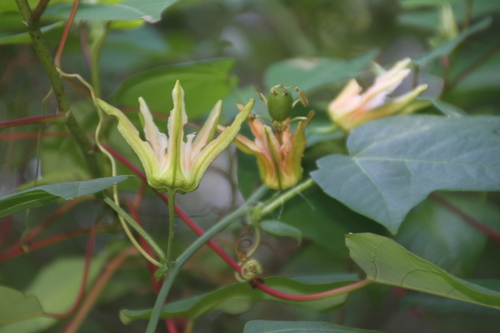
(c) Ian McMaster, some rights reserved (CC BY-NC), uploaded by Ian McMaster
What to Eat
Edible parts: Fruit
The fruit, which grows up to 7cm long, has a fragrant pulp and can be eaten raw or cooked.
Where to Find It
A subtropical plant. It grows in wet sclerophyll forest in New South Wales and Queensland in Australia. Well drained acid soils in tropical, subtropical and warm temperate climates are best. It does best with light shade. A subspecies occurs on Norfolk Island.
Australia*, Lord Howe Island,
How to Identify
A vigorous climber. The young growth is hairy. The stems are slender and with a few hairs. The leaves are 6-12 cm long by 8 cm wide. They have 3-5 lobes. The leaves are deep green and the tips are pointed. The stalk is 7 cm long. There are 2 dark glands near the tip. The flowers are 7 cm across. They are cream but turn greenish-yellow then pink or orange. They occur singly in the axils of the upper leaves. The fruit are 5 cm long by 4 cm wide. They are oval.
How to Grow
Requires a well-drained soil with plenty of moisture in the growing season, otherwise it is not fussy. Plants are not very frost tolerant and are best grown in a greenhouse. However, the roots are somewhat hardier and can survive the winter outdoors if the soil is prevented from freezing. If plants are cut down to the ground by frost they can regenerate from the base. Roots of outdoor grown plants should be restricted to encourage fruiting. Any pruning is best carried out in the spring. If fruit is required, especially when the plant is grown indoors, it is best to hand pollinate, using pollen from a flower that has been open for 12 hours to pollinate a newly opened flower before midday. The flowers open in sunny weather and do not open on dull cloudy days. A climbing plant, attaching itself to other plants by means of tendrils that are produced at the leaf axils. Plants in this genus are notably resistant to honey fungus.
Propagation: Pre-soak seed for 12 hours in warm water, then sow in late winter or early spring in a warm greenhouse. Seed sown in January and grown on quickly can flower and fruit within its first year. Germination takes 1–12 months at 20°C. Prick seedlings out into individual pots once large enough to handle. Plants intended for outdoor growing are best overwintered in the greenhouse during their first year, then planted out in late spring or early summer after the last expected frosts. Mulch roots well in late autumn for cold protection. Take cuttings of young shoots (15cm with a heel) in spring, or use leaf bud cuttings in spring. Cuttings of fully mature wood taken in early summer take about 3 months and have a high success rate.
Medicinal Uses
None known.
Other Uses
None known.
Wikipedia
Source ↗Passiflora herbertiana, or native passionfruit, is a widespread climbing twiner native to moist forests on the coast and ranges of eastern Australia. The subspecies P. h. insulae-howei P.S.Green is endemic to Lord Howe Island in the Tasman Sea.
Production
It is quick growing. Plants last 4-6 years. Fruit ripen 3 months after flowering.
Notes
There are about 400 Passiflora species.
Names & Synonyms
References (19)
- Blomberry, A.M., 1979, Australian Native Plants. Angus and Robertson p 162
- Bodkin, F., 1991, Encyclopedia Botanica. Cornstalk publishing, p 764
- Bot. Reg. 9: t. 737. 1823
- Caton, J.M. & Hardwick, R. J., 2016, Field Guide to Useful Native Plants from Temperate Australia. Harbour Publishing House. p 172
- Cherikoff V. & Isaacs, J., The Bush Food Handbook. How to gather, grow, process and cook Australian Wild Foods. Ti Tree Press, Australia p 196
- Cooper, W. and Cooper, W., 2004, Fruits of the Australian Tropical Rainforest. Nokomis Editions, Victoria, Australia. p 393
- Cribb, A.B. & J.W., 1976, Wild Food in Australia, Fontana. p 67
- Cronin, L., 1989, The Concise Australian Flora. Reed. p 102
- Elliot, W.R., & Jones, D.L., 1997, Encyclopedia of Australian Plants suitable for cultivation. Vol 7. Lothian. p 179
- Flora of Australia, Volume 8, Lecythidales to Batales, Australian Government Publishing Service, Canberra (1982) p 152
- Flora of Australia Volume 49, Oceanic Islands 1, Australian Government Publishing Service, Canberra. (1994) p 127
- Hedrick, U.P., 1919, (Ed.), Sturtevant's edible plants of the world. p 466
- Jones D, L, 1986, Ornamental Rainforest Plants in Australia, Reed Books, p 297, 340
- Lazarides, M. & Hince, B., 1993, Handbook of Economic Plants of Australia, CSIRO. p 184
- Leiper, G & Houser, J., Mutooroo. Plant Use by Australian Aboriginal People. Assembly press, Queensland.
- Morley, B.D., & Toelken, H.R., (Eds), 1983, Flowering Plants in Australia. Rigby. p 97
- Plants for a Future database, The Field, Penpol, Lostwithiel, Cornwall, PL22 0NG, UK. http://www.scs.leeds.ac.uk/pfaf/
- White, G., 2008, The Bush Tucker Survival Guide. https://www.survival.org.au
- World Checklist of Useful Plant Species 2020. Royal Botanic Gardens, Kew


