Passiflora morifolia
Masters
Woodland passionflower
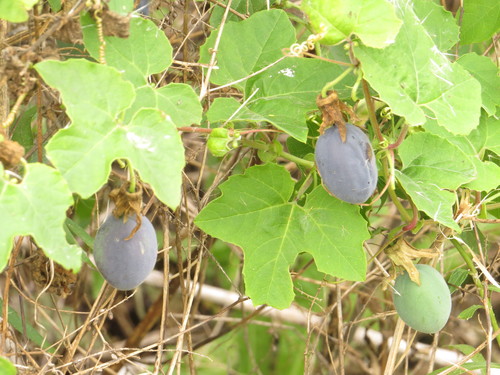
(c) Leonel Roget, some rights reserved (CC BY), uploaded by Leonel Roget
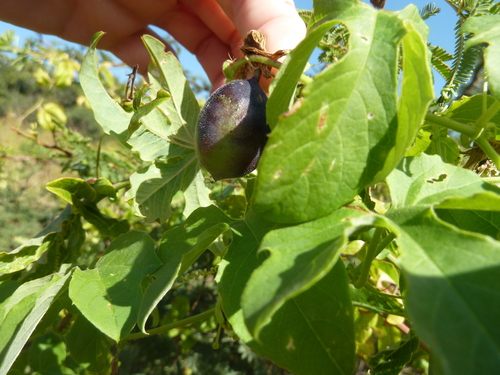
(c) milenka, some rights reserved (CC BY-NC)
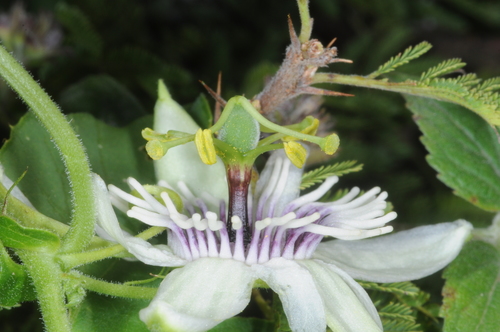
(c) aacocucci, some rights reserved (CC BY), uploaded by aacocucci
What to Eat
Edible parts: Fruit
Fruit.. The whitish pulp is edible - it can be eaten raw and is sometimes preserved. Not a very good flavour.The bluish, purple or black, globose fruit is 17 - 40mm x 11 - 40mm. The purple, globose fruit is around 20mm in diameter.
Where to Find It
A tropical plant.
Africa, Argentina, Asia, Australia, Bolivia, Brazil, Central America, Colombia, East Africa, Guatemala, Indonesia, Malaysia, Pacific, Paraguay, Peru, SE Asia, South America, Zimbabwe,
How to Identify
A climbing herb. The stems are yellow. They are grooved and slightly four angled. There are tendrils in the axils of leaves. The leaves are alternate and have 3 triangle shaped lobes. They are heart shaped at the base. There are teeth around the edge. The leaf stalks are 6 cm long. The flowers occur singly. They are 2-3 cm across. They are white and mottled with red. The fruit are 2 cm across. They are blue-green and roughly hairy.
How to Grow
Passiflora species generally grow best in a sheltered, sunny position or in dappled shade. Most species are found in the wild in moist but well-drained soils, generally of a lighter texture, and will often flower and fruit more heavily if the soil fertility is low. They often develop deep roots and can be moderately tolerant of dry spells. Most Passiflora species prefer a neutral to slightly alkaline soil, growing best where the pH is around 6. 5 - 7.5.
Propagation: Seed - best sown as soon as it is ripe along with the pulp which will help break down the seed coat and speed up germination. Stored seed should be soaked for 24 hours in warm water and germination time can be reduced if the seed is then mixed with the juice of a fresh passion fruit (of any species). Even so, it can take 12 months for stored seed to germinate. Place the seed tray in a shady position, maintaining a temperature around 19 - 24°c. Prick the seedlings out into individual containers as soon as they are large enough to handle and plant out when large enough. Cuttings of young shoots, taken at the nodes. The cuttings root best in a neutral to slightly acid compost, but 100% sharp sand also produces good results. Cuttings of fully mature wood taken at a node. They can take 3 months. Layering. Very easy. Air layering.
Medicinal Uses
The leaves and roots of some, if not all, members of this genus contain a substance called 'passiflorina' which has similaritiesr to morphine and is an effective tranquilizer. We have no specific information for this species but many species are used in herbal infusions to calm the nerves and help bring about a restful sleep. The leaves of many species are also considered to be anthelmintic, antihysteric and diaphoretic. They are used in Brazil to combat intermittent fevers, cutaneous inflammations, and erysipelas.
Wikipedia
Source ↗Passiflora morifolia is a species of flowering plant in the family Passifloraceae. It is sometimes referred to by the common names the blue sweet calabash or woodland passionflower. It grows as a twiner, with white and purple flowers and blue or purple fruit. The very fast-growing vine can grow a few dozen feet in a season. Flowers are ornate, white, blue and purple fruits follow, which ripen to blue or purple. The orange pulp is edible, but not particularly flavoursome. The hardiness of P. morifolia is to at least 32 °F (0 °C), some sources claim as low as 15 to 20 °F (−9 to −7 °C). It grows well in full sun or filtered sun. The vine is fast growing and once established it is quite vigorous. Its propagation is by seed or by cuttings. It is grown as an ornamental. It is not cultivated for its fruit. It is native to Argentina, Bolivia, Brazil, Colombia, Ecuador, Guatemala, Mexico, Paraguay, Peru, and Venezuela.
Notes
There are about 400 Passiflora species.
Names & Synonyms
References (7)
- C. F. P. Martius, Fl. bras. 13(1):555. 1872
- Fouqué, A., 1972, Espèces fruitières d'Amérique tropicale. Institut français de recherches fruitierès outre-mer (As Passiflora warmingii)
- http://www.botanic-gardens-ljubljana.com/en/plants
- Kermath, B. M., et al, 2014, Food Plants in the Americas: A survey of the domesticated, cultivated and wild plants used for Human food in North, Central and South America and the Caribbean. On line draft. p 617
- USDA, ARS, National Genetic Resources Program. Germplasm Resources Information Network - (GRIN). [Online Database] National Germplasm Resources Laboratory, Beltsville, Maryland. Available: www.ars-grin.gov/cgi-bin/npgs/html/econ.pl (10 April 2000)
- Wiersema, J. H. & Leon, B., 2013, World Economic Plants. A Standard Reference CRC Press. 2nd Ed. p 500
- World Checklist of Useful Plant Species 2020. Royal Botanic Gardens, Kew


