Passiflora nitida
Kunth
Bell-apple, Semito

(c) João Medeiros, some rights reserved (CC BY)
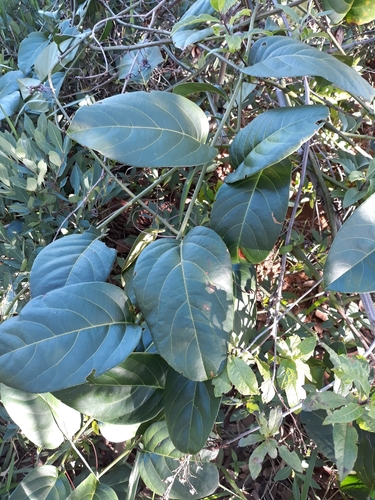
(c) Laurent Quéno, some rights reserved (CC BY-NC), uploaded by Laurent Quéno
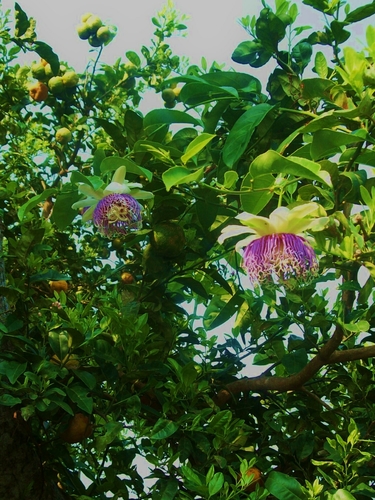
(c) Carlos F Rodríguez, some rights reserved (CC BY-NC), uploaded by Carlos F Rodríguez
What to Eat
Edible parts: Fruit, Seeds
The fruit are eaten fresh; both fruit and seeds are edible. The fruit are popular and sold in markets.
Where to Find It
It is a tropical plant. It grows naturally all over Brazil. It grows on floodplains and uplands.
Asia, Amazon, Bolivia*, Brazil*, Central America, Colombia, Costa Rica, Ecuador, Guiana, Guianas, Guyana, Indonesia, Panama, Peru*, SE Asia, South America, Suriname, Venezuela,
How to Identify
A creeping vine. It can be 15-20 m long. The leaves are oval or oblong. The leaves are 8-20 cm long by 6-10 cm wide. The flowers are 8-11 cm across. They have a scent. The fruit is round The fruit is 5-7 cm across. They are yellow and filled with grey seeds.
How to Grow
It is grown from seed. Seedlings can be transplanted when 30-40 cm loong.
Propagation: Seed - best sown as soon as it is ripe along with the pulp which will help break down the seed coat and speed up germination. Stored seed should be soaked for 24 hours in warm water and germination time can be reduced if the seed is then mixed with the juice of a fresh passion fruit (of any species). Even so, it can take 12 months for stored seed to germinate. Place the seed tray in a shady position, maintaining a temperature around 19 - 24°c. Prick the seedlings out into individual containers as soon as they are large enough to handle and plant out when large enough. Cuttings of young shoots, taken at the nodes. The cuttings root best in a neutral to slightly acid compost, but 100% sharp sand also produces good results. Cuttings of fully mature wood taken at a node. They can take 3 months. Layering. Very easy. Air layering.
Medicinal Uses
The leaves are used to treat intestinal disorders. The leaves and roots of some, if not all, members of this genus contain a substance called 'passiflorina' which has similaritiesr to morphine and is an effective tranquilizer. We have no specific information for this species but many species are used in herbal infusions to calm the nerves and help bring about a restful sleep. The leaves of many species are also considered to be anthelmintic, antihysteric and diaphoretic. They are used in Brazil to combat intermittent fevers, cutaneous inflammations, and erysipelas.
Wikipedia
Source ↗Passiflora nitida, the bell apple, is a tasty, but relatively unknown passion fruit. It is similar to P. laurifolia, with orange-yellow fruits that have a sweet, succulent pulp. It is a fast-growing tropical vine. Its flowers are blue and red, a bit like P. laurifolia and P. quadrangularis. The fruits grow up to 4 centimetres (1.6 in). The exact hardiness in unknown, but it is tropical and should be protected from prolonged temperatures below 50–55 °F (10–13 °C). It is not frost hardy. Passiflora nitida is the cousin of almost all the Passiflora species like P. actinia, P. flavicarpa, P. loefgrenii and so on. Its propagation is by seeds. The fruits are eaten fresh and reportedly quite good in flavor. The bell apple is a native to the Amazon jungle region. Passiflora nitida is also a useful fruit in a drink called Purple Passion. Passiflora nitida has one of the widest geographic ranges. It grows in the tropical lowlands from Costa Rica in the north and French Guiana in the northeast, through wide parts of Brazil.
Other Information
It is a cultivated food plant. The fruit are popular. They are sold in markets.
Notes
There are about 400 Passiflora species.
Names & Synonyms
Granadilla de monte, Granadilla de olor, Granadilla silvestre, Maracuya do rato, Pachio naranja, Merekuya
References (20)
- Grandtner, M. M. & Chevrette, J., 2013, Dictionary of Trees, Volume 2: South America: Nomenclature, Taxonomy and Ecology. Academic Press p 484
- Kermath, B. M., et al, 2014, Food Plants in the Americas: A survey of the domesticated, cultivated and wild plants used for Human food in North, Central and South America and the Caribbean. On line draft. p 617
- Lopez-Diago, D. & Garcia, N., 2021, Wild edible fruits of Colombia. Biota ColomBiana 22 (2) p 47
- Lorenzi, H., Bacher, L., Lacerda, M. & Sartori, S., 2006, Brazilian Fruits & Cultivated Exotics. Sao Paulo, Instituto Plantarum de Estuados da Flora Ltda. p 270
- NYBG herbarium "edible"
- Paz, F. S., et al, 2021, Edible Fruit Plant Species in the Amazon Forest Rely Mostly on Bees and Beetles as Pollinators. Journal of Economic Entomology, XX(XX), 2021, 1–13
- Peres, M. K., 2011, Diasporos do Cerrado Atrativos para Fauna: Chave Interativa Caracterizacao Visual e Relacoes Ecologicas. Masters thesis. Universidade de Brasilia.
- PROSEA
- Reis, S. V. and Lipp, F. L., 1982, New Plant Sources for Drugs and Foods from the New York Botanical Garden herbarium. Harvard. p 197
- Roa, J. A. G. & Boada, D. S. G., 2018, Fundación para el Fortalecimiento de la Fruticultura y Plantas Alimenticias no Convencionales en Colombia.
- Smith, N., et al, 2007, Amazon River Fruits. Flavors for Conservation. Missouri Botanical Gardens Press. p 208
- USDA, ARS, National Genetic Resources Program. Germplasm Resources Information Network - (GRIN). [Online Database] National Germplasm Resources Laboratory, Beltsville, Maryland. Available: www.ars-grin.gov/cgi-bin/npgs/html/econ.pl (10 April 2000)
- van Andel, T., 2000, Useful plants of Guyana. Non-timber forest products of the North-West District of Guyana. Part 2. A Field Guide. Tropenbos-Guyana Programme. p 299
- van Roosmalen, M.G.M., 1985, Fruits of the Guianan Flora. Utrecht Univ. & Wageningen Univ. p 357
- Vasquez, R. and Gentry, A. H., 1989, Use and Misuse of Forest-harvested Fruits in the Iquitos Area. Conservation Biology 3(4): 350f
- Vasquez, Roberto Ch. & Coimbra, German S., 1996, Frutas Silvestres Comestibles de Santa Cruz. p 182
- Villachica, H., (Ed.), 1996, Frutales Y hortalizas promisorios de la Amazonia. FAO, Lima. p 119
- F. W. H. A. von Humboldt et al., Nov. gen. sp. 2:103[folio]; 2:130[quarto]. 1817
- Wiersema, J. H. & Leon, B., 2013, World Economic Plants. A Standard Reference CRC Press. 2nd Ed. p 500
- World Checklist of Useful Plant Species 2020. Royal Botanic Gardens, Kew


