Passiflora subpeltata
Ortega
White passionfruit

(c) riana60, some rights reserved (CC BY-NC), uploaded by riana60
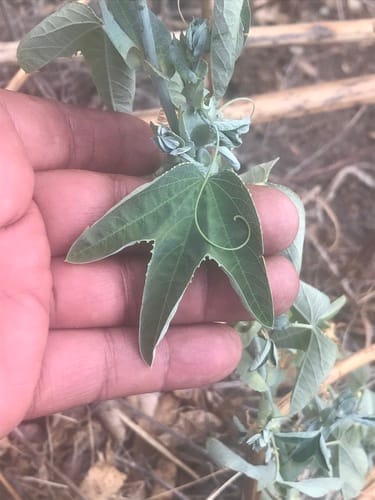
(c) mvz-juangonzalezromero, some rights reserved (CC BY-NC)
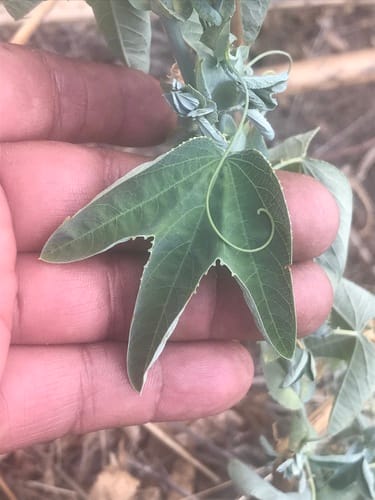
(c) mvz-juangonzalezromero, some rights reserved (CC BY-NC)
What to Eat
Edible parts: Fruit, Leaves
Both the fruit pulp and leaves are edible; the leaves are cooked and eaten as a vegetable, while the fruit pulp is eaten fresh.
Where to Find It
A tropical plant. It grows in areas of disturbed rain-forest. It has become self sown in some warm temperate coastal places. It needs a temperature above 10°C. It is best with a temperature between 15-30°C. In Zimbabwe it grows between 1,300-1,600 m above sea level.
Africa, Asia, Australia, Bahamas*, Brazil, Central America, Cuba*, East Africa, Eswatini, Haiti, India, Madagascar, Mexico, North America, Northeastern India, South Africa, Southern Africa, South America, Swaziland, Venezuela, West Indies*, Zimbabwe,
How to Identify
A vine which climbs by tendrils. The leaves are simple and 6-8 cm long. They can have 3 blunt lobes. The upper side is bluish green while the underside is covered with a waxy bloom. There are 2-4 stalked glands along the leaf stalk. The flowers are white and have conspicuous bracts around the base. The fruit is 20-60 mm long. They hang singly or in pairs in the axils of leaves. The pulp ripens from white to yellow. The pulp has an unpleasant smell. There are many seeds. The pulp is edible.
How to Grow
Passiflora species generally grow best in a sheltered, sunny position or in dappled shade. Most species are found in the wild in moist but well-drained soils, generally of a lighter texture, and will often flower and fruit more heavily if the soil fertility is low. They often develop deep roots and can be moderately tolerant of dry spells. Most Passiflora species prefer a neutral to slightly alkaline soil, growing best where the pH is around 6. 5 - 7.5. The plant is often grown as an ornamental. It has escaped from cultivation in some areas outside its native range and is invading native habitats.
Propagation: Seed - best sown as soon as it is ripe along with the pulp which will help break down the seed coat and speed up germination. Stored seed should be soaked for 24 hours in warm water and germination time can be reduced if the seed is then mixed with the juice of a fresh passion fruit (of any species). Even so, it can take 12 months for stored seed to germinate. Place the seed tray in a shady position, maintaining a temperature around 19 - 24°c. Prick the seedlings out into individual containers as soon as they are large enough to handle and plant out when large enough. Cuttings of young shoots, taken at the nodes. The cuttings root best in a neutral to slightly acid compost, but 100% sharp sand also produces good results. Cuttings of fully mature wood taken at a node. They can take 3 months. Layering. Very easy. Air layering.
Medicinal Uses
The leaves and roots of some, if not all, members of this genus contain a substance called 'passiflorina' which has similaritiesr to morphine and is an effective tranquilizer. We have no specific information for this species but many species are used in herbal infusions to calm the nerves and help bring about a restful sleep. The leaves of many species are also considered to be anthelmintic, antihysteric and diaphoretic. They are used in Brazil to combat intermittent fevers, cutaneous inflammations, and erysipelas.
Wikipedia
Source ↗Passiflora subpeltata, commonly known as white passionflower, is a passion flower bearing yellow-green fruits. It is a vining plant with three-lobed leaves and 2-3 ornate flowers. It is grown as an ornamental plant. This vine is also a marginal pest in areas.
Other Information
It is enjoyed by children.
Notes
There are about 400 Passiflora species.
Names & Synonyms
Granadina, Kilela, Malai kovai, Mufuranta, Nhabel
References (16)
- Chase, P. & Singh, O. P., 2016, Bioresources of Nagaland: A Case of Wild 4 Edible Fruits in Khonoma Village Forest. in J. Purkayastha (ed.), Bioprospecting of Indigenous Bioresources of North-East India. p 51
- Cooper W & Cooper W T, 1994, Fruits of the Rain Forest. RD Press p 218
- Cooper, W. and Cooper, W., 2004, Fruits of the Australian Tropical Rainforest. Nokomis Editions, Victoria, Australia. p 394
- Flora of Australia, Volume 8, Lecythidales to Batales, Australian Government Publishing Service, Canberra (1982) p 156
- Jones, D.L. & Gray, B., 1977, Australian Climbing Plants. Reed. p 155
- Kannan, M., et al, 2015, Ethnobotanical survey on wild edible plants of Kalrayan Hills, Salem District, Tamil Nadu, India. Global J. Res. Med Plants & Indigen. med. 4(12): 236-246
- Lamp, C & Collet F., 1989, Field Guide to Weeds in Australia. Inkata Press. p 206
- Lazarides, M. & Hince, B., 1993, Handbook of Economic Plants of Australia, CSIRO. p 184
- Long, C., 2005, Swaziland's Flora - siSwati names and Uses http://www.sntc.org.sz/flora/
- Melzer, R. & Plumb, J., 2011, Plants of Capricornia. Belgamba, Rockhampton. p 541
- Mokganya, M. G. et al, 2018, An evaluation of additional uses of some wild edible fruit plants of the Vhembe District Municipality in the Limpopo Province, South Africa. Indian Journal of Traditional Knowledge. Vol 17(2) April 2018, pp 276-281
- Nov. pl. descr. dec. 6:78. 1798
- Plants of Haiti Smithsonian Institute http://botany.si.edu/antilles/West Indies
- Porcher, V., et al, 2022, Growing up in the Betsileo landscape: Children’s wild edible plants knowledge in Madagascar. PLoS ONE 17(2): e0264147.
- Ramachandran,V. S., & Udhayavani, C., 2013, Knowledge and uses of wild edible plants by Paniyas and Kurumbas of Western Nilgiris, Tamil Nadu. Indian Journal of Natural Products and Resources. 4(4) December 2013, pp 412-418
- Swaziland's Flora Database http://www.sntc.org.sz/flora


