Pastinaca sativa
L.
Parsnip
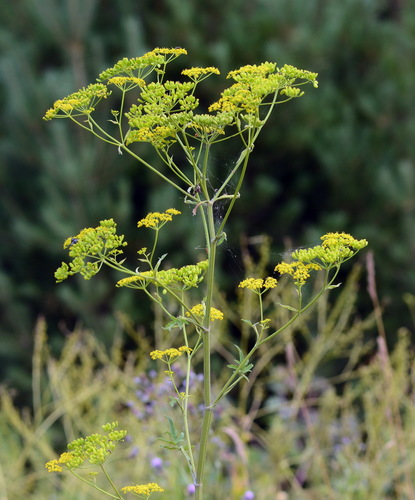
(c) Pavel Gorbunov, some rights reserved (CC BY-NC), uploaded by Pavel Gorbunov

(c) Larry Clarfeld, some rights reserved (CC BY-NC), uploaded by Larry Clarfeld

(c) Douglas Goldman, some rights reserved (CC BY-SA), uploaded by Douglas Goldman
What to Eat
Edible parts: Root, Leaves, Seeds, Spice, Vegetable
The root can be eaten raw or cooked. When well grown, the cooked root has a very tender texture, though it is rather chewy raw. Flavour improves after autumn frosts, becoming noticeably sweeter. It is delicious baked, works well in soups, and can be added to cakes, pies, and puddings. Young leaves and shoots are cooked with other greens as a vegetable or added to soups, particularly in early spring. The seed is used as a condiment with a flavour similar to dill.
Known Hazards
Dangerous Lookalikes
This plant can be confused with the following toxic species. Always verify identification carefully before consuming any wild plant.


Poison Hemlock: Smooth stems with purple blotches, foul musty smell, white flowers.
Parsnip: Grooved stems, distinctive parsnip/celery scent, yellow flowers.


Hemlock Water Dropwort: Grows near water, white flowers, roots exude yellowish sap when cut, causes violent convulsions.
Parsnip: Grows in dry/disturbed ground, grooved stem, yellow flowers.
Where to Find It
It is a temperate plant. It grows in the highlands in the tropics from 1700-2600 m altitude. It is frost resistant. In Argentina it grows between 500-1,500 m above sea level. In Papua New Guinea it grows between 1,160-2,790 m above sea level. It suits hardiness zones 4-8.
Africa, Albania, Algeria, Argentina, Asia, Australia, Austria, Balkans, Belgium, Bosnia, Britain, Bulgaria, Caucasus, Chile, China, Cuba, Czech Republic, Dominican Republic, East Africa, Ecuador, Eswatini, Europe*, France, Germany, Greece, Haiti, Hawaii, Hungary, India, Indochina, Ireland, Italy, Jamaica, Laos, Luxembourg, Macedonia, Malaysia, Mediterranean, Morocco, Myanmar, Netherlands, New Zealand, North Africa, North America, Norway, Pacific, Papua New Guinea, PNG, Peru, Philippines, Poland, Romania, Russia, SE Asia, Scandinavia, Serbia, Slovenia, South Africa, Southern Africa, South America, Spain, Swaziland, Switzerland, Tasmania, Turkey, Türkiye, Ukraine, Uruguay, USA, West Indies, Yugoslavia, Zimbabwe,
How to Identify
A herb with long thickened tap root. The stems are angular and have grooves along them. The leaves are divided. The ones near the base have 5-11 lobes. These are oval and have teeth along the edge. The thickened root is yellowish white. The taproot can be 3 m long. Wild parsnip grows in some temperate places. It has a very strong parsnip smell. It can be used as food.
Nutrition Score: 42/100
| Part | Moisture | kJ | kcal | Protein | Vit A | Vit C | Iron | Zinc |
|---|---|---|---|---|---|---|---|---|
| Roots | 79.5 | 3140 | 750 | 1.2 | — | 17 | 0.6 | — |
| Root - boiled | 83.2 | 238 | 57 | 1.3 | 0 | 10 | 0.5 | 0.1 |
| Root - raw | 82.5 | 210 | 50 | 1.7 | 0 | 15 | 0.6 | 0.1 |
How to Grow
Succeeds in most ordinary well-drained soils. Requires an open situation. Prefers a deep rich soil that is not too stiff. The parsnip is often cultivated in the temperate zone for its edible root, there are a number of named varieties. Normally cultivated as a winter root crop, some cultivars are faster to mature and can be available in late summer. The roots are very frost hardy and can be left in the ground to be harvested as required, though they can also be lifted in the autumn and stored for a few months. The flowers are very attractive to hover flies and predatory wasps. Plants have very few insect pests, though they are sometimes attacked by carrot root fly. Growing onions with the parsnips can reduce the damage. Roots of the wild form can quite quickly be increased in size by selective breeding and good cultivation, it is possible to obtain good sized roots in only 6 years. In garden design, as well as the above-ground architecture of a plant, root structure considerations help in choosing plants that work together for their optimal soil requirements including nutrients and water. Thick or swollen - fibrous or tap root.
Propagation: Sow seed from late winter to late spring directly in situ. Germination can be slow, especially from earlier sowings; sowing a few radishes in the same rows helps mark them. Seed viability is short — very few seeds remain viable 15 months after harvesting.
Medicinal Uses
A tea made from the roots has been used in the treatment of women's complaints. A poultice of the roots has been applied to inflammations and sores. The root contains xanthotoxin, which is used in the treatment of psoriasis and vitiligo. Xanthotoxin is also the substance responsible for photosensitivity reactions.
Other Uses
The leaves and roots can be made into an insect spray. Roughly chop the leaves and roots, place them in a basin with enough water to cover, leave overnight, then strain and use as an insecticide against aphids and red spider mite.
Wikipedia
Source ↗This is incorrect, this is not the same as parsnip, it is wild parsnip, a toxic plant. Do the research. http://www.dnr.state.mn.us/invasives/terrestrialplants/herbaceous/wildparsnip.html
Production
Plants are slow growing. The taste is best after the first frosts.
Other Information
It is a commercially cultivated vegetable. In Papua New Guinea, it is not widely grown and not liked by many people. It is a vegetable of minor importance in the tropics.
Notes
There are 14 Pastinaca species. Parsnips contain psoralens which has been linked with some cancers.
Names & Synonyms
Chirivia, Hammelmohre, Navadni rebrinec, Panais, Pastunak sety, Patinak, Pastinaca, Ywetsa-monla
References (52)
- Beckstrom-Sternberg, Stephen M., and James A. Duke. "The Foodplant Database." http://probe.nalusda.gov:8300/cgi-bin/browse/foodplantdb.(ACEDB version 4.0 - data version July 1994)
- Bodkin, F., 1991, Encyclopedia Botanica. Cornstalk publishing, p 765
- Bourke, R. M., Altitudinal limits of 230 economic crop species in Papua New Guinea. Terra australis 32
- Burkill, I.H., 1966, A Dictionary of the Economic Products of the Malay Peninsula. Ministry of Agriculture and Cooperatives, Kuala Lumpur, Malaysia. Vol 2 (I-Z) p 1706
- Cerne, M., 1992, Wild Plants from Slovenia used as Vegetables. Acta Horticulturae 318
- Cheifetz, A., (ed), 1999, 500 popular vegetables, herbs, fruits and nuts for Australian Gardeners. Random House p 85
- Cundall, P., (ed.), 2004, Gardening Australia: flora: the gardener's bible. ABC Books. p 992
- Curtis, W.M., 1963, The Students Flora of Tasmania Vol 2 p 261
- Denes, A., et al, 2012, Wild plants used for food by Hungarian ethnic groups living in the Carpathian Basin. Acta Societatis Botanicorum Poloniae 81 (4): 381-396
- Dogan, A., et al, 2014, A review of edible plants on the Turkish Apiaceae species. J. Fac. Pharm. Istanbul, 44(2) pp 251-262
- Ertug, F, Yenen Bitkiler. Resimli Türkiye Florası -I- Flora of Turkey - Ethnobotany supplement
- Esperanca, M. J., 1988. Surviving in the wild. A glance at the wild plants and their uses. Vol. 2. p 135 (As Peucedanum sativum)
- Facciola, S., 1998, Cornucopia 2: a Source Book of Edible Plants. Kampong Publications, p 21
- French, B.R., 1986, Food Plants of Papua New Guinea, A Compendium. Asia Pacific Science Foundation p 147
- Grubben, G. J. H. and Denton, O. A. (eds), 2004, Plant Resources of Tropical Africa 2. Vegetables. PROTA, Wageningen, Netherlands. p 409
- Hadfield, J., 2001, The A-Z of Vegetable Gardening in South Africa. Struik p 114
- Hedrick, U.P., 1919, (Ed.), Sturtevant's edible plants of the world. p 474 (As Peucedanum sativum)
- http://www.botanic-gardens-ljubljana.com/en/plants
- Hussey, B.M.J., Keighery, G.J., Cousens, R.D., Dodd, J., Lloyd, S.G., 1997, Western Weeds. A guide to the weeds of Western Australia. Plant Protection Society of Western Australia. p 84
- Hu, Shiu-ying, 2005, Food Plants of China. The Chinese University Press. p 601
- Irving, M., 2009, The Forager Handbook, A Guide to the Edible Plants of Britain. Ebury Press p 128
- Jardin, C., 1970, List of Foods Used In Africa, FAO Nutrition Information Document Series No 2.p 93
- Kays, S. J., and Dias, J. C. S., 1995, Common Names of Commercially Cultivated Vegetables of the World in 15 languages. Economic Botany, Vol. 49, No. 2, pp. 115-152
- Kiple, K.F. & Ornelas, K.C., (eds), 2000, The Cambridge World History of Food. CUP p 433
- Lazarides, M. & Hince, B., 1993, Handbook of Economic Plants of Australia, CSIRO. p 184
- Lim, T. K., 2015, Edible Medicinal and Non Medicinal Plants. Volume 9, Modified Stems, Roots, Bulbs. Springer p 63
- Long, C., 2005, Swaziland's Flora - siSwati names and Uses http://www.sntc.org.sz/flora/
- Łukasz Łuczaj and Wojciech M Szymański, 2007, Wild vascular plants gathered for consumption in the Polish countryside: a review. J Ethnobiol Ethnomedicine. 3: 17
- Lukasz, L., 2016, Wild Edible Plants Traditionally Used in Poland.
- Macmillan, H.F. (Revised Barlow, H.S., et al), 1991, Tropical Planting and Gardening. Sixth edition. Malayan Nature Society. Kuala Lumpur. p 367
- Mabey, R., 1973, Food for Free. A Guide to the edible wild plants of Britain, Collins. p 62
- Miguel, E., et al, 1989, A checklist of the cultivated plants of Cuba. Kulturpflanze 37. 1989, 211-357
- Paczkowska, G. & Chapman, A.R., 2000, The Western Australian Flora. A Descriptive Catalogue. Western Australian Herbarium. p 147
- Pieroni, A. & Soukand, R., 2018, Forest as Stronghold of Local Ecological Practice: Currently Used Wild Food Plants in Polesia, Northern Ukraine. Economic Botany, XX(X) pp. 1-21
- Plants for a Future database, The Field, Penpol, Lostwithiel, Cornwall, PL22 0NG, UK. http://www.scs.leeds.ac.uk/pfaf/
- Plants of Haiti Smithsonian Institute http://botany.si.edu
- Redzic, S. J., 2006, Wild Edible Plants and their Traditional Use in the Human Nutrition in Bosnia-Herzegovina. Ecology of Food and Nutrition, 45:189-232
- Redzic, S., 2010, Use of Wild and Semi-Wild Edible Plants in Nutrition and Survival of People in 1430 Days of Siege of Sarajevo during the War in Bosnia and Herzegovina (1992–1995). Coll. Antropol 34 (2010) 2:551-570
- Sansanelli, S., et al, 2017, Ethnobotanical survey of wild food plants traditionally collected and consumed in the Middle Agri Valley (Basilicata region, southern Italy). Journal of Ethnobiology and Ethnomedicine (2017) 13:50
- Schneider, E., 2001, Vegetables from Amaranth to Zucchini: The essential reference. HarperCollins. p 473
- Skinner, G. & Brown, 1981, C., Simply Living. A gatherer's guide to New Zealand's fields, forests and shores. Reed. p 28
- Simkova, K. et al, 2014, Ethnobotanical review of wild edible plants used in the Czech Republic. Journal of Applied Botany and Food Quality 88, 49-67
- Smith, P.M., 1979, Parsnip, in Simmonds, N.W., (ed), Crop Plant Evolution. Longmans. London. p 322
- Sp. pl. 1:262. 1753
- Staples, G.W. and Herbst, D.R., 2005, A tropical Garden Flora. Bishop Museum Press, Honolulu, Hawaii. p 116
- Swaziland's Flora Database http://www.sntc.org.sz/flora
- Tasmanian Herbarium Vascular Plants list p 3
- Terra, G.J.A., 1973, Tropical Vegetables. Communication 54e Royal Tropical Institute, Amsterdam, p 65
- Torre, de la L., et al, 2008, Enciclopedia de las Plantas Útiles del Ecuador. Herbario QCA. Pontificia Universidad Católica del Ecuador. p 171
- USDA, ARS, National Genetic Resources Program. Germplasm Resources Information Network - (GRIN). [Online Database] National Germplasm Resources Laboratory, Beltsville, Maryland. Available: www.ars-grin.gov/cgi-bin/npgs/html/econ.pl (10 April 2000)
- Wiersema, J. H. & Leon, B., 2013, World Economic Plants. A Standard Reference CRC Press. 2nd Ed. p 501
- World Checklist of Useful Plant Species 2020. Royal Botanic Gardens, Kew