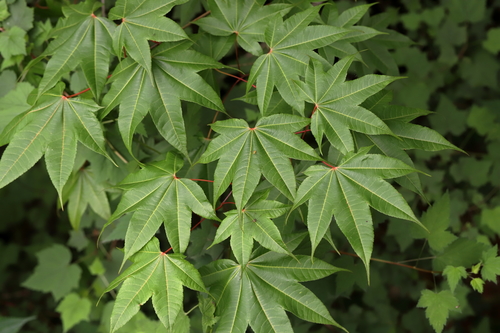
Paullinia yoco
R. E. Schultes & Killip
Yoco, Yoko

Husskeyy (via Wikimedia Commons)

Rapid Reference Collection (RRC) | Field Museum of Natural History - Keller Science Action Center

President and Fellows of Harvard College

President and Fellows of Harvard College
What to Eat
Edible parts: Bark - coffee, Stems - drink, Fruit
The softer tissues of the bark, stems, and wood are used to extract a white or brownish sap containing 2.73% caffeine, used as a stimulating beverage. To prepare it, the stem is cut into pieces 30–100cm long and the epidermis, cortex, and phloem are rasped. The scrapings are squeezed to express the caffeine-bearing sap into cold water — hot or warm water is never used. The resulting cloudy milky-white or light chocolate-brown liquid is drunk cold, typically early every morning, where it allays hunger and provides muscular stimulation. Only lianas with a stem at least 8cm in diameter at the base are used. Several trees may need to be felled before the liana reaches the ground. The cut stem pieces are stored in cool corners of houses and can retain their stimulating properties for a month or longer.
Where to Find It
A tropical plant.
Amazon, Colombia*, Ecuador*, Peru*, South America,
How to Identify
A vine. The stems can be 12 cm across. They attach to other plants by tendrils.
How to Grow
Not known
Propagation: Seed.
Medicinal Uses
A beverage made from the stem is taken medicinally as a febrifuge and as a treatment for a bilious disease. In larger dosages, it is used as an anti-malarial febrifuge and as a medicine for a bilious disease common in the Putumayo region.
Other Uses
None known
Wikipedia
An evergreen climbing vine reaching 15 m tall and 2 m wide at a medium growth rate. Hardy to UK zone 10. The vine grows in light sandy, medium loamy, or heavy clay soils with good drainage, tolerating mildly acidic through mildly alkaline pH. It thrives in semi-shade or full sun and prefers moist soil. Bee-pollinated flowers develop on sturdy stems at least 8 cm in diameter at the base.
Notes
It contains caffeine.
Names & Synonyms
Yoco, yoko.
References (11)
- Bot. Mus. Leafl. 10:302. 1942
- Etkin, N.L. (Ed.), 1994, Eating on the Wild Side, Univ. of Arizona. p 158
- Hermandez Bermejo, J.E., and Leon, J. (Eds.), 1994, Neglected Crops. 1492 from a different perspective. FAO Plant Production and Protection Series No 26. FAO, Rome. p 226
- Kermath, B. M., et al, 2014, Food Plants in the Americas: A survey of the domesticated, cultivated and wild plants used for Human food in North, Central and South America and the Caribbean. On line draft. p 623
- Lopez-Diago, D. & Garcia, N., 2021, Wild edible fruits of Colombia. Biota ColomBiana 22 (2) p 51
- Purseglove, J.W., 1968, Tropical Crops Dicotyledons, Longmans. p 644
- Roa, J. A. G. & Boada, D. S. G., 2018, Fundación para el Fortalecimiento de la Fruticultura y Plantas Alimenticias no Convencionales en Colombia.
- Schultes, R. E., 1987, A Caffeine Drink Prepared from Bark. Economic Botany 41(4) 526-527
- van Wyk, B., 2005, Food Plants of the World. An illustrated guide. Timber press. p 282
- Wiersema, J. H. & Leon, B., 2013, World Economic Plants. A Standard Reference CRC Press. 2nd Ed. p 501
- World Checklist of Useful Plant Species 2020. Royal Botanic Gardens, Kew