Pavetta lanceolata
Eckl.
Kaffir bride, Christmas tree
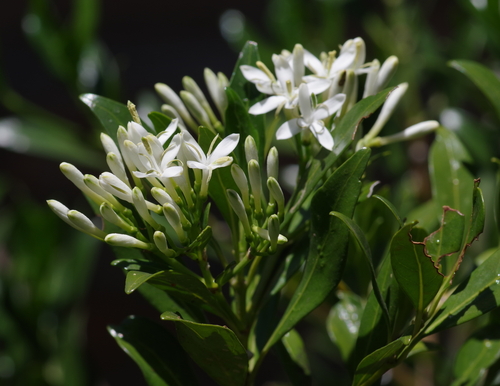
(c) Craig Peter, some rights reserved (CC BY-NC), uploaded by Craig Peter

(c) aldynl, some rights reserved (CC BY-NC)

(c) Samantha Mteshane, some rights reserved (CC BY-NC), uploaded by Samantha Mteshane
What to Eat
Edible parts: Leaves
The leaves of the Pavetta tristis form are eaten as a vegetable and taste similar to watercress.
Where to Find It
A subtropical plant. It grows in coastal and inland forests in South Africa. It suits hardiness zones 10-11.
Africa, Australia, Eswatini, South Africa, Southern Africa, Swaziland, Zambia,
How to Identify
A shrub or medium sized tree. The trunk can be 23 cm across. The leaves are opposite and simple. They are slender and 3.8-11 cm long. They are narrowed at both ends. The leaves are pointed and shiny above and dull beneath. The edges of the leaves are often rolled inwards. The flowers are large and tubular. The tube is 1.9 cm long. The fruit are small and round. They are pea sized and black. The leaves of the form known as Pavetta tristis are edible.
How to Grow
Prefers a position in full sun, growing best in a fertile, humus-rich but well-drained soil. Many Pavetta species, including this one, produce leaves with bacterial nodes - these bacteria live in symbiosis with the plant and pass into any seeds that are produced, thus seedlings are already inocculated with the bacteria. It is not certain what function the bacteria play, theories include nitrogen-fixation, growth-regulation and making the leaves poisonous to livestock.
Propagation: Seed - Cuttings Air layering
Medicinal Uses
The leaves of the tristis form are used traditionally.
Notes
There are about 400 Pavetta species. They grow in the tropics.
Names & Synonyms
Christmas bush, Forest bride's bush, Weeping bride's bush
References (11)
- Cundall, P., (ed.), 2004, Gardening Australia: flora: the gardener's bible. ABC Books. p 993
- Etherington, K., & Imwold, D., (Eds), 2001, Botanica's Trees & Shrubs. The illustrated A-Z of over 8500 trees and shrubs. Random House, Australia. p 513
- Ferns, Useful Tropical Plants
- Fox, F. W. & Young, M. E. N., 1982, Food from the Veld. Delta Books. p 324
- https://growwild.co.za Edible Indigenous plants
- Long, C., 2005, Swaziland's Flora - siSwati names and Uses http://www.sntc.org.sz/flora/
- Palgrave, K.C., 1996, Trees of Southern Africa. Struik Publishers. p 896
- Palmer, E and Pitman, N., 1972, Trees of Southern Africa. Vol. 2. A.A. Balkema, Cape Town p 2117
- Ruiters-Welcome, A. K., 2019, Food plants of southern Africa. Ph.D. thesis. Univ. of Johannesburg p 97
- Swaziland's Flora Database http://www.sntc.org.sz/flora
- Welcome, A. K. & Van Wyk, B.-E., 2019, An inventory and analysis of the food plants of southern Africa. South African Journal of Botany 122 (2019) 136–179


