Pedalium murex
L.
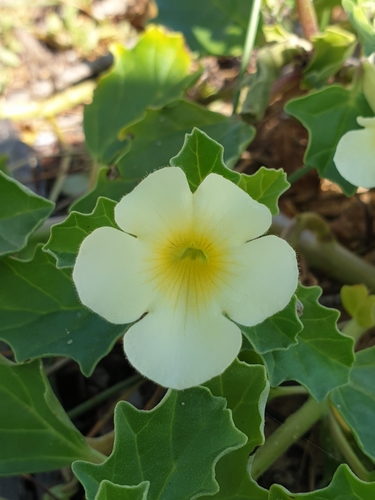
(c) Aravinth, some rights reserved (CC BY), uploaded by Aravinth

(c) Dinesh Valke, some rights reserved (CC BY-SA)
What to Eat
Edible parts: Leaves, Vegetable
The leaves are boiled and eaten as a vegetable. The leafy stems are used to thicken buttermilk; when stirred briskly in cold water they produce a thick mucilage similar to raw egg white.
Known Hazards
Where to Find It
It is a tropical plant. It grows on moist alluvial flats. It can grow in salty soil. It needs an annual rainfall above 500 mm. It can grow in arid places. It is often near the edges of beaches. It can grow in salty, sandy and limestone soils.
Asia, Africa, Côte d'Ivoire, East Africa, Ethiopia, Ghana, India, Indonesia, Ivory Coast, Kenya, Madagascar, Mozambique, Myanmar, Nigeria, Pakistan, SE Asia, Socotra, Somalia, Southern Africa, Sri Lanka, Tanzania, Togo, West Africa,
How to Identify
An annual plant. It has many branches. It is spreading and succulent. It grows 60 cm tall. It can cover an area one metre across. The roots are the colour of turmeric. The leaves are simple and opposite. They are oval. They are 1-5 cm long by 1-3 cm wide. They have coarse teeth. The flowers are about 2 cm across. The fruit are 1-1.8 cm long and narrow at the base and have spreading spines at the other end. There are 1 or 2 seeds in each section. The seeds are oblong.
Medicinal Uses
The plant is a popular traditional medicine in many areas where the plant grows wild. There is no information on the chemical composition of the leaves, but alkaloids, a greenish fatty oil, a little resin, phenolic acids, vanillin and flavones have been isolated from the fruits. By soaking, a mucilaginous mass is formed in the water, which is a popular demulcent medicine. The water in which the leaves have been boiled, or a decoction of the root, is drunk to treat venereal diseases. The leaves and roots have been used in a clinical test with patients suffering from gonorrhoea; it was found to have no effect. The viscid mucilage produced by soaking the plant is used as a demulcent, diuretic and tonic, to treat gonorrhoea and dysuria, and to dissolve urethral stones. The plant is taken as an emmenagogue and oxytocic and the root is considered antibilious.
Other Uses
The plant is an indicator of saline soils.
Other Information
A minor leafy vegetable of only local importance.
Notes
There is only one Pedalium species.
Names & Synonyms
Ana nerinnil, Anai-nerunji, Annegalu-gida, Bara-ghokru, Bara-gokhru, Burra gookeroo, Enugu-palleri, Gokara, Gokhru, Gokru kalan, Gokshura, Hatti-charatte, Kadvagokkru, Kakamulla, Motte-gokharu, Motto-gokharu, Peda palleru, Peru-nerunji, Su-le-gyi, Wilayati gokhru, Yaanai nerunchil
References (14)
- Ambasta, S.P. (Ed.), 2000, The Useful Plants of India. CSIR India. p 435
- Burkill, H. M., 1985, The useful plants of west tropical Africa, Vol. 4. Kew.
- Dobriyal, M. J. R. & Dobriyal, R., 2014, Non Wood Forest Produce an Option for Ethnic Food and Nutritional Security in India. Int. J. of Usuf. Mngt. 15(1):17-37
- Facciola, S., 1998, Cornucopia 2: a Source Book of Edible Plants. Kampong Publications, p 168
- Flora of Pakistan. www.eFloras.org
- Grubben, G. J. H. and Denton, O. A. (eds), 2004, Plant Resources of Tropical Africa 2. Vegetables. PROTA, Wageningen, Netherlands. p 409
- Hedrick, U.P., 1919, (Ed.), Sturtevant's edible plants of the world. p 469
- Jardin, C., 1970, List of Foods Used In Africa, FAO Nutrition Information Document Series No 2.p 93
- Martin, F.W. & Ruberte, R.M., 1979, Edible Leaves of the Tropics. Antillian College Press, Mayaguez, Puerto Rico. p 211
- Royal Botanic Gardens, Kew (1999). Survey of Economic Plants for Arid and Semi-Arid Lands (SEPASAL) database. Published on the Internet; http://www.rbgkew.org.uk/ceb/sepasal/internet [Accessed 5th May 2011]
- SAXENA,
- Syst. nat. ed. 10, 2:1123. 1759
- Uphof,
- World Checklist of Useful Plant Species 2020. Royal Botanic Gardens, Kew


