Pelargonium bowkeri
Harvey

(c) Duncan McKenzie, some rights reserved (CC BY-NC), uploaded by Duncan McKenzie
(c) themba_nsibande, some rights reserved (CC BY-NC), uploaded by themba_nsibande

(c) afromomum, some rights reserved (CC BY-NC)
What to Eat
Edible parts: Leaves, Root
The leaves are edible, though no further details on preparation or use are recorded.
Where to Find It
It is a Mediterranean plant. It grows between 300-2.200 m altitude in South Africa. It grows in areas with an annual rainfall between 600-800 mm. It can tolerate frost. It can grow in arid places. It suits hardiness zones 9-10.
Africa, Australia, Europe, Lesotho, South Africa*, Southern Africa,
How to Identify
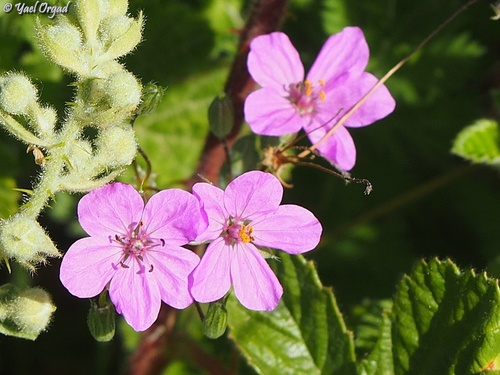
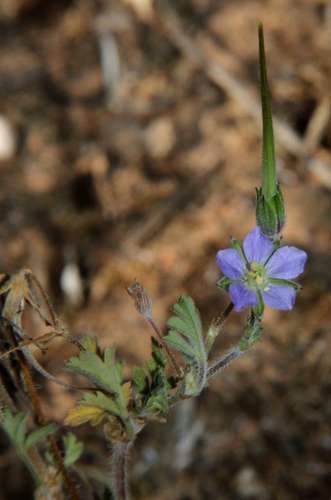
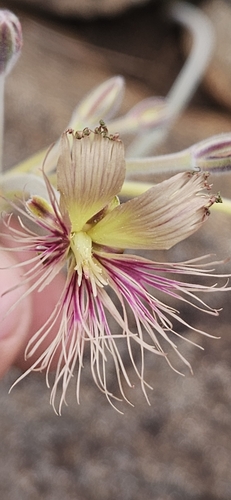
A herb or small shrub which forms tubers and over-winters using these. It grows 30-40 cm high and spreads 50-100 cm wide. The roots are thickened and like tubers. The lower leaves are simple, rounded and have teeth. The later leaves are finely divided and like feathers. The flowers have fringed petals. They are pink. There are 2 upper petals and then the lower petals are finely divided into filaments.
How to Grow
Requires a light well-drained neutral to alkaline soil in a sunny position. Plants are not very hardy in Britain, they generally require greenhouse protection but might succeed outdoors when grown in a very sheltered warm spot in the mildest parts of the country. They can also be grown in containers that are placed outdoors in the summer and then brought into the greenhouse or conservatory for the winter. The plants need to be kept fairly dry in the winter. Very tolerant of pruning, they can be cut right down to the base in the autumn when bringing them back indoors, or in the spring to encourage lots of fresh growth.
Propagation: Sow seed as soon as it is ripe in a greenhouse, or in early spring if using stored seed. A minimum germination temperature of 13°C is recommended; seeds usually sprout within 2 weeks, though germination can sometimes take several months. Prick seedlings out into individual pots when large enough to handle and overwinter them under glass for at least their first year. If planting outdoors, do so in early summer and consider extra winter protection. Cuttings can be taken at almost any point during the growing season, though early summer is ideal to allow the new plant to establish before winter.
Medicinal Uses
All parts of the plant are astringent.
Other Uses
None known.
Wikipedia
Source ↗A frost-tender perennial suitable for light sandy or medium loamy, well-drained soils with mildly acid to basic pH. Flowers bloom July to August. The plant requires full sun and adapts to both dry and moist soil conditions.
Other Information
The leaves are eaten especially by children.
Notes
There are about 230 Pelargonium species.
Names & Synonyms
Bolila khomo, Khvaara, Kxoara
References (11)
- Cundall, P., (ed.), 2004, Gardening Australia: flora: the gardener's bible. ABC Books. p 995
- Fox, F. W. & Young, M. E. N., 1982, Food from the Veld. Delta Books. p 235
- Guillarmod, J., 1971,
- W. H. Harvey & O. W. Sonder, Fl. cap. 2:592. 1862
- Morley, B. & Everard, B., 1970, Wild Flowers of the World. Ebury press. Plate 74
- Peters, C. R., O'Brien, E. M., and Drummond, R.B., 1992, Edible Wild plants of Sub-saharan Africa. Kew. p 115
- Plants for a Future database, The Field, Penpol, Lostwithiel, Cornwall, PL22 0NG, UK. http://www.scs.leeds.ac.uk/pfaf/
- Royal Botanic Gardens, Kew (1999). Survey of Economic Plants for Arid and Semi-Arid Lands (SEPASAL) database. Published on the Internet; http://www.rbgkew.org.uk/ceb/sepasal/internet [Accessed 16th April 2011]
- Ruiters-Welcome, A. K., 2019, Food plants of southern Africa. Ph.D. thesis. Univ. of Johannesburg p 64
- Welcome, A. K. & Van Wyk, B.-E., 2019, An inventory and analysis of the food plants of southern Africa. South African Journal of Botany 122 (2019) 136–179
- World Checklist of Useful Plant Species 2020. Royal Botanic Gardens, Kew