Pellionia repens
(Lour.) Merr.
Trailing watermelon begonia
(c) 陳育維, some rights reserved (CC BY-NC)
(c) 陳育維, some rights reserved (CC BY-NC)
(c) 陳育維, some rights reserved (CC BY-NC)
Where to Find It
A tropical plant. It grows in dark damp places between 800-1,100 m above sea level in southern China. In Brisbane Botanical Gardens. In Yunnan.
Asia, Australia, Bhutan, Cambodia, China, Himalayas, India, Indochina, Indonesia, Laos, Malaysia, Myanmar, Philippines, SE Asia, Singapore, Thailand, Vietnam,
How to Identify
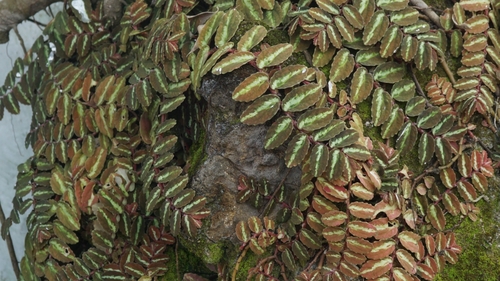
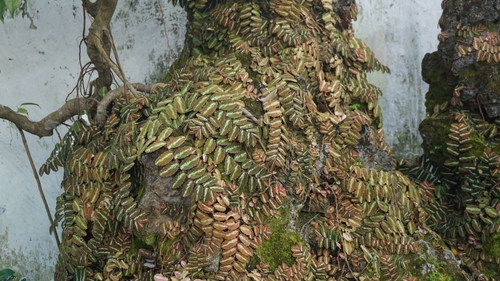
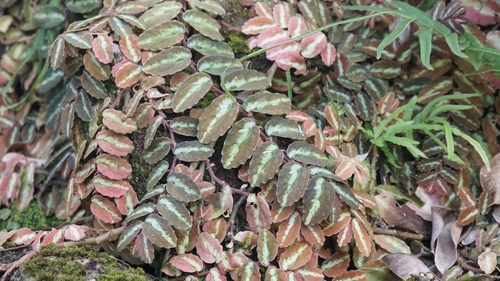
A herb. The stems lie along the ground. It grows 20 cm tall. The leaves are alternate. They are oval and 2-11 cm long by 1-4 cm wide. The edges are wavy. There are some rounded teeth along the edge. The flowers are in groups above the axils of the leaves. They are small and white to yellow. The fruit is dry and oval.
Nutrition Score: 36/100
| Part | Moisture | kJ | kcal | Protein | Vit A | Vit C | Iron | Zinc |
|---|---|---|---|---|---|---|---|---|
| Leaves | 86.4 | 185 | 44 | 2.4 | — | 50 | — | — |
How to Grow
Plants can be grown from seeds.
Medicinal Uses
It is used in Chinese medicine.
Notes
It is used in Chinese medicine.
Names & Synonyms
Begonia rambat
References (4)
- Flora of China @ efloras.org Volume 5
- Lingnan Sci. J. 6:326. 1928
- Mot So Rau Dai an Duoc O Vietnam. Wild edible Vegetables. Ha Noi 1994, p 66
- Sukarya, D. G., (Ed.) 2013, 3,500 Plant Species of the Botanic Gardens of Indonesia. LIPI p 1129


