Peperomia pellucida
(Linnaeus) H.B. et Kunth
Greenhouse tea plant, Pepper elder

(c) Douglas Goldman, some rights reserved (CC BY-SA), uploaded by Douglas Goldman
(c) Douglas Goldman, some rights reserved (CC BY-SA), uploaded by Douglas Goldman
What to Eat
Edible parts: Leaves, Leaves - tea, Spice, Vegetable
Peperomia pellucida has been used as a food item as well as a medicinal herb. Although mostly grown for its ornamental foliage, the entire plant is edible, both cooked and raw.
Known Hazards
Where to Find It
A tropical plant. It grows in warm regions. It occurs widely in the tropics. It grows in wet and shady places around houses. In Nepal it grows to about 2000 m altitude. It grows in rock crevices and near the base of cliffs. In China it grows from sea level to 200 m altitude.
Asia, Africa, Amazon, American Samoa, Angola, Australia, Bangladesh, Benin, Bhutan, Burkina Faso, Cambodia, Central Africa, Central America*, China, Chuuk, Congo DR, Cuba*, Dominican Republic, East Africa, East Timor, Ethiopia, Fiji, FSM, Guiana, Guianas, Guinea, Guinée, Guinea-Bissau, Guyana, Haiti, Hawaii, Himalayas, India, Indochina, Indonesia, Japan, Laos, Malawi, Malaysia, Mexico, Micronesia, Mozambique, Myanmar, Nauru, Nepal, Nigeria, North America, Northeastern India, Pacific, Pantropical, Papua New Guinea, PNG, Philippines, Pohnpei, Puerto Rico, Rotuma, Samoa, Sao Tome and Principe, Saudi Arabia, SE Asia, Senegal, Sierra Leone, Solomon Islands, South America*, St Lucia, Sudan, Suriname, Tanzania, Thailand, Timor-Leste, Tuvalu, USA, Venezuela, Vietnam, West Africa, West Indies, Zambia, Zimbabwe,
How to Identify
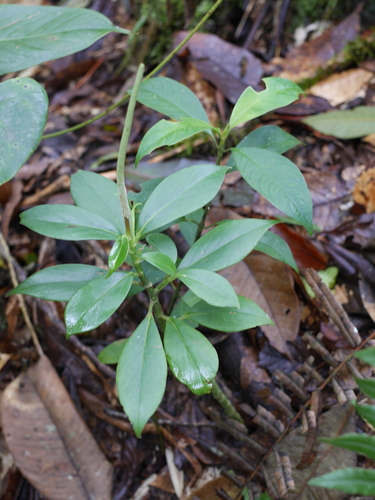
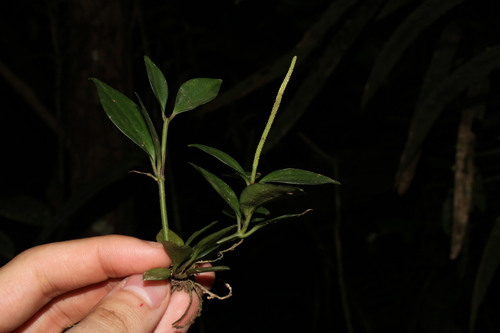
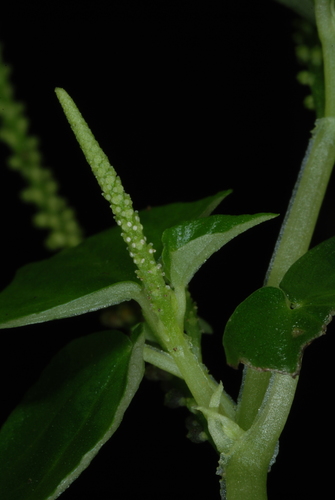
A herb. It grows 10-30 cm tall. It grows from seed each year. The stems are thick and rounded. They are pale green and fleshy. The leaves have stalks. These are 1-2 cm long. The leaf blades are 0.8-3.5 cm long by 0.6-2.8 cm wide. They are oval and shiny pale green. The base is heart shaped. The flowers are yellow. They are very small and borne on a light green spike. This is produced at the end of a branch or opposite the leaves. The nutlet is round and 0.5 mm across.
Nutrition Score: 14/100
| Part | Moisture | kJ | kcal | Protein | Vit A | Vit C | Iron | Zinc |
|---|---|---|---|---|---|---|---|---|
| Leaves | 92.2 | 105 | 25 | 0.5 | — | — | 3.2 | — |
How to Grow
Plants are grown from seed. It can also be grown by stem cuttings.
Propagation: Seed - sow in situ. Germination takes about 15 days.
Medicinal Uses
The analgesic properties of the plant seem to be related to its effect on prostaglandin synthesis. It may have potential as a broad spectrum antibiotic, as demonstrated in tests against Staphylococcus aureus, Bacillus subtilis, Pseudomonas aeruginosa, and Escherichia coli. Chloroform extracts from dried leaves of P. pellucida have been shown to exhibit antifungal activity against Trichophyton mentagrophytes in vitro. Anti-inflammatory activity (in paw edema) and analgesic activity has been demonstrated in rats and mice. Although the plant can cause asthma-like symptoms in patients with known hypersensitivity reactions to the species, no clinical data have yet been reported on human toxicity. Ethnomedicinal uses for the plant vary. P. pellucida has been used for treating abdominal pain, abscesses, acne, boils, colic, fatigue, gout, headache, renal disorders, and rheumatic joint pain. In Bolivia, Alteños Indians use the whole plant to stop hemorrhages. The roots are used to treat fevers and the aerial parts are used as dressing for wounds. In northeastern Brazil, the plant has been used to lower cholesterol. In Guyana and the Amazon region, it is a popular cough suppressant, emollient, and diuretic. It is also used to treat proteinuria. It is also used topically for skin disorders such as acne and boils. In the western parts of Nigeria, it is used as water extract in the treatment of high blood pressure and urinary tract infections and insomnia. In the Philippines, it is one of the 10 medicinal plants endorsed by the Department of Health. It is used to decrease uric acid levels, which is a cause of arthritis and gout. It can be used as a decoction or eaten raw as a salad.
Wikipedia
Source ↗Peperomia pellucida (also known by common names pepper elder, shining bush plant, crab claw herb, and man to man) is an annual, shallow-rooted herb, usually growing to a height of about 15 to 45 cm (6 to 18 inches), it is characterized by succulent stems, shiny, heart-shaped, fleshy leaves and tiny, dot-like seeds attached to several fruiting spikes. It has a mustard-like odor when crushed.
Other Information
It is a popular vegetable. It is sometimes sold in markets.
Notes
There are about 1000 Peperomia species. They are in the tropics and subtropics. It is also put in the family Peperomiaceae. This one may be the same as or confused with Peperomia exigua.
Names & Synonyms
Bithe, Cang cua, Cao hu jiao, Clearweed, Kasang pak, Ketumpangan ayer, Krosang tiep, Latapate, Liha pambi, Lombaye lolitoko, Luchi pata, Luchi shak, Olasiman ihalas, Pak-kra-sank, Pakkrasung, Phak krasang, Punounuwa, Rangu-rangu, Sakauenleng, Sasaladaan, Sekewenleng, Shining bush, Silver bush, Sladanan, Suna-kosho, Suruhan, Thit-yay-gyi, Vao vai, Zaub qwj
References (61)
- Ambasta, S.P. (Ed.), 2000, The Useful Plants of India. CSIR India. p 439
- Anderson, E. F., 1993, Plants and people of the Golden Triangle. Dioscorides Press. p 217
- Borrell, O.W., 1989, An Annotated Checklist of the Flora of Kairiru Island, New Guinea. Marcellin College, Victoria Australia. p 117
- Burkill, H. M., 1985, The useful plants of west tropical Africa, Vol. 4. Kew.
- Burkill, I.H., 1966, A Dictionary of the Economic Products of the Malay Peninsula. Ministry of Agriculture and Cooperatives, Kuala Lumpur, Malaysia. Vol 2 (I-Z) p 1722
- Cooper, W. and Cooper, W., 2004, Fruits of the Australian Tropical Rainforest. Nokomis Editions, Victoria, Australia. p 397
- Cowie, I, 2006, A Survey of Flora and vegetation of the proposed Jaco-Tutuala-Lore National Park. Timor-Lests (East Timor) www.territorystories.nt/gov.au p 52
- Dalziel, J. M., 1937, The Useful plants of west tropical Africa. Crown Agents for the Colonies London.
- Dangol, D. R. et al, 2017, Wild Edible Plants in Nepal. Proceedings of 2nd National Workshop on CUAOGR, 2017.
- Dutta, U., 2012, Wild Vegetables collected by the local communities from the Churang reserve of BTD, Assam. International Journal of Science and Advanced Technology. Vol. 2(4) p 122
- Facciola, S., 1998, Cornucopia 2: a Source Book of Edible Plants. Kampong Publications, p 168
- Flora of Solomon Islands
- Food Composition Tables for use in East Asia FAO http://www.fao.org/infoods/directory No. 652
- Fowler, D. G., 2007, Zambian Plants: Their Vernacular Names and Uses. Kew. p 53
- Grivetti, L. E., 1980, Agricultural development: present and potential role of edible wild plants. Part 2: Sub-Saharan Africa, Report to the Department of State Agency for International Development. p 29
- Grubben, G. J. H. and Denton, O. A. (eds), 2004, Plant Resources of Tropical Africa 2. Vegetables. PROTA, Wageningen, Netherlands. p 564
- Henty, E.E., & Pritchard, G.S., 1973, Weeds of New Guinea and their control. Botany Bulletin No 7, Division of Botany, Lae, PNG. p 135
- Hossain, U. & Rahman, A., 2018, Study and quantitative analysis of wild vegetable floral diversity available in Barisal district, Bangladesh. Asian J. Med. Biol. Res. 2018, 4 (4), 362-371
- Jacquat, C., 1990, Plants from the Markets of Thailand. D.K. Book House p 63
- Jardin, C., 1970, List of Foods Used In Africa, FAO Nutrition Information Document Series No 2.p 93
- Jiwajinda, S., et al, 2002, Suppressive Effects of Edible Thai Plants on Superoxide and Nitric Oxide Generation. Asian Pacific Journal of Cancer Prevention, Vol 3, 2002
- Joshi, N., et al, 2007, Traditional neglected vegetables of Nepal: Their sustainable utilization for meeting human needs. Tropentag 2007. Conference on International Agricultural Research for Development.
- Kachenchart, B., et al, 2008, Phenology of Edible Plants at Sakaerat Forest. In Proceedings of the FORTROP II: Tropical Forestry Change in a Changing World. Bangkok, Thailand.
- Katz, E., et al, 2012, No greens in the forest? Note on the limited consumption of greens in the Amazon. Acta Soc Bot Pol 81(4):283–293
- Kermath, B. M., et al, 2014, Food Plants in the Americas: A survey of the domesticated, cultivated and wild plants used for Human food in North, Central and South America and the Caribbean. On line draft. p 629
- Liefting, A., et al, Samoan plant names. http://en.wikipedia.org
- Lugod, G.C. and de Padua L.S., 1979, Wild Food Plants in the Philippines. Vol. 1. Univ. of Philippines Los Banos. p 64
- Maikhuri, R, K, and Gangwar, A. K., 1993, Ethnobiological Notes on the Khasi and Garo Tribes of Meghalaya, Northeast India, Economic Botany, Vol. 47, No. 4, pp. 345-357
- Manandhar, N.P., 2002, Plants and People of Nepal. Timber Press. Portland, Oregon. p 351
- Martin, F.W. & Ruberte, R.M., 1979, Edible Leaves of the Tropics. Antillian College Press, Mayaguez, Puerto Rico. p 107, 212
- Mot So Rau Dai an Duoc O Vietnam. Wild edible Vegetables. Ha Noi 1994, p 188
- Paczkowska, G . & Chapman, A.R., 2000, The Western Australian Flora. A Descriptive Calatogue. Western Australian Herbarium. p 455
- Patiri, B. & Borah, A., 2007, Wild Edible Plants of Assam. Geethaki Publishers. p 118
- Peekel, P.G., 1984, (Translation E.E.Henty), Flora of the Bismarck Archipelago for Naturalists, Division of Botany, Lae, PNG. p 123, 125
- Peters, C. R., O'Brien, E. M., and Drummond, R.B., 1992, Edible Wild plants of Sub-saharan Africa. Kew. p 161
- Pham-Hoang Ho, 1999, An Illustrated Flora of Vietnam. Nha Xuat Ban Tre. p 289
- Phon, P., 2000, Plants used in Cambodia. © Pauline Dy Phon, Phnom Penh, Cambodia. p 494
- Plants of Haiti Smithsonian Institute http://botany.si.edu/antilles/West Indies
- PROSEA handbook Volume 13 Spices. p 279
- Sakunpak, A. & Panichayupakaranant, P., 2012, Antibacterial activity of Thai edible plants against gastrointestinal pathogenic bacteria and isolation of a new broad spectrum antibacterial polyisoprenylated benzophenone, chamuangone. Food Chemistry 130 (2012) 826–831
- Sang, D. T., & Mizoue, K. O. N., 2012, Use of Edible Forest Plants among Indigenous Ethnic Minorities in Cat Tien Biosphere Reserve, Vietnam. Asian Journal of Biodiversity Vol. 3 (1), p 23-49
- Sarma, H., et al, 2010, Updated Estimates of Wild Edible and Threatened Plants of Assam: A Meta-analysis. International Journal of Botany 6(4): 414-423
- Sawian, J. T., et al, 2007, Wild edible plants of Meghalaya, North-east India. Natural Product Radiance Vol. 6(5): p 420
- Singh, S.R. and Singh, N.I., 1985, A Preliminary Ethnobotanical studies on wild edible plants in the markets of Manipur - 1. J. Econ. Tax. Bot. Vol. 6 No. 3 pp 699-703
- Smith, A.C., 1981, Flora Vitiensis Nova, Lawaii, Kuai, Hawaii, Volume 2 p 89
- Solomon, C., 2001, Encyclopedia of Asian Food. New Holland. p 277
- Staples, G.W. and Herbst, D.R., 2005, A tropical Garden Flora. Bishop Museum Press, Honolulu, Hawaii. p 455
- Stone, B.,
- Suksri, S., et al, 2005, Ethnobotany in Bung Khong Long Non-Hunting Area, Northeast Thailand. Kasetsart J., (Nat. Sci) 39: 519-533
- Tanaka, Y. & Van Ke, N., 2007, Edible Wild Plants of Vietnam. Orchid Press. p 110
- Termote, C., et al, 2011, Eating from the wild: Turumbu, Mbole and Bali traditional knowledge of non-cultivated edible plants, District Tshopo, DRCongo, Gen Resourc Crop Evol. 58:585-618
- Terra, G.J.A., 1973, Tropical Vegetables. Communication 54e Royal Tropical Institute, Amsterdam, p 65
- Thaman, R. R, 2016, The flora of Tuvalu. Atoll Research Bulletin No. 611. Smithsonian Institute p 106
- Thoa P. T. K., et al, 2013, Biodiversity indices and utilization of edible wild plants: a case study of the Cham Island in Quang Nam Province, Vietnam. Journal of Research in Environmental Science and Toxicology 2(9) :167-174
- Tseng Yung-chien, Xia Nianhe, Gilbert, M.G., Piperaceae. Flora of China.
- Udo, E. S., et al, 2009, Life-form and Density of Valuable Non-timber Plants in Ukpom Community Forest, Akwa Ibom State, Nigeria. African Research Review 3(3) p 8
- F. W. H. A. von Humboldt et al., Nov. gen. sp. 1:53[folio]; 1:64[quarto]. 1816
- Whitney, C. W., et al, 2014, Conservation and Ethnobotanical Knowledge of a Hmong Community in Long Lan, Luang Prabang, Lao People’s Democratic Republic. Ethnobotany Research and Applications 12:643-658
- Wiersema, J. H. & Leon, B., 2013, World Economic Plants. A Standard Reference CRC Press. 2nd Ed. p 508
- World Checklist of Useful Plant Species 2020. Royal Botanic Gardens, Kew
- Zon, A.P.M. van der, Grubben, G.J.H., 1976, Les legumes-feuilles spontanes et cultives du Sud-Dahomey, Communication 65, Royal Tropical Institute, Amsterdam, p 84