Persoonia cornifolia
A. Cunn. ex R. Br.
Broad-leafed Geebung
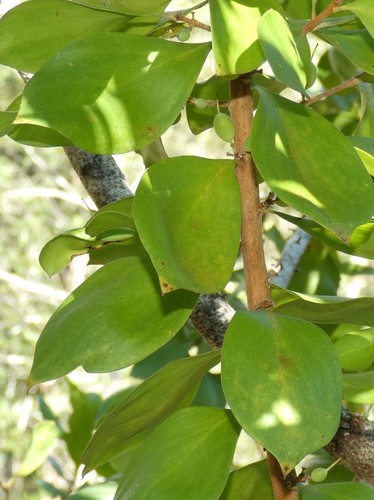
(c) Scott W. Gavins, some rights reserved (CC BY-NC), uploaded by Scott W. Gavins

(c) Darren Fielder, some rights reserved (CC BY-NC), uploaded by Darren Fielder
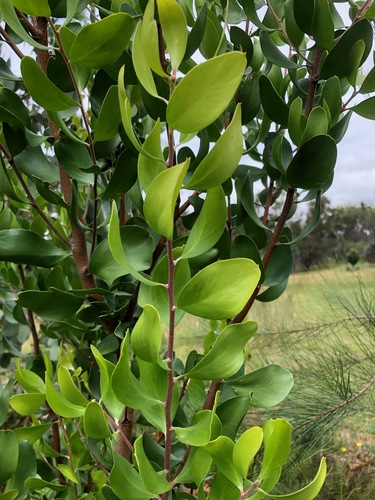
(c) Lise Kool, some rights reserved (CC BY-NC), uploaded by Lise Kool
What to Eat
Edible parts: Fruit
The fruit are edible and are especially eaten by children.
Where to Find It
It grows in open woodland and dry forest. It grows on sandy and gravelly soils. It needs well drained acid soil. It suits temperate and subtropical regions. It can grow in the sun or in light shade. It can tolerate frost.
Australia*,
How to Identify
A tall shrub. It grows 2-7 m high and spreads 1.5-4 m wide. The young growth has grey or rusty hairs. The bark is smooth. The branches are spreading. The small branches are hairy. The leaves are 2-10 cm long by 1-5.5 cm wide. They are oval. They are green and alternate. The edges curve backwards. The flowers are 0.8 cm across and yellow. The fruit is fleshy with one stone inside. The fruit are 1-1.5 cm long by 0.7-1 cm wide. They are purplish.
How to Grow
Plants can be grown from seed or cuttings of very young growth.
Wikipedia
Source ↗Persoonia cornifolia is a plant in the family Proteaceae and is endemic to eastern Australia. It is a shrub with elliptic to egg-shaped leaves and hairy yellow flowers, and grows in northern New South Wales and south-eastern Queensland.
Other Information
The fruit are especially eaten by children.
Notes
There are about 90 Persoonia species. They grow in Australia. Many have fruit which are edible.
References (5)
- Low, T., 1992, Bush Tucker. Australia’s Wild Food Harvest. Angus & Robertson. p 44
- Elliot, W.R., & Jones, D.L., 1997, Encyclopedia of Australian Plants suitable for cultivation. Vol 7. Lothian. p 212
- Flora of Australia Volume 16, Elaeagnaceae, Proteaceae 1. Melbourne: CSIRO Australia (1995) p 84
- Haslam, S., 2004, Noosa's Native Plants. Noosa Integrated Catchment Assn. Inc. p 32
- Reis, S. V. and Lipp, F. L., 1982, New Plant Sources for Drugs and Foods from the New York Botanical Garden herbarium. Harvard. p 48
More from Proteaceae


