Persoonia falcata
A. Cunn. ex R. Br.
Geebung, Milky Plum, Sickle-leaved Geebung, Wild Pear
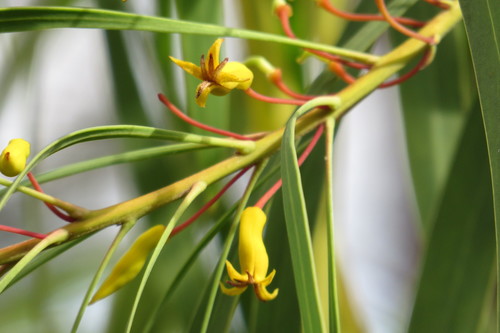
(c) coenobita, some rights reserved (CC BY), uploaded by coenobita
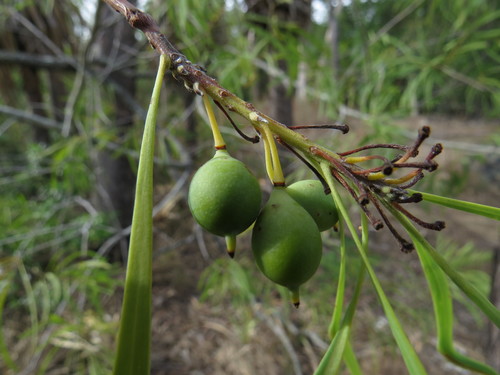
(c) kerrycoleman, some rights reserved (CC BY-NC), uploaded by kerrycoleman
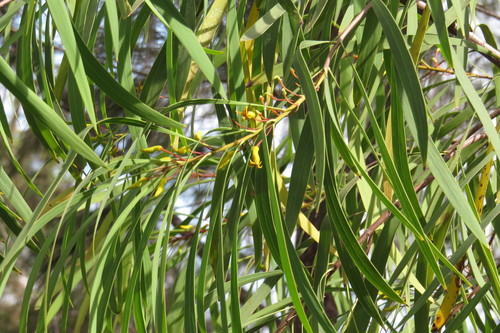
(c) coenobita, some rights reserved (CC BY), uploaded by coenobita
What to Eat
Edible parts: Fruit, Kernel
Fruit - raw. Fleshy. A sweet-tasting, fibrous pulp, it is a bit like eating sweet cotton wool. The pale green, round fruits are 7 - 20mm in diameter.
Where to Find It
A tropical plant. Plants grow naturally in open forest. They are often on sandy soils. It suits seasonally dry areas. It needs well drained soil. It can tolerate drought. It can resist fire damage.
Australia*,
How to Identify
A slender shrub or tree. It grows 3-9 m high. It is often a shrub 2-3 m high. The small branches often hang down. The new shoots have fine hairs. The leaves are alternate and smooth. They are slightly leathery. They vary in shape and size. Leaves can be straight or curved. The blade is 10-20 cm long by 0.5-2.5 cm wide. They are dull green and have a distinct midrib. The flowers are yellow and like tubes. They are 1-1.5 cm long. They occur singly in the axils of the upper leaves. They can also be in groups along stalks. The fruit is smooth and oval. It has a hard stone inside. The fruit are 1.5-2 cm long by 0.8-1 cm wide. They are greenish-yellow when ripe. They contain a single seed. The fruit are edible.
Nutrition Score: 42/100
| Part | Moisture | kJ | kcal | Protein | Vit A | Vit C | Iron | Zinc |
|---|---|---|---|---|---|---|---|---|
| Fruit | 66.2 | 231 | 55 | 3.2 | — | 4 | 3.6 | 1.8 |
How to Grow
Plants can be grown from seed. Plants can also be grown from cuttings of very young growth.
Medicinal Uses
An infusion of the leaves and bark are used as a treatment against sore throat and colds.
Other Uses
The wood can be used or small posts and ornamental items. The wood is used for fuel.
Wikipedia
Source ↗Persoonia falcata, commonly known as the wild pear, is a shrub native to northern Australia.
Notes
There are about 90 Persoonia species. They grow in Australia. Many have fruit which are edible.
Names & Synonyms
Andak, Bololo, Dangapa, Gadala, Gamalun, Gandala, Jimijinga, Mi katan, Nanchee, Tarpoon, Thelh-leri, Tjiwekbe
References (33)
- Beasley, J., 2011, Plants of Tropical North Queensland - the compact guide. Footloose publications. p 153
- Bodkin, F., 1991, Encyclopedia Botanica. Cornstalk publishing, p 774
- Brock, J., 1993, Native Plants of Northern Australia, Reed. p 279
- Cancilla, D., 2018, Ethnobotanical and Ethnozoological Values Desktop Assessment - Eliwana Project. p 44
- Cherikoff V. & Isaacs, J., The Bush Food Handbook. How to gather, grow, process and cook Australian Wild Foods. Ti Tree Press, Australia p 155, 190, 201
- Crawford, I. M., 1982, Traditional Aboriginal Plant Resources in the Kalumburu Area: Aspects in Ethno-economics. Records of the Western Australian Museum Supplement No. 15
- Doran, J.C., & Turnbull, J.W. (Eds), 1997, Australian Trees and Shrubs: species for land rehabilitation and farm plantings in the tropics. ACIAR Monograph No 24. p 356
- Dunlop, C.R., Leach, G.J. & Cowie, I.D., 1995, Flora of the Darwin Region. Vol 2. Northern Territory Botanical Bulletin No 20. p 126
- Elliot, W.R., & Jones, D.L., 1997, Encyclopedia of Australian Plants suitable for cultivation. Vol 7. Lothian. p 214 (Photo)
- Flora of Australia Volume 16, Elaeagnaceae, Proteaceae 1. Melbourne: CSIRO Australia (1995) p 119
- Garde, M., et al, 2003, A Preliminary List of Kundedjnjenghmi Plant Names. Northern Land Council. (Arnhem Land, Australia)
- Hardwick, G., 2001, Economically Useful Plants for Northern Australia: Master Species List. Crusader eBooks.
- Hiddins, L., 1999, Explore Wild Australia with the Bush Tucker Man. Penguin Books/ABC Books. p 141
- Jackes, B.R., 2001, Plants of the Tropics. Rainforest to Heath. An Identification Guide. James Cook University. p 75
- Kenneally, K.E., Edinger, D. C., and Willing T., 1996, Broome and Beyond, Plants and People of the Dampier Peninsula, Kimberley, Western Australia. Department of Conservation and Land Management. p 171
- Lands, M., 1987, Mayi: Some Bush fruits of Dampierland. Magabala Books, Broome West Australia. p 13
- Lazarides, M. & Hince, B., 1993, Handbook of Economic Plants of Australia, CSIRO. p 186
- Levitt, D., 1981, Plants and people. Aboriginal uses of plants on Groote Eylandt. Australian Institute of Aboriginal Studies, Canberra. p 118
- Paczkowska, G . & Chapman, A.R., 2000, The Western Australian Flora. A Descriptive Calatogue. Western Australian Herbarium. p 499
- Petheram, R.J. and Kok, B., 2003, Plants of the Kimberley Region of Western Australia. UWA Press p 513
- Scarth-Johnson, V., 2000, National Treasures. Flowering Plants of Cooktown and Northern Australia. Vera Scarth-Johnson Gallery Association. Cooktown, Australia. p 98
- Smith, K & I., 1999, Grow your own bushfoods. New Holland. Australia. p 40
- Smith, M & Kalotas, A. C., 1985, Bardi Plants: An Annotated List of Plants and Their Use by the Bardi Aborigines of Dampierland, in North-western Australia. Rec. West Aust. Mus. 1985, 12(3): 317-359
- Smith, N and Wightman, G.M., 1990, Ethnobotanical Notes from Belyuen Northern Territory Australia. Northern Territory Botanical Bulletin No 10. Parks and Wildlife Commission of the Northern Territory. p 19
- Smith, N. M., 1991, Ethnobotanical Field Notes from the Northern Territory, Australia, J. Adelaide Bot. Gard. 14(1): 1-65
- Tiwi Plants and Animals. 2001, Aboriginal flora and fauna knowledge from Bathurst and Melville Islands, northern Australia. Northern Territory Botanical Bulletin; No. 24 p 72
- Townsend, K., 1994, Across the Top. Gardening with Australian Plants in the tropics. Society for Growing Australian Plants, Townsville Branch Inc. p 311
- Townsend, K., 1999, Field Guide to Plants of the Dry Tropics. Society for Growing Australian Plants, Townsville Branch Inc. p 76
- Vigilante, T., et al, 2013, Island country: Aboriginal connections, values and knowledge of the Western Kimberley islands in the context of an island biological survey. Records of the Western Australian Museum Supplement 81: 145-182
- Wheeler, J.R.(ed.), 1992, Flora of the Kimberley Region. CALM, Western Australian Herbarium, p 479
- Wightman, G. & Andrews, M., 1991, Bush Tucker Identikit. Common Native Food Plants of Australia’s top end. Conservation Commission Northern Territory. p 20
- Wightman, Glenn et al. 1992, Mangarrayi Ethnobotany: Aboriginal Plant Use from the Elsey Area Northern Australia. Northern Territory Botanical Bulletin No 15. Parks and Wildlife Commission of the Northern Territory. p 40, 39.
- Yunupinu Banjgul, Laklak Yunupinu-Marika, et al. 1995, Rirratjinu Ethnobotany: Aboriginal Plant Use from Yirrkala, Arnhem Land, Australia. Northern Territory Botanical Bulletin No 21. Parks and Wildlife Commission of the Northern Territory. p 63.
More from Proteaceae


